
Yes, you can date while you are in therapy. If you have been typing how to date while in therapy into a search bar at midnight, the honest answer is that nothing about your sessions has to change. You keep your appointments, treat new relationships as another part of life, and bring the awkward moments into the room instead of handling them alone.
This guide covers the practical side: how to decide what you actually want, what to say when your therapy schedule collides with plans, how much to disclose about your sessions, and how to notice your own patterns before they run the date. It takes about fifteen minutes to read. Some steps take a week of thought before they feel natural, and that is fine.
One thing to hold onto as you read: therapy is not a prerequisite for dating, and it is not a status you have to explain to earn a date. This guide was last reviewed in 2026 and is general education, not a substitute for advice from your own therapist.
Table of Contents→
- What You Need
- Step-by-Step
- 1. Define What You Want From Dating Right Now
- 2. Tell Your Therapist and Check Their Boundaries
- 3. Set Healthy Boundaries Before You Match
- 4. Disclose Only What You Choose, Not Everything You Fear
- 5. Notice Your Patterns Without Letting Them Run the Date
- 6. Evaluate Compatibility, Safety, and Your Own Well-Being
- Common Mistakes
- Frequently Asked Questions
- Should I tell someone I meet while in therapy?
- Can I date if I am seeing a therapist for anxiety, depression, trauma, or an eating disorder?
- How do I bring up therapy on a dating app?
- What if I like someone but I am worried I will repeat an unhealthy relationship pattern?
- When should I pause dating or speak with my therapist?
- Start With One Clear Boundary
What You Need
You do not need to be “finished” with therapy before you meet anyone. Plenty of people start dating in the first month. What you do need is a small amount of clarity, so that dating supports your recovery instead of quietly working against it.
- An answer about what you want right now. Companionship, exploring compatibility, a serious relationship, or a genuine pause are four very different jobs. You cannot date well while holding all four at once.
- A sense of where your treatment stands. Know how often you meet, what your therapist’s cancellation policy looks like, and whether any part of your work needs a quieter social season.
- A short list of non-negotiables. Things you will not negotiate: no drinking and driving, no anger in the car, no financial entanglement, no being spoken over, no secrecy about where you are.
- One outside perspective. Either your therapist or one trusted person who tells you the truth. Dating distorts your view of yourself, and a second set of eyes catches that early.
Step-by-Step
Here is the order I would follow if someone asked me for the whole thing at once. Six steps, each with a way to tell whether it is working.
1. Define What You Want From Dating Right Now
Start by picking one of three lanes. Casual dating means you are not looking for a partner and want low-stakes contact. Serious dating means you are actively evaluating someone as a possible partner. A pause means you are not dating, and that is a legitimate choice while you work through something.
Say it in one sentence, the way you would tell a friend. “I want to meet people and see whether I like them” is a different plan from “I want a partner within the next six months.” Overthinking tends to add pressure that the actual work does not need, so keep it blunt and low-pressure.
You will know this step worked when a well-meaning friend can repeat your plan back to you correctly. If they cannot, it is still too fuzzy, and that fuzziness is where most people get how to date while in therapy wrong: they start matching before they know what they are matching for.
2. Tell Your Therapist and Check Their Boundaries
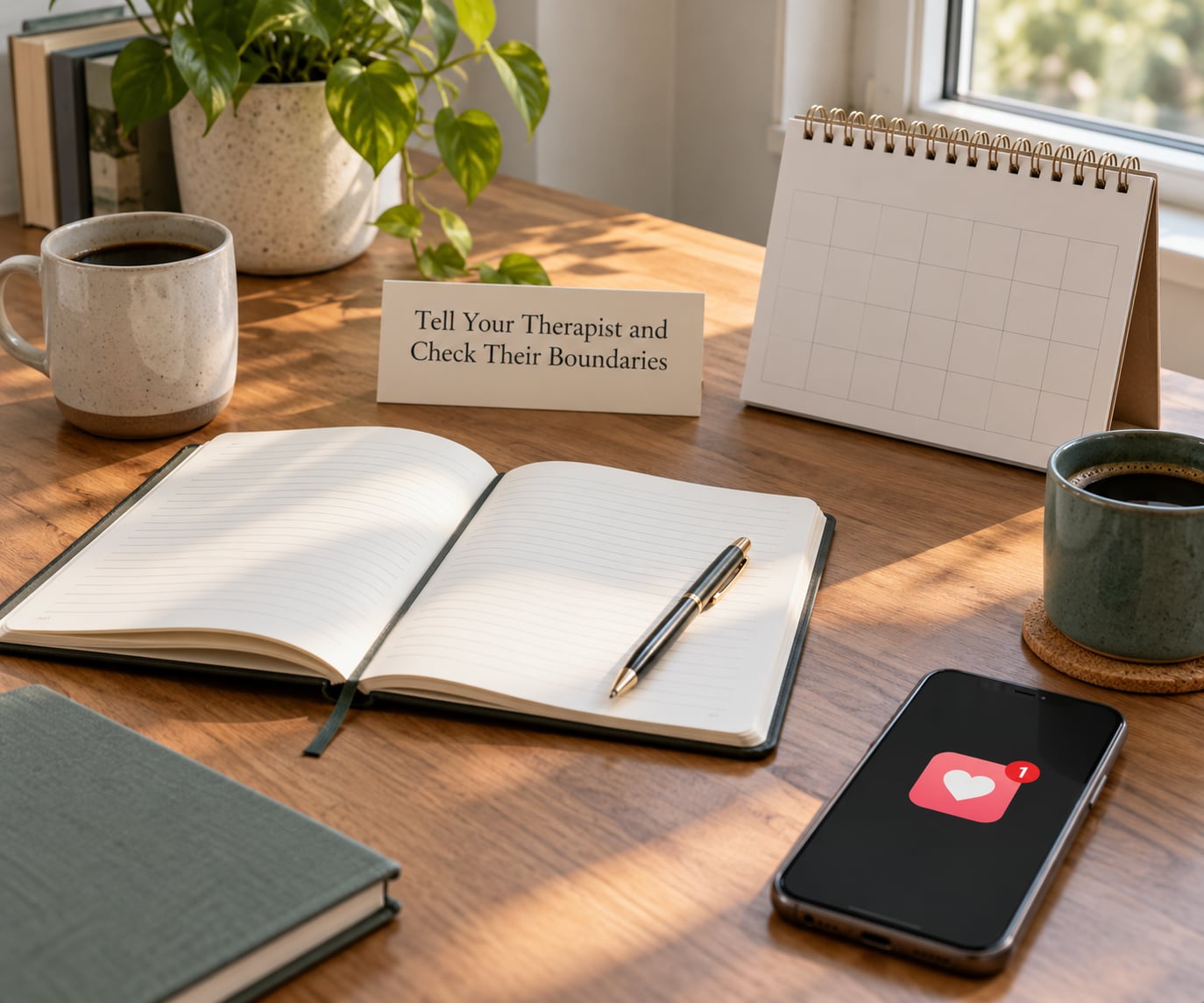
Tell your therapist you are dating or thinking about it. Not because you need permission, but because your therapist needs accurate information to give good advice, and because dating changes what belongs in the room.
Ask two practical questions. First, how much flexibility is built into your appointment time, and what happens when you need to move or cancel. Second, whether anything in your current work means dating should wait for now, such as an active crisis, an unresolved safety plan, or a legal proceeding you do not want complicated.
What you will not get is a therapist who approves or vetoes each date. That is not their role. Their job is to help you think clearly, and dating is excellent material for that.
One scheduling note worth sorting early: the weekly session is a fixed commitment, so build dates around it rather than the other way around. Something like “I have a standing appointment on Wednesdays, so Thursdays or weekends work best for me” says what you need without oversharing.
3. Set Healthy Boundaries Before You Match
Write your boundaries down before a conversation makes them necessary. In the moment, people often agree to things they privately resent, then resent them quietly for weeks.
- Communication pace. How often you text, and whether you answer straight away.
- Physical and emotional availability. What you can offer on a Tuesday versus a Saturday.
- Sex. What you do and do not do on a given date, and that condoms are always used.
- Alcohol and drugs. Your limit, and that impaired driving is off the table.
- Conflict. That you will pause rather than raise your voice, and that you both come back to it.
- Unwanted contact. What you do when a message keeps coming after you have asked it to stop.
This list is not cold. People tend to relax more easily when they already know the edges, and it filters out anyone who pushes them early.
4. Disclose Only What You Choose, Not Everything You Fear
You get to choose how much of your therapy other people hear about. What usually matters is not the diagnosis but the honesty around it, because the real trust test is whether someone hides something from you, not whether they see a therapist.
A workable rule: share the fact early enough that it is not a surprise, and share detail only to the degree that it affects the other person. Being in therapy is a fact about your week. The specific reason may involve someone else’s privacy, your own safety, or nothing about them at all.
Three levels of detail tend to cover most situations. Naming it only: “I see a therapist, it’s part of my week.” One line of context: “I’ve been working through some anxiety and it’s going well.” Full context, offered when they ask and when you trust them: whatever you want to say about what you’ve been dealing with.
If someone asks what you talk about, a workable answer is: “Mostly my relationships and my own patterns, and figuring out what I want.” Then you can say as much or as little beyond that. You are allowed to end the question.
5. Notice Your Patterns Without Letting Them Run the Date
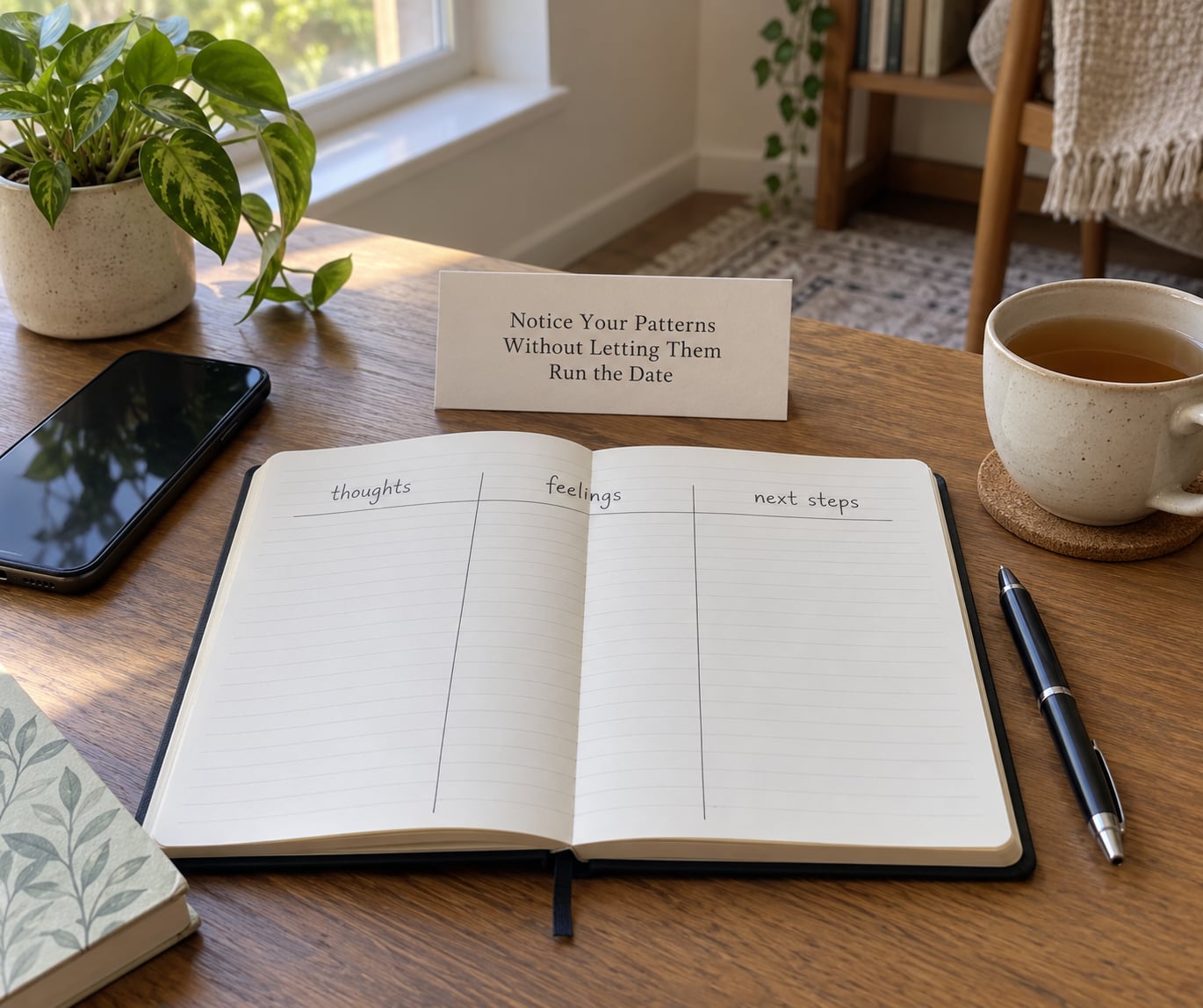
Dating tends to activate the exact material you are working on. If your work involves anxiety, rejection sensitivity, people pleasing, or attachment, those patterns will show up on dates with people who have no idea what you are working through.
The goal is not to stop having the reaction. It is to create a gap between the reaction and what you do next. Three patterns are worth watching, because they are common and easy to spot once you know the shape.
Reassurance-seeking. You text first, twice, then three times, because silence has become evidence of something. One message is contact. Four is a request for reassurance you already know the answer to.
People pleasing. You agree to the restaurant, the plans, the pace, and then feel oddly hollow and slightly resentful. Resentment that shows up early is useful data, not a character flaw.
Withdrawal after intimacy. Something gets real, and you pull back to protect yourself. Staying present through one uncomfortable moment, instead of leaving, is often the whole assignment.
When you notice one, use a pause rather than a reaction. A drink, a bathroom, a genuine question about their week. In the gap, ask three things: what did I just feel, what story did I attach to it, and what would I do if I were being honest? That is a short version of work many people do in session, and it does more on a date than talking yourself out of the feeling.
This step is working when you catch the pattern earlier than you used to, not when the patterns disappear. They take months.
6. Evaluate Compatibility, Safety, and Your Own Well-Being
After a date, review it deliberately rather than on the high of it. Write down three things: how you felt, whether you felt safe, and whether anything contradicted what you said you wanted. Comparing dates over a few weeks is far more useful than your memory of a single evening.
Look past excitement for the slower signals. Does this person keep small commitments? Do they ask about you and then remember? Can they handle a “no” without sulking? Do they treat service staff with the same tone they use on you?
Check the effect on your week too. If dating leaves you sleeping less, skipping sessions, or dreading your own phone, something is costing more than it gives. Bring that to your next session rather than absorbing it.
Common Mistakes
Using therapy as a dating script. Trying to say the perfect reframe on a first date turns conversation into a performance. Being a work in progress is allowed; performing recovery is not required.
Treating a diagnosis as a personality. “I have anxiety” is information. “I am anxious” is an identity, and it lets you avoid choosing. Practice phrasing it as something you work on, not something that is done to you.
Rushing intimacy to prove you’re over it. Sexual or emotional closeness does not erase a difficult history, and it rarely does the healing work. Go at the pace of trust, which is slower than the pace of chemistry.
Skipping hard conversations. If a topic keeps coming back and you keep not raising it, it is usually the important one. Ask about kids, money, exes and drinking early, while leaving is still easy.
Expecting one date to prove something. You cannot learn whether someone is safe in an evening. Reading a verdict out of a single meeting is the most common way people try to speed this up, and it is exactly the habit worth bringing to a session instead.
Ignoring red flags because you are doing well in therapy. Working on yourself changes what you can tolerate, which means some relationships you used to accept no longer fit. That is progress, even when it is disappointing.
Two safety rules cover most situations. Keep first meetings in public and tell a friend where you are, and if something feels off, leave early without explaining. If you are in crisis or worried about your safety, contact 988 in the US or your local emergency service.
Frequently Asked Questions
Should I tell someone I meet while in therapy?
Tell them before it becomes a hidden fact, because hiding it tends to matter more to people than the therapy itself. You do not need to name the reason or describe your sessions. A simple line works: I see a therapist and it is part of my week. Say it when you have seen each other a couple of times, or sooner if you expect to sleep together. Share detail only as far as it affects them, and stop wherever you want.
Can I date if I am seeing a therapist for anxiety, depression, trauma, or an eating disorder?
Usually yes. Anxiety, depression, trauma work and eating disorder treatment are common reasons people see a therapist, and none of them stops you from dating. What matters is whether your symptoms are managed enough that you can hold a boundary and tell the truth when something feels off. Some situations call for a slower pace, such as active disordered eating or an open safety plan. Ask your therapist directly whether this is a season for dating or for steadying yourself.
How do I bring up therapy on a dating app?
Most apps make it awkward, so keep it simple and move the detail to conversation. A profile line such as I work on myself in therapy, and I have a good sense of humour about it, invites the right questions without writing your biography. If a match asks, answer in one sentence and let the conversation move on. Avoid using therapy as a filter for who deserves your attention, since apps reward the most polished version of you rather than the real one.
What if I like someone but I am worried I will repeat an unhealthy relationship pattern?
That worry is useful, so take it to session rather than acting on it alone. Notice what specifically you predict will happen, then look at what actually happened in your last relationship at that point. Patterns feel inevitable from the inside and look predictable from the outside. Slow the pace by one step and name what you are doing differently, such as raising a disagreement directly instead of going quiet. If the pattern repeats, that is useful data for your therapist, not a verdict on you.
When should I pause dating or speak with my therapist?
Pause and speak with your therapist when dating is consistently costing you something important, such as missed sessions, less sleep, escalating anxiety, or money you cannot spare. Pause dating entirely during an active crisis, an unresolved safety plan, a fresh injury or loss, or legal proceedings such as a divorce where a new relationship would complicate things. You can also pause simply because you want to. Pausing is a decision, not a setback.
Start With One Clear Boundary
Pick one: companionship, exploring compatibility, or a deliberate pause. Say that out loud to your therapist this week and ask what they would want you to watch for.
Then write down three boundaries you will actually hold, and let them do their job.
When you feel steady enough, take one low-pressure step, a coffee or a walk, with someone you are genuinely curious about rather than someone who would be impressive. That is how to date while in therapy without putting the treatment at risk: one clear intention, three written lines, and no rush.