You know you are ready for marriage when you have the emotional maturity to stay respectful during a disagreement, you and your partner hold the same core values about children, money, religion and family, and you are choosing a shared life on purpose rather than drifting toward it. Readiness is a set of behaviors you can test, not a feeling you wait for. If you want to know how to know if you are ready for marriage, this guide walks through the signs that hold up under scrutiny, the red flags that mean wait, and the practical preparation most couples skip.
There is no age, number of months, or ring that makes a person ready. People on forums like r/Waiting_To_Wed and r/Adulting ask for a benchmark and rarely find one, because readiness is not measured in time. It shows up in how two people handle a hard conversation, a disappointing weekend, and a bill they cannot pay.
What follows is written without a religious or denominational frame. If faith matters to you, there is a place for that in your assessment, and you can add it to the checklist at the end.
Table of Contents→
- How to Know If You’re Ready for Marriage
- What Does Being Ready for Marriage Actually Mean?
- Are You Emotionally Ready to Marry?
- Does Your Relationship Have the Foundation Marriage Needs?
- Have You Discussed the Big Life Decisions?
- Are You Ready to Handle Marriage’s Practical Demands?
- Questions to Ask Yourself Before Saying Yes
- Signs You May Need More Time Before Marriage
- A Marriage-Readiness Checklist for Engaged Couples
- Frequently Asked Questions
- How do I know if I am emotionally ready to get married?
- Is it bad to still feel nervous about getting married?
- Do you have to live together before deciding to marry?
- How much time should couples take before getting married?
- Can a relationship become ready for marriage?
- What if my family or friends do not support our decision to marry?
- What to Do First
How to Know If You’re Ready for Marriage
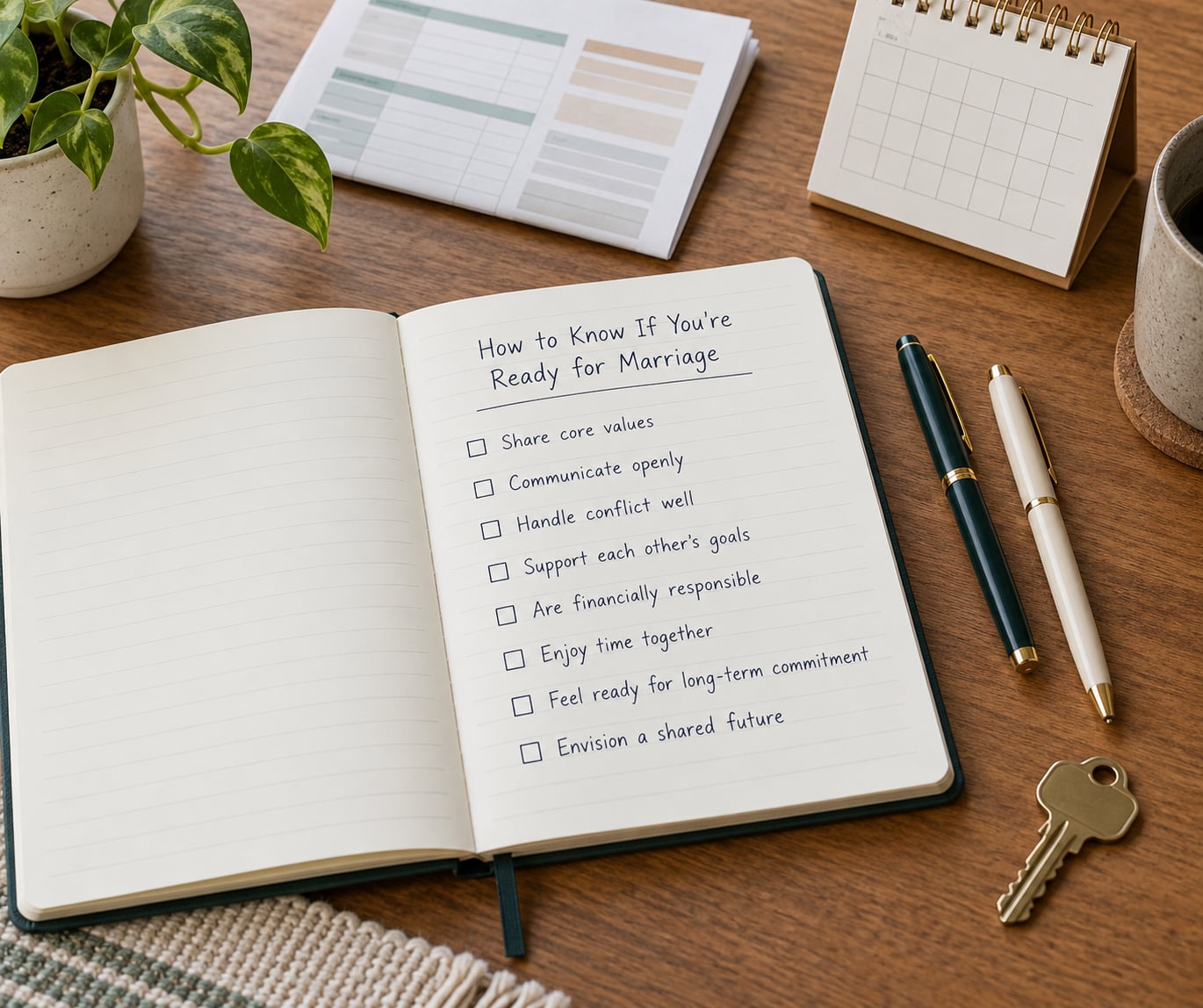
Here is the short version. Eight signs come up again and again, and most of them are observable rather than internal. You do not have to feel certain to check them off. You have to be able to describe the behavior, not just the hope.
- You can handle conflict without damaging the relationship. Disagreements end with a return to ordinary life, not a week of silence. Both of you can raise a hard topic without insults, threats, or shutdown.
- Your core values line up. You have actually discussed children, money, religion, where you will live, and how involved your families will be. Not assumed. Discussed.
- You can talk about difficult things calmly. Money, jealousy, past relationships, and boundaries come up without the conversation turning into a trial.
- You want marriage itself, not only the feeling of being in love. The excitement has not carried the whole decision. You would still choose this person on an ordinary Tuesday when nothing feels particularly romantic.
- You each have a life you are choosing to share. Both of you work, study, have friends, and make decisions alone. Marriage adds to a full life rather than rescuing an empty one.
- Your expectations are realistic. You are not planning to change your partner, and you are not expecting marriage to fix your personality, your family, or your mood.
- You have lived through real life together. You have seen each other sick, broke, grieving, unemployed, and unfun, and you chose each other afterward.
- You are both choosing it freely. Nobody is marrying to satisfy a parent, end a pregnancy, hold a family together, or meet a deadline.
One forum member described readiness better than any list can: it is less about any sign that proves you are ready and more about the absence of any sign that suggests you are not. Hold that thought. It becomes useful in the second half of this guide.
What Does Being Ready for Marriage Actually Mean?
Readiness means you can choose marriage with your eyes open. You understand that it is a daily decision rather than a permanent state, that it will be boring in the middle on a Wednesday, and that the person you are marrying will not be fixed. You are committing to a person as they are today, plus the person they may become.
Researcher Scott Stanley’s distinction between sliding and deciding is useful here. Sliding means events accumulated without a decision: you moved in because it was convenient, you got pregnant, you kept postponing the conversation, and now a wedding has assembled itself around you. Deciding means you named what you wanted, checked whether you wanted it, and chose it on purpose. Sliding is not a moral failure. It is very common, and it is much harder to reverse.
The trap most people fall into is wanting one specific thing rather than the institution. You want to be married to this person, or you want to stop feeling alone, or you want the structure. Marriage is a legal, financial, emotional, and social contract, and it delivers all four. If the motivation is mostly one of the other three, the mismatch tends to surface later.
| Type of readiness | What it covers | Typical question |
|---|---|---|
| Emotional readiness | Regulation, trust, repair, mutual respect | Can we stay close after a bad week? |
| Practical readiness | Budget, housing, debt, insurance, division of labor | Could we absorb one lost income for six months? |
| Shared vision | Children, location, work, religion, family roles | Would we choose the same five-year plan? |
| Freedom to choose | No pressure, no clock, no hidden obligation | Would we still say yes if nobody else knew? |
People often confuse the second row with the first. You can be deeply in love and completely logistically unprepared. Those are separate conversations, and both need to happen.
Are You Emotionally Ready to Marry?
Emotional maturity in this context is not calm all the time. It is the ability to stay yourself when something provokes you. Four things tend to predict whether you can do that.
Can you regulate yourself, or do you hand it off?
Watch how you handle a hard day at work followed by a hard evening at home. If your mood has to be managed by your partner, and they are exhausted, the household runs on whoever has the most capacity left. That works until there is no one left to hold it.
Self-test question: after a disagreement, are you still able to hear your partner’s point without needing them to change your mind first?
Do you know yourself without a partner’s reflection?
Some people figure out who they are only in relation to someone else. That works for dating. In marriage, someone has to make a call at 7pm when both of you are tired, and you want that person to have a baseline. Ask yourself where you are in your own life right now, not where you are inside the relationship.
Self-test question: if your partner moved to another city for work for two years, what would your week look like?
Do you recover, or do you store grievances?
Every long relationship accumulates a backlog. The question is whether things get resolved or get archived and resurface at the worst moment, usually during an unrelated argument. Repair is the underrated skill. Can you say, in your own words, what you did that hurt someone, without a paragraph of justification attached?
Self-test question: when was the last time you took responsibility for something without arguing the point first?
Can you accept that you will sometimes be the problem?
Marriage makes you ordinary to each other in a way dating never does. Someone will see you ill-tempered on a Tuesday. Readiness is having enough self-regard that being seen imperfectly does not feel like being rejected.
Self-test question: what is something about you that a partner would find tiring, and have you said it out loud to them?
Does Your Relationship Have the Foundation Marriage Needs?
A relationship that works while things are good has not been tested yet. The foundation is what shows up when money is tight, a parent is ill, or a friendship ends badly. Look at three things.
Trust. Not the absence of jealousy. Trust is that you both know the details. Where money came from and where it went, who you talk to when it is bad, what you did ten years ago that you have not told anyone. Couples who skip this find it later, at the worst possible time.
Repair. Every couple breaks the rules at some point. The couples who do well are not the ones who never cross a line. They are the ones who come back within a day or two without requiring a full apology ritual each time.
Respect. Watch how you talk about each other when the other person is not in the room. That is the most honest version of your marriage.
Then consider whether you can both make decisions as partners rather than expecting the relationship to freeze at the stage it reached in its twenties. Marriage adds weight. If one of you is still treating the relationship as a place to be looked after, that expectation does not improve with a ring on it.
Ask yourself: have we had one serious conversation this year that we did not avoid? If the answer is no, the avoidance pattern matters more than the topic you have not discussed yet.
Have You Discussed the Big Life Decisions?
Most couples who feel ready are not light. They have just deferred the expensive conversations, and deferral feels like agreement until it does not. Go through these one at a time, out loud, and notice what happens when the answers differ.
Children. Whether to have them, how many, timing, and what you would do if pregnancy came earlier than planned. Also worth naming: your own childhood, your assumptions about discipline, and how much of your childhood you intend to hand your kid.
Where you live. City, country, proximity to family, and what happens if a job moves. Couples have ended engagements over this quietly, years later, when the assumption finally collided with a real job offer.
Work and study. Whose career comes first, what happens if one of you wants to pause for something the other does not support, and how you handle a year where both incomes drop.
Money. Financial readiness is separate from love and it deserves its own conversation. What you each earn, what you each owe, and what you will do about it. A credit card balance, a car loan, or a parent you have been quietly supporting all need to exist in the open. Decide together what the plan is, rather than each assuming the other will cover it.
Religion and values. Do you both practice, do you differ, and what will your household look like? Do you want children raised in a faith, and what happens if your own families react badly to that choice.
Family boundaries. How often you see each family, who gets invited to what, and how you handle a parent who disagrees with your partner. This becomes a test early and a permanent condition later.
The useful part is not reaching identical answers. It is finding out that you can disagree about money or children without it becoming evidence against the relationship.
Are You Ready to Handle Marriage’s Practical Demands?
Practical readiness is boring and it saves you. Two people who merge a household need to know what they are merging.
Write down what you each owe and what you each own. Both of you should know the numbers. Then look at a realistic budget for shared housing, insurance, transport, and a modest buffer, and ask whether it holds up if one of you loses income for six months.
Get the documents straight: identification, wills or a will conversation, beneficiaries, emergency contacts, and who handles the paperwork when you cannot. Couples who have never discussed this discover it during a crisis.
Agree on the division of labor before you assume it will divide itself. Rent versus buy, how chores get assigned, who handles the calendar, who calls the plumber. Small decisions delegated early prevent a slow build-up of resentment over who does what.
You do not need a paid-off house, a stable career, or a savings cushion before you marry. You need to know what the actual numbers are and have agreed on a plan.
Questions to Ask Yourself Before Saying Yes
Answer these on your own first, in writing, before you compare notes with your partner. Doing it separately keeps the answers honest.
- What am I marrying this person for, in three sentences?
- What do I expect marriage to change about my life, and what would happen if it changed nothing?
- What is the hardest subject for me in this relationship, and have we actually discussed it?
- Where do we genuinely disagree, and what have we agreed to disagree about?
- What am I hoping this relationship will fix in me?
- Who in my life would be unhappy about this decision, and how much of my hesitation belongs to them?
- What would I need in order to say no, and is any of it true today?
- If I asked a friend in my exact situation, what would I tell them?
Question seven matters most. A vague sense that something would need to change is a reason to look harder. A concrete, negotiable condition, like waiting until a debt is cleared, is a plan.
Signs You May Need More Time Before Marriage
Nobody’s guide covers this side, so consider it seriously. Each of these is a reason to pause rather than a permanent disqualification.
You are rushing to end something. A deadline, an age, a pregnancy, or a parent’s illness is a schedule, not a reason. Speed is not evidence of readiness.
The conflict goes underground. If arguments stop happening because one of you has gone quiet permanently, that is not peace. It is unresolved material accumulating.
There are threats, intimidation, or property damage. None of these belong in a marriage decision. Leaving is not a failure of the relationship; it is information about it.
One of you has untreated addiction or an untreated mental health condition. Marriage will amplify it. Get treatment and stability first, without a deadline attached.
The finances are a mystery. If you do not know what the other person earns, owes, or spends, you are not ready to merge legally and financially.
You disagree on the fundamentals and have stopped discussing it. Children, location, and faith cannot be parked. A wedding date cannot resolve them.
You are engaged and have stopped asking questions. The ring changes the emotional stakes, not the information required. Keep asking them.
One 30-year-old woman on r/Waiting_To_Wed described five and a half years of dating, a partner with unstable finances, no experience living together, and a nagging sense that she was mothering him more than partnering with him. She asked whether she was crazy. She was not crazy. She was reading her own situation accurately and looking for permission to slow down, which nobody gave her.
A Marriage-Readiness Checklist for Engaged Couples
Run through these together and compare answers honestly. Any row where you give different answers is the row to work on.
- We have discussed children and we are close to aligned.
- We have compared actual debt, income, and savings openly.
- We have a budget that survives one lost income.
- We have argued at least once and repaired well afterward.
- Both of us can name what we want in our own life, separate from the marriage.
- We have talked about where we live and whose career comes first.
- We have agreed on boundaries with our families of origin.
- We have told our families of origin, not just our friends.
- Neither of us is hiding something that would change the other’s decision.
- Nobody is pushing us toward a date.
- We are choosing each other for the ordinary weeks, not only the good ones.
- We have considered premarital counseling, or decided deliberately not to.
On that last item: counseling works best as a diagnostic rather than a formality. A good premarital counselor will walk through money, family of origin, conflict history, and expectations in a few sessions, and both of you will leave with something specific to work on. If one of you refuses to go, that refusal is information.
Frequently Asked Questions
How do I know if I am emotionally ready to get married?
Emotional readiness shows up in behavior rather than certainty. Look at whether you can stay regulated during a disagreement, whether you can take responsibility without arguing the point first, and whether you recover and reconnect afterward. Most people in forums describe it less as a feeling and more as the absence of anything making them want to wait.
Is it bad to still feel nervous about getting married?
No. Nerves are extremely common, and people describe them right up to the wedding day and for years after. What matters is what the nervousness is made of. Nervous about logistics is normal. Nervous because you are not sure about your partner, dreading a specific conversation, or hoping the decision will make a feeling go away are worth pausing on.
Do you have to live together before deciding to marry?
No, plenty of happily married couples never did, and plenty who moved in together first found out what they needed to know the hard way. Living together is a useful test because it exposes money habits, cleaning standards and daily mood, but it is not a requirement. What matters is whether the big decisions were discussed and whether either of you is drifting rather than deciding.
How much time should couples take before getting married?
There is no reliable minimum, and the usual advice of a year or two is a rough marker rather than a rule. Time alone tells you very little. Two years of easy dating can reveal less than six months of shared budget, shared grief and shared decisions. Judge readiness by what you have lived through together, not by the calendar.
Can a relationship become ready for marriage?
Yes, sometimes. Relationships improve when both people do specific work: getting treatment for an addiction, working through debt, having the conversation about children, or rebuilding trust after a betrayal. Readiness can be built as long as both of you want it and the work is real. It cannot be built by one person alone, and a deadline cannot substitute for it.
What if my family or friends do not support our decision to marry?
Their discomfort is real and it is not readiness. Family reactions are usually about expectations, timelines, religion or money, none of which are your partner’s. Ask yourself whether their disapproval changes anything factual about the relationship. If it does not, you may still choose to wait out the season, but do it as your own decision rather than as their verdict.
What to Do First
Write down your reasons for wanting marriage, in plain sentences, before you talk to anyone else. Then show them to the one person you trust most, and name the single unresolved concern you keep circling back to.
That concern is your first conversation. Book the time with your partner, or with a counselor if you would rather be heard by someone neutral first. Readiness gets clearer when you stop carrying it privately.