Short answer: use your first name, a nickname or your initials, and keep your surname off the profile. Whether you should use your real name on a dating app comes down to one question: how easy is it for a stranger to connect that name to your address, your job and your daily routine? A full legal name makes that a ten-minute search for anyone motivated to look.
Most safety guidance says the same thing. A first name keeps conversations human; withholding the surname removes the cheapest identifier a scammer, an ex or a stalker has to work with. Neither mainstream safety organizations nor the dating platforms require you to publish a full legal name to build a profile.
Last reviewed October 2026.
Table of Contents→
- Should You Use Your Real Name on a Dating App?
- What Name Is Safest to Use on a Dating Profile?
- How to Protect Your Identity While Dating Online
- Should You Use Your Real Name on Every Dating App?
- When Should You Share More Identifying Information?
- What Details Can Help Confirm Someone’s Identity?
- Why Someone Might Ask for Your Full Name
- What Red Flags Mean You Should Pause or Leave
- Frequently Asked Questions
- Is it safe to use my real first name on a dating app?
- Should I use my full name or a nickname?
- Can someone find me from my dating profile?
- Is a profile photo proof that someone is telling the truth?
- Should I share my phone number before a first date?
- How can I verify someone is not using a fake identity?
- Bottom Line
Should You Use Your Real Name on a Dating App?
You can, but most people shouldn’t. A first name, a nickname or initials give matches something real to call you without handing over the one detail that makes a search engine your enemy.
Three terms get mixed up, and the difference matters:
- Display name — what other users see on your profile. This is the field you control, and it is where a nickname belongs.
- Username or screen name — the handle you type in to log in. Use one you have never used on any other account.
- Legal name — what appears on a government ID. It is not required to browse, match, chat or attend an event on any major app.
Doxxing is the word safety guides use for what happens when scattered public details are assembled into your address. A surname is often the join that makes it work, which is why it is the piece most worth withholding.
What Name Is Safest to Use on a Dating Profile?
There is no single safest option, because every option trades a little privacy for a little transparency. Here is how the common ones compare.
| Name option | Privacy | Transparency | Best for |
|---|---|---|---|
| Full legal name | Low | Highest | Almost nobody, and never as a default |
| First name only | Good | High | Most people, most of the time |
| Nickname or initials | Good | Medium | Anyone who wants warmth without exposure |
| Middle name | Medium to good | High | Re-entering dating after a long absence |
| Fully invented name | High | Low | Closeted users and people in high-risk situations |
The middle ground is where most advice is thin, and it matters. A nickname is not the same as a fabricated identity. “Sam” for Samantha, “Rob” for Robert, or the name your family actually calls you keeps your profile honest in every way that affects the other person’s safety, because they are dealing with the person who shows up.
A completely invented name creates a different problem. If you invent a name and quietly use it, then reveal the real one later, people often assume the first one was attached to something else. Forum posters on r/dating_advice say the thing that actually bothered them was not the nickname — it was that nobody mentioned it.
Does using a nickname hurt your chances of getting matches?
No, not meaningfully. People read photos, prompts and conversation before they read names. What does cost you is secrecy: if you swap a different alias on every app, a consistent first name disappears and the profile starts to look like a catfish. Use the same first name everywhere you can.
Is using a nickname dishonest?
Only if you let someone believe something false. A nickname is not a lie. Lying about your age, your intentions, your relationship status or whether you have kids is a lie, and it is the thing that actually predicts harm. Tell people early that you go by a nickname, in your own words, and it stops being an issue at all.
How to Protect Your Identity While Dating Online
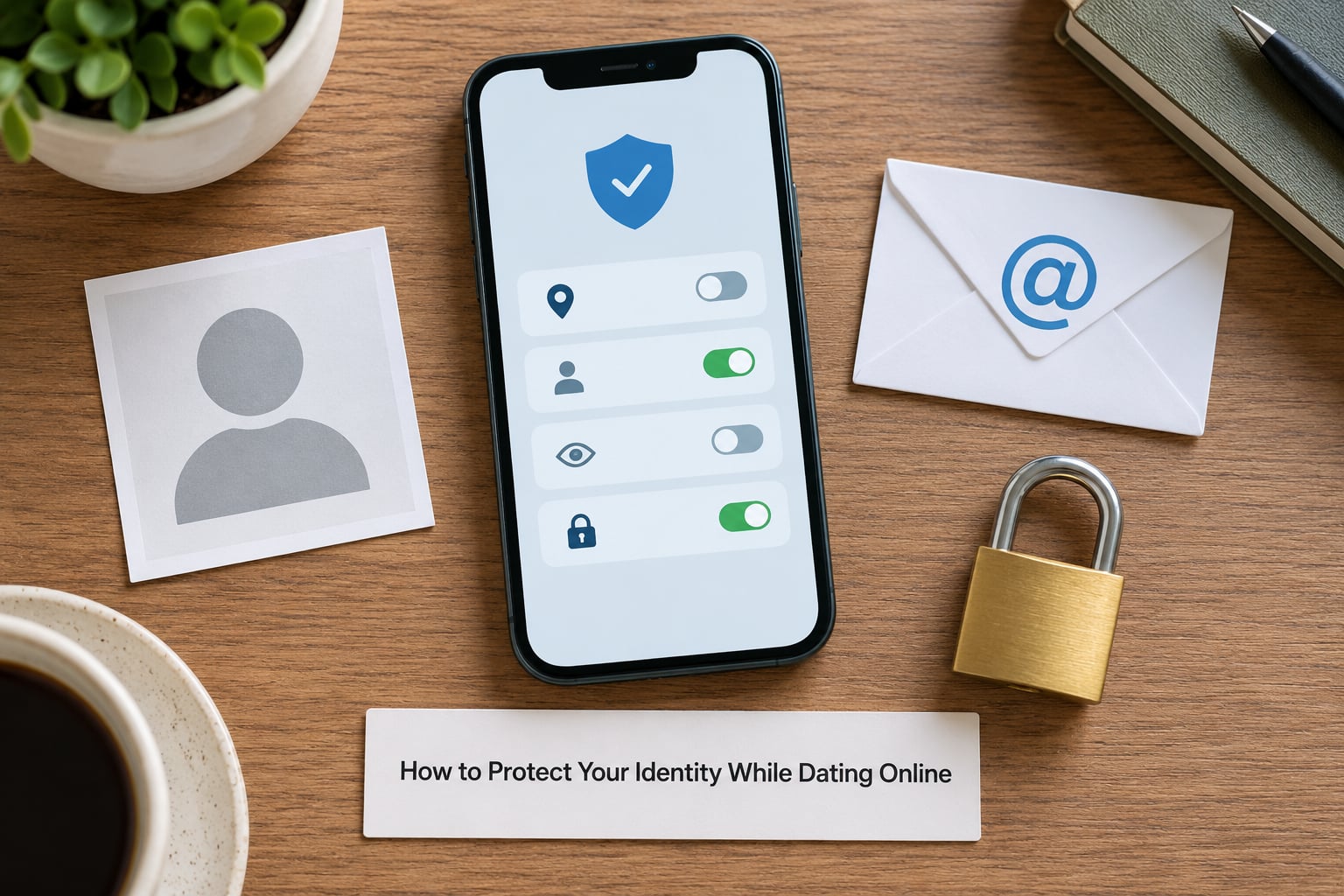
The name on the profile is one part of a larger set of decisions. These are the steps that make the biggest difference.
- Use a separate email address you have never used anywhere else, ideally with an alias or alias-style forwarding.
- Turn off anything that broadcasts your location, including distance settings and photo metadata habits such as filming at home in front of a window with a street sign.
- Photograph yourself away from identifying detail — no workplace lanyards, school logos, house numbers, mail on a table, or a license plate in frame.
- Run your own photos through a reverse image search using Google Images or TinEye, and search a line of your profile text, to see what a stranger could find.
- Give your employer a version of your job, not the company name. “I work in healthcare” is enough for a date; “I run the fourth floor lab at County General” is not.
- Keep your handle unique to dating apps so a single search does not stitch your profiles together.
- Check whether the app offers identity verification, and understand what it actually does before you rely on it.
One more habit pays off: audit yourself as though you are the person looking. Search your own first name, your employer and your town together and see what comes up. If the results make you wince, change the profile detail that caused it.
Should You Use Your Real Name on Every Dating App?
Not every platform, and not every situation. The deciding factors are how the app displays and verifies your name, who the audience is, and how much your social world overlaps with the app’s.
Hinge, Tinder and Bumble all let you set a display name freely, and none of them ask for a legal name to browse or match. Bumble adds a photo verification prompt on some accounts. OkCupid asks for a display name and lets you control how much of your profile is visible to users you have not liked. Facebook Dating inherits your Facebook profile, which is the real problem: it carries your existing friend graph, your photos and your workplace history with it. Match.com works the same way as Hinge and Tinder on this point.
Where identity verification exists, understand the scope. Verification usually means the app compared a live photo or a government ID to confirm the person behind the account matches the person in the pictures. It confirms the account holder is the one in the photos. It does not confirm their story, their intentions or their relationship history.
A few situations change the calculus completely:
- Survivors of abuse or stalking with a court order or safety plan should not publish a real name, a workplace or a home area. Talk to an advocate before choosing what to put in a profile.
- Closeted LGBTQ+ users in unsupportive households or workplaces have a concrete reason to use an invented name and a private email. Outing risk is a safety issue, not a preference.
- Small-town daters are unusually exposed. A surname plus a nearby town can identify one person, and your matches can tell which town you are in from a photo.
- Public figures and high-profile professionals should assume a doxxing attempt at some point and treat the surname as permanently off-limits.
When Should You Share More Identifying Information?
Share it as trust accumulates, and never as a price of admission. Someone asking for your details early is not owed them.
| Stage | Reasonable to share | Hold back | Why |
|---|---|---|---|
| While you are only chatting | First name, general area, what you do for work in broad terms | Surname, home address, workplace, phone number, social handles | Nothing has been verified yet |
| Before the first date | First name, the venue, an approximate time | Home address, car details, where you live alone | Public place, own transport, someone knows where you are |
| After a few meetups | Surname, a second phone number, a social account you already use | Financial details, account logins, copies of documents | Patterns are established and consistent |
| Serious relationship | Full name, shared social accounts, ordinary life details | Nothing, but keep separate devices and accounts for finance | Verification is not the goal; safety habits are |
Two things do not count as proof. A profile photo only shows a picture, and a video call only shows a live face. Catfishing exists precisely because both are easy to borrow. What does count is time, consistency, willingness to meet in public, and a willingness to be checked in ordinary ways.
What Details Can Help Confirm Someone’s Identity?
Use signals that are easy to fake but hard to keep up, and that cost the other person nothing.
- A live video call in which they respond to something you say on camera.
- A social account years old with a normal posting history, rather than a week-old page with no friends.
- A photo verification badge, understood for what it is: the account matches the person, nothing more.
- A phone number that is not a VoIP number, exchanged after a first meeting rather than before.
- Consistency over time — the same first name, the same story about work and family, no contradictions across weeks.
Three lines you do not cross: never send money or gift cards to someone you have not met, never hand over a copy of an ID or a bank login, and never accept a request to move to an unmonitored app where reporting is impossible. Services that offer background checks exist, and reputable ones do not ask for payment or documents through the chat window.
Why Someone Might Ask for Your Full Name
Some requests are ordinary. A restaurant reservation for two under a surname, a colleague-style introduction, or a shared joke about a name misheard on the phone are all normal things to want.
Other requests are not. A surname requested in the first three messages, combined with pressure, is a control move — it hands over an identifier for a person who has shown no reason to be trusted. So are requests paired with money, with intimate photos, with a threat about an existing partner, with immigration or legal leverage, or with a demand that you keep a relationship secret from anyone who knows you.
A person who needs your legal name for something legitimate can almost always wait a few days. A person who cannot wait is telling you something.
What Red Flags Mean You Should Pause or Leave
- Pressure for personal details early, especially combined with guilt about wanting to be careful.
- Refusal to meet in public, or a suggestion of your home, a car, or a private location.
- Inconsistent photos, or a camera that never turns on, including “my internet is bad” as the reason.
- Any financial request, including a story about a stranded traveler, a medical bill or a business opportunity.
- Moving you to another platform or app where the app’s reporting and blocking tools no longer apply.
- Trademark secrecy — “don’t tell anyone we’re talking” — which removes your safety net entirely.
- Aggression when questioned, or a match who reacts to a boundary by insulting you.
Block, report and leave. A genuine match will not punish a boundary. If you feel unsafe or someone is pressuring you for intimate images, contact RAINN’s National Sexual Assault Hotline or the National Human Trafficking Hotline; both offer confidential help, and local authorities can assist with protection orders.
Frequently Asked Questions
Is it safe to use my real first name on a dating app?
Yes, a first name is the standard compromise. It gives matches something to call you while leaving the detail that makes a stranger’s search easy. The risk is not the first name itself but what people attach to it, so keep your employer, your town and your social handles out of the same profile. Many users use the same first name on every app, which also signals authenticity rather than catfish behaviour.
Should I use my full name or a nickname?
Use a first name or a nickname, and disclose it early if someone asks. A nickname is not deception, but quietly substituting one and revealing the real name later is what creates distrust. If you want maximum privacy, a middle name you actually use is a good middle ground, since it is yours and verifiable without exposing the surname.
Can someone find me from my dating profile?
Often, yes, and faster than people expect. A first name plus a town, an employer, a university or a distinctive photo is usually enough to narrow results down to a handful of profiles. The surname is the fastest shortcut because it is unique. Using a separate email, a unique username, and photos with no workplace or address detail cuts most of that trail.
Is a profile photo proof that someone is telling the truth?
No. A photo only shows a picture, and photos are the easiest thing to borrow. A live video call raises the bar because the person has to respond in real time, but it still proves nothing about their intentions. Look for patterns instead: consistency about work and family over weeks, willingness to meet in public, and a phone number that is not a disposable one.
Should I share my phone number before a first date?
It is safer to wait until you have met at least once in public. Numbers are trivially forwarded and linked, and an early exchange often arrives with pressure for more personal details. If you do share it, use a secondary number, keep location sharing off, and do not answer calls from unknown numbers. Meeting first also gives you a voice and manner to check.
How can I verify someone is not using a fake identity?
Reverse image searching their photos, checking whether their social accounts are years old, comparing what they say about their life across several conversations, and asking to meet in public all raise your confidence without handing over anything sensitive. Never pay for a background check through the chat, never send money, and never send a copy of your ID to someone you have not met.
Bottom Line
Start with a first name or a nickname, keep the surname off, and give out identifying details in stages rather than all at once. Use a separate email, audit your photos and your own search results once, and reveal more only after someone has behaved consistently and met you in person.
If you have an active safety plan, a court order or anyone who could be harmed by your profile, talk to a specialist advocate first. Their advice beats any general guide, including this one.