If you are searching how to deal with dating anxiety, you have probably already noticed it shows up in the worst possible places: before you open a dating app, before you walk into a cafe to meet someone, and then again while you stare at a phone waiting for a reply. The fix is not to become someone who never feels nervous. It is to get one small, repeatable action you can do in each of those three moments.
Start with the reframe that does most of the work: shift your attention from “am I being liked” to “am I getting to know this person.” That sounds small. It is also the single change people report most, because self-monitoring is what turns a normal first date into an audition nobody volunteered for.
What follows is a six-step sequence built around the three phases anxiety actually shows up in: before, during, and after. If you only have two minutes right now, skip to step 1 and do the grounding routine. It takes ninety seconds and it works in a parking lot, a hallway, or a bar bathroom.
What You Need Before You Start
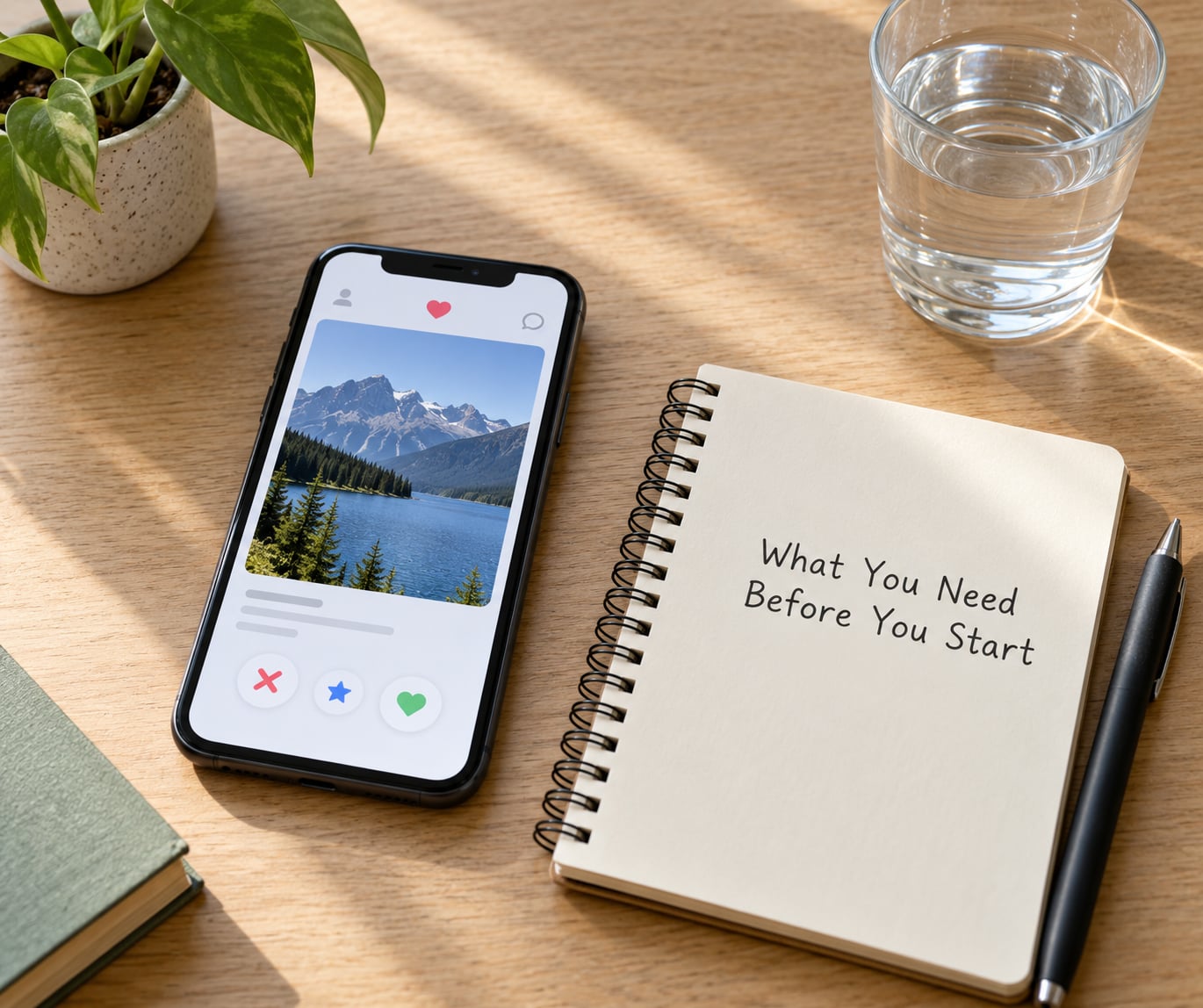
Nothing to buy. There is no toolkit, no course, no app subscription required to work through dating anxiety. What helps is mostly a decision you make before you’re in the moment.
A realistic time budget is the first one. Ten minutes of preparation beats two hours of rehearsing, because two hours of rehearsing usually ends with you more anxious than when you started. A private place to think matters too, even if it is the passenger seat of your own car.
Three conversation prompts in your pocket do more work than you would think. Two questions you actually want answered will carry you through the gap after hello, when the silence makes everybody’s heart rate climb. And one piece of knowledge matters more than the other four: the anxiety is common. Plenty of people on any given first date feel exactly what you feel right now.
How to Deal With Dating Anxiety, Step by Step
Step 1: Name What You Are Feeling
Ordinary nerves settle. A tight stomach an hour before, jittery hands for the first ten minutes, then it fades once you start talking. That is what first date nerves look like for most people, and they are not a sign anything is wrong with you.
The version worth paying attention to is worry that keeps running. It shows up days ahead, it survives the date, and it comes back every time you open the app. If you recognize that pattern, the useful move is to name the trigger in one plain sentence: “I’m afraid of being left on read” or “I’m afraid of ordering wrong at the restaurant.”
Write that sentence down. Naming a feeling is not being dramatic about it; it is the step that stops the vague hum from turning into a story.
Then ground yourself before making any dating decision, because an anxious body makes bad calls. Sit with both feet on the floor and run through 5-4-3-2-1: five things you can see, four you can feel, three you can hear, two you can smell, one you can taste. Sixty to ninety seconds is enough. You are not relaxing the feeling away; you are putting your attention back on the present, where the actual decision lives.
How you know it’s working: you can describe what you feel without spiraling, and the urge to check your phone, reread a message, or cancel drops from constant to occasional.
Step 2: Set a Small, Concrete Goal
“Find a partner” is not a goal for tonight. Neither is “be confident” or “don’t come across as needy.” Those are outcomes, and you have no control over them, which is exactly why they make you anxious.
Replace them with one action you can finish. Send one message about something you genuinely read on their profile. Ask three questions during the date. Stay for fifty-five minutes, then leave without deciding anything huge. Text one honest sentence afterwards.
One action per date, then repeat. Dating anxiety gets quieter through exposure, not through waiting until you feel ready, because readiness usually arrives after the fourth date rather than before the first.
How you know it’s working: you can finish the evening and tick something off, instead of reviewing it for what you should have done better.
Step 3: Prepare Without Overthinking
Give yourself a hard limit of about fifteen minutes. That single rule prevents the most common trap, which is spending two hours rehearsing an imaginary conversation that will never happen the way you planned it.
Inside those fifteen minutes: reread their profile and pick up two specific details. Write three open-ended prompts, the kind that can’t be answered yes or no. Choose somewhere public and reasonably quiet, with a walk or a drink that doesn’t require shouting over music. Decide one boundary you will not move past tonight, and say how you will leave if you need to.
Plan the exit before the date rather than during it. Knowing you can walk out at any moment is one of the cheapest anxiety reducers available, because the option itself lowers the stakes.
How you know it’s working: you arrive with a small plan and a time to stop, rather than a script to defend.
Step 4: Start Small Conversations
The texting stage is harder than the date for a lot of people, and the research on anxious daters agrees. Reply timing gets read as rejection far more often than it is.
Open with something specific and low-pressure: a question about the trip on their profile, a dog, a badly made coffee order, or a thing you both have in common. Then ask a real follow-up instead of switching topics. Curiosity is doing the work here; you are not trying to sound impressive, you are trying to find out who they are.
One detail worth using: say plainly when you are interested. A clear signal of interest takes a lot of guessing out of the exchange for both people, and guessing is where most of the anxiety lives.
On delays, use a rule instead of a feeling. Give yourself two check-in windows a day, morning and evening, and read messages only then. A slow reply means a busy life, a bad mood, or a conversation that isn’t going anywhere. It rarely means you did something wrong.
How you know it’s working: you can send a message, put the phone down, and get on with your evening.
Step 5: Make the First Date Easier
Pick a public, low-stakes setting. An activity date helps, because doing something gives you something to do with your hands and with the silence. Daylight beats a crowded evening bar, and a quieter room beats a loud one every time.
Say what you want out of the evening early. “I’m glad you suggested this” is a sentence with no pressure in it, and it gives you something to say if your own voice fails at the door.
When the nerves hit mid-date, use a pattern with actual counts. Box breathing is four counts in, four hold, four out, four hold, repeated for about two minutes. The longer 4-7-8 breathing works even better for a spike: inhale for four counts, hold for seven, exhale for eight, and repeat three or four times. Both slow the exhale, and a slow exhale is the signal your body uses to stand down. Four minutes is a realistic ceiling, since holding your breath past that makes people lightheaded.
Keep alcohol to a couple of drinks at most, or skip it. Alcohol takes the edge off for an hour and then amplifies the low point, which is the worst possible trade if you are already running anxious.
And give yourself permission to leave. Ten minutes in, ask yourself whether you want to stay because you like this person’s company, or because leaving feels harder. Both are allowed reasons to finish your drink and go home.
How you know it’s working: within about ten minutes of sitting down, you forget you were nervous.
Step 6: Review the Experience Instead of Judging Yourself
The after-phase is where dating anxiety does the most damage, because the date is over and the grading starts. Rereading every message, replaying a joke that landed flat, treating eight hours of silence as a verdict.
Score the date instead of yourself, on four things: did I feel safe, did I feel comfortable, did the conversation work, and was there interest on both sides. Anything below your line is information about fit, not about your worth. A bad match with a good person is a successful evening, because it costs you one evening and answers a question that would otherwise take a month.
Then close the loop. Decide on a fixed check-in window for their reply, decide in advance what you’ll do if nothing comes, and do both of those things. The not-coming-back half is worth planning too, so a cancellation or a rejection lands as information rather than as proof about you.
How you know it’s working: you can put the phone down after a good date without needing to know what happens next.
Common Mistakes That Make Dating Anxiety Worse
Rereading messages on a loop. Every reread raises the stakes of the reply you’re waiting for. Set two daily check-in times, mute the conversation notifications, and turn off read receipts if they make every read feel like a verdict.
Trying to be perfect. Charming is not achievable on demand, and the effort to perform usually shows. Being specific, curious, and a little quieter is far easier to pull off and reads as more genuine anyway.
Treating one awkward moment as the whole date. One long silence, one clumsy question, one joke that fell flat. People forget things like that while still talking to you. Nobody else is replaying your table the way you replay yours.
Drinking through it. Alcohol dulls the anxiety and sharpens everything after it, including the morning after a rejection. A sober first date leaves you with your actual reactions intact.
Dropping your boundaries to seem easygoing. Push back on meeting where you feel unsafe, on drinking more than you want, on staying later than you planned. Anxiety grows fastest when you teach it that your limits get ignored.
Quitting after every bad date. One bad date is data. Ending the whole process after it turns a small disappointment into a prediction, and predictions are what the anxiety was built on in the first place.
Frequently Asked Questions
Does dating anxiety mean the other person is not interested?
No. Dating anxiety is your own nervous system reacting to an uncertain situation, and it usually appears whether or not anyone else is interested. A first date is inherently hard to read because both people are performing calm. If you notice yourself spiraling before you have any real information, treat the feeling as yours rather than as a signal about them. Only what they actually say and do, over more than one interaction, tells you anything about interest.
How do I calm down in the last five minutes before a first date?
Stop rehearsing and start regulating your body. Do four rounds of 4-7-8 breathing: inhale for four counts, hold for seven, exhale for eight. Then take a slow walk for two or three minutes, ideally outside, letting your eyes scan far away rather than at the door. Stick to one drink or none, and remind yourself of the small goal you set: three questions, then an honest end to the evening. You are trying to lower the stakes, not feel completely calm.
How do I stop overthinking texts while waiting for a reply?
Replace the urge with a rule. Pick two check-in windows a day, read messages only then, and mute the conversation notifications in between. Turn off read receipts if they turn every read into a verdict. Each time you want to reread something, write one sentence about what you are actually worried about, usually the rejection underneath, and put the phone down afterwards. Slow replies usually mean a busy person, a hard day, or a fading conversation, rarely that you did something wrong.
Is dating anxiety the same thing as an anxiety disorder?
They overlap but they are not the same. Ordinary first date nerves peak before or during the date, fade once you are talking, and leave you able to eat dinner afterwards. An anxiety disorder is broader: the worry shows up across work, friendships, and health, it is hard to switch off, and it often comes with physical symptoms such as a racing heart, panic attacks, or difficulty sleeping. Dating simply gives that existing anxiety more frequent chances to appear. A licensed professional is the right person to make that call, not a web article.
When should I talk to a professional about dating anxiety?
Talk to someone when it stops you dating for months, when it affects other parts of your life, when you have panic attacks before or during dates, or when you already have a diagnosis such as generalized or social anxiety. A therapist who works with anxiety or with cognitive behavioral therapy can give you structured practice rather than reassurance, and there is no need to wait until things get worse. If anxiety comes with hopelessness, self-harm thoughts, or changes in sleep and appetite that last more than two weeks, contact a doctor or a crisis line right away.
Conclusion
Pick one small action and do it this week. Send one specific message, or set the time and place for a first date with an exit plan written down.
Then judge the experience on safety and comfort rather than on whether you felt brave. Anxiety does not have to disappear before you can date; it just has to stop running the show.