
What emotional availability looks like is simpler than most people make it sound: someone knows what they feel, says so in plain words, stays present when the conversation turns hard, and does what they said they would do. That combination shows up in texts, on dates, and most clearly in the first disagreement you have together.
It is also a capacity, not a personality type. People have more of it some weeks than others. The goal here is not to sort people into boxes on a first date, but to know what you are actually looking at so you stop guessing.
Table of Contents→
- What Emotional Availability Looks Like in Practice
- The Signs of Emotional Availability
- Emotional Availability vs. Other Kinds of Availability
- Why Emotional Availability Matters in Modern Dating
- Differences Between Healthy Caution and Emotional Unavailability
- Questions to Ask About Someone’s Emotional Readiness
- How to Check Availability Without Making It an Interview
- What to Do When You Are Not Emotionally Available
- Frequently Asked Questions
- Can someone be emotionally available but not ready for a relationship?
- How can I tell if a date is emotionally unavailable?
- Does taking longer to text mean someone is emotionally unavailable?
- Is emotional availability the same as being good at communication?
- How long should I date someone before assessing emotional availability?
- Start With Actions, Not Assumptions
What Emotional Availability Looks Like in Practice
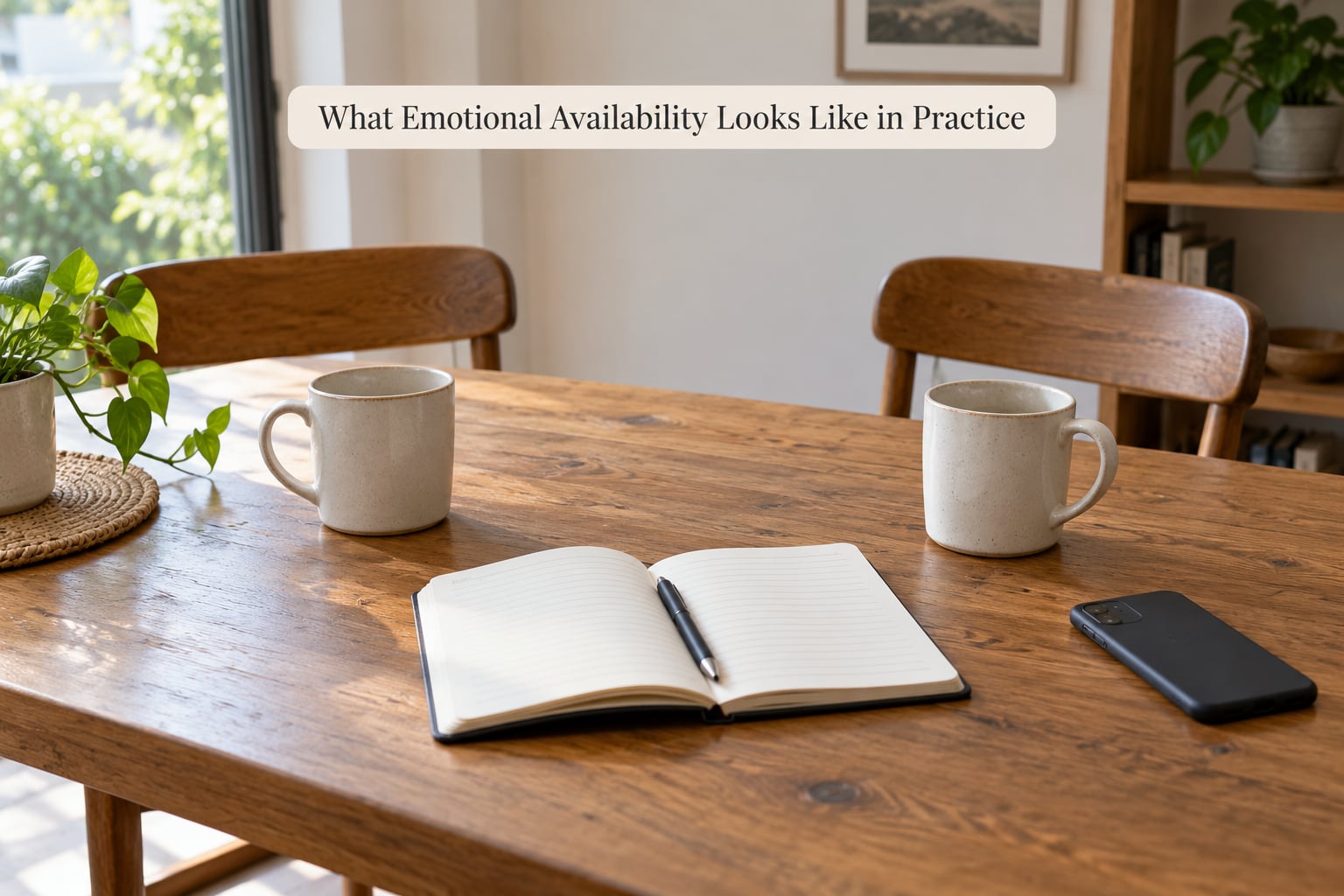
Emotional availability is the ability to stay open to yourself and to the people close to you — to notice a feeling, put words to it, and let someone else in without immediately retreating. It is not constant cheerfulness, and it is not the absence of hard feelings. It is willingness.
Several things get mistaken for it, so it helps to separate them early.
- Being lonely looks like high contact and low depth. Someone texts constantly, sees people constantly, and still avoids one honest question about how they are doing.
- Relationship-curious looks like genuine interest without commitment to a structure yet. They are available in spirit and undecided in practice, which is fine at six weeks and worth revisiting at six months.
- Being cautious looks like slow disclosure that widens as trust builds. The pace is deliberate and explained, not hidden.
- Being physically available looks like free time, clear schedule, and willingness to go out. It says almost nothing about the inner life, which is the part people get burned by.
Two people can spend a whole evening together and only reveal that neither one wants to go deeper. Conversely, an hour of honest talk on a walk says plenty. Behavior under mild pressure is a better signal than behavior under no pressure at all.
The Signs of Emotional Availability
The signs split cleanly into what someone does in conversation and what they do with their actions. Both matter, and both have to show up before you have an answer.
Signs in communication
- They ask follow-up questions. Not polite ones — real ones, about the thing you said two minutes ago.
- They name feelings, including their own. “I’m disappointed” comes out instead of silence.
- They can hear a complaint without getting defensive in the first three seconds.
- They say no to things, which is how you know yes means something.
- They tolerate a pause in the conversation rather than steering it back to safe ground.
- They can receive good news about you without making it about themselves.
Signs in actions
- They do what they said they would do, and they follow up if they cannot.
- They make plans ahead rather than waiting for the mood to arrive.
- They keep a consistent rhythm of contact, not bursts followed by nothing.
- They can be vulnerable without making you responsible for it afterward.
- They respect a boundary you set without testing it.
- They repair small frictions quickly instead of keeping a list.
What emotional availability looks like day to day
Day to day, availability shows up in the unglamorous places. Someone who texts back within an hour or two without performing panic. Someone who reschedules once, early, and offers a new time. Someone who says “I don’t want to talk about it right now, can we do it Thursday” and then actually does it on Thursday.
Watch what happens when their week goes sideways. A partner with capacity says “work blew up, I’m short with everyone today, I don’t think I can be good company tonight.” A partner without it cancels without explanation and reappears two days later like nothing happened. Both are common. Only one of them is a pattern you can plan around.
The clearest everyday test is reciprocity. You give a small amount of honesty — one real sentence about your evening — and you get one back. You make a small ask, and it is met without negotiation. Availability grows in both directions or it is not really there.
Emotional Availability vs. Other Kinds of Availability
Readers often use one word for several different things. Separating them prevents the most common dating mistake, which is mistaking interest for availability.
| Type | What it actually looks like | What it does not tell you |
|---|---|---|
| Emotional availability | Names feelings, stays in hard conversations, follows through, gives and receives honesty | That the relationship will be easy, or that they will agree with you |
| Romantic interest | Pursues you, plans dates, says attractive things, pays attention | Whether they can handle conflict or commitment |
| Sexual availability | Enthusiastic, present, curious, comfortable with physical intimacy | Anything at all about emotional risk |
| Consistent contact | Fast replies, daily check-ins, always reachable | Depth — some people are fluent in contact and empty when it matters |
| Being single and free | No current partner, open calendar, no commitment elsewhere | Readiness. Free calendars are common and meaningless on their own |
A useful side note: availability is not accessibility. Someone can talk for an hour about their own week and never once ask about yours. Accessible people make room for your experience in the conversation. That is a different skill, and you want both.
Why Emotional Availability Matters in Modern Dating
Dating apps removed most of the natural filtering that used to happen through repeated contact. Weeks or months of low-stakes exposure used to do the work that a single evening now has to do. That is why availability signals matter more than they used to.
Trust builds in a specific way: you say something true, nothing bad happens, so you say something more true. Without someone who can receive it and stay in the room, that sequence never advances. A relationship can look fine for months at the level of dinner plans and never get past that first exchange.
Expectations also sharpen. Someone with capacity will tell you they cannot do Friday, and you learn early that their yes is reliable. Someone without it will say yes, cancel twice, and you recalibrate your own plans around their weather. Over time, the reliable version builds a life you can plan inside, and the other one builds a life you plan around.
Resilience is the quieter benefit. Every couple hits a rough patch — a family illness, money trouble, a bad month at work. When both people can say what they feel, the bad stretch is a bad stretch. When neither can, it becomes the whole relationship.
Fairness is the one most readers notice last. Posts on r/emotionalintelligence describe couples with real emotional stability and describe the same effect from both sides: less emotional labor for each person. When one partner does all the initiating, all the checking in, and all the repair, the imbalance eventually turns into resentment. Availability is a share of that workload, not a favor one person does for the other.
Differences Between Healthy Caution and Emotional Unavailability
The most common mistake in reading availability is calling careful people broken. Several things can easily look like unavailability and are not.
Slow starts, past hurt, introversion, limited dating experience, and firm boundaries all coexist with genuine availability. A person who was hurt in a previous relationship may disclose slowly for months and still be fully present once trust builds. An introvert may need more recovery time after social contact and still care deeply. Someone with few relationships may be honestly unsure what they want, which is different from not wanting closeness.
Boundaries in particular get mistaken for avoidance. “I do not do relationships” may be a preference, and “I am not ready to talk about my family” may be self-protection, not refusal of you.
The markers that separate caution from a real barrier are more concrete:
- They explain the pace. Caution usually comes with a reason; avoidance does not.
- The pace holds steady or widens. Real caution is a slow curve; avoidance tends to be flat, with progress that reverses after vulnerability, commitment, or conflict.
- They can talk about feelings in general terms even when they are not ready to dive into their own. Total flatness is different from caution.
- Disappointment does not lead to disappearance. Available people get hurt and stay.
- They own their patterns. Someone who says “I know I get quiet and I am working on it” is in a very different position from someone who insists the problem is always you.
One more distinction worth keeping: being temporarily depleted is not the same as being structurally avoidant. Exhaustion from illness, caregiving, a new baby, or a brutal work stretch can shut someone down for weeks. The difference shows in what happens after the pressure lifts. If they come back and start repair, that was bandwidth. If nothing changes and nothing is ever named, that is a pattern.
Questions to Ask About Someone’s Emotional Readiness

Good questions here are open and about behavior rather than declarations. Ask them in a context where there is time, not in a car on the way home from dinner.
- What are you looking for right now, and what would make you stop looking?
- How do you handle it when something hurts you — do you say so right away, or do you go quiet first?
- What did the last real conflict in a relationship look like, and how did it end?
- When you are upset, what do you need from the other person?
- What does a boring week look like for you? I want the ordinary version.
- How much space do you want around a relationship at the start?
- What are you not ready for yet?
- What does being cared for look like in practice, not just in theory?
Listen to the shape of the answer rather than only the content. Someone who describes conflict in concrete detail — who said what, how it resolved — has usually lived with it. Someone who describes every ex as crazy or flawless has not yet looked closely.
How to Check Availability Without Making It an Interview
Interviews get honest-sounding answers nobody intends to keep. Conversation works better, and it gives you the same information with less effort from both sides.
Reveal something small about yourself first, then see what comes back. A sentence about a hard week is a low-stakes test. Available people meet it; uninterested or avoidant people let it pass and the conversation closes over it.
Ask for a small commitment early and watch it closely. A concrete plan next Tuesday, kept or rescheduled with notice, tells you more than three hours of warm conversation.
Let a small disagreement happen. Not a fight — a difference in taste in food, in plans, in how late is acceptable. How they handle a low-stakes friction is a preview of how they handle a real one.
Match your own pace to theirs for a few weeks and note the direction. Reciprocity is the metric. If you are the only one initiating, the only one asking follow-ups, and the only one saying something true, the imbalance is the answer, whatever the reason.
When answers and actions do not line up, name the action rather than the character. “You said you would call Sunday and then I did not hear from you until Tuesday” lands better than “you are not emotionally available.” You get the same information without handing them a label to defend against.
On forums like r/dating_advice and r/relationship_advice, the recurring complaint is rarely about a partner being silent. It is about never being given a straight answer, and about readers trying to decode silence for months instead of simply asking. A direct question, asked once, early, saves a lot of guessing.
What to Do When You Are Not Emotionally Available
If you recognize yourself in the previous section, the honest version is usually more interesting than the defensive one. Availability is something people build after a bad relationship, a hard family, or a stretch of exhaustion. It is learned, and it is not a character flaw.
Start by getting specific about your capacity. The question is not “am I emotionally available,” which is too big to answer honestly. It is smaller: available for closeness right now, available for touch but not for hard conversation, available on a week when nothing has gone wrong. People who say “I am bad at feelings” are usually describing a skill they never learned, not a fixed trait.
Do not mislead anyone while you figure it out. Dating someone while quietly knowing you cannot meet them is the situation that produces the worst outcomes on r/infp and r/relationship_advice alike, and it leaves someone who gave you their honesty wondering what they did wrong.
Say the true thing in plain words instead. A version that works: “I like you, and I am not able to be in a relationship right now. That is about where I am, not about you.” Short, unhedged, and it does not ask the other person to manage your recovery.
If you want to be more available, start with the smallest versions of the behaviors that create safety: answer when you said you would, say “I am tired and I do not have much in me tonight” instead of going quiet, ask one follow-up question. People describe availability as a practice more often than a personality, and small repeated actions are what make it one.
Some patterns come from things worth talking through with a therapist or counselor, which is normal and not an indictment. Online and in-person options both exist now, and past harm, grief, trauma, and chronic stress all sit behind availability more often than people expect.
Frequently Asked Questions
Can someone be emotionally available but not ready for a relationship?
Yes, and it is common. Someone can be fully honest about their feelings, listen well, and stay present in hard conversations while still not wanting a committed relationship right now. The distinction is between capacity and intention: availability is about how they relate, readiness is about what they want. Both can change over time, so ask directly about goals early rather than inferring commitment from warmth.
How can I tell if a date is emotionally unavailable?
Look for the contrast between early charm and later honesty. On a first date most people are warm. The signal comes later: does this person respond when you say something true, do they keep plans they made, do they get quiet the moment a conversation turns personal. One evening cannot tell you much. Watch what happens after vulnerability, after a cancellation, and after a small disagreement. Consistency over weeks is the real evidence.
Does taking longer to text mean someone is emotionally unavailable?
Not by itself. A slow texter may simply be busy, at work, or bad at their phone. Plenty of emotionally available people are slow responders and excellent partners in person. What matters is whether the pattern is steady and whether they show up when it counts. If your messages disappear for days with no explanation and no interest in reconnecting, that is about reciprocity rather than typing speed. Raise it once, plainly, and see what happens next.
Is emotional availability the same as being good at communication?
No. Communication skill is about delivering words clearly and calmly. Emotional availability is about being willing to have the feeling in the first place. A skilled communicator can talk smoothly about almost nothing, and an emotionally available person may struggle with the words but still show up and stay. Many good therapists work on both separately, which is why someone can be a clear communicator at work and unavailable at home with the person closest to them.
How long should I date someone before assessing emotional availability?
Give it enough time to see at least one real test: a cancellation, a disagreement, a bad week, or a moment when you say something honest. That usually means several weeks, not a couple of dates. What you can judge early is reliability, reciprocity, and whether questions get asked back. What needs more time is conflict behavior, which almost never shows up in the first month unless you create it gently and watch what happens.
Start With Actions, Not Assumptions
If you take one thing from this: what emotional availability looks like is mostly made of small verifiable things. They answered. They came. They said the true version instead of the safe one. Those are the observations worth making, and they accumulate faster than charm does.
Give it time to prove itself, check reciprocity rather than just warmth, and ask one honest question when the signals get thin. Then decide on what they did, not on what you hoped they meant.