
Early-dating jealousy is the jolt you feel when someone you have just started getting close to seems to be drifting toward another person. It shows up in the first weeks far more often than most people admit, and the fix is usually a single calm conversation that names the trigger, separates what you know from what you’re imagining, and makes one specific request.
This guide is for anyone in roughly the first one to three months of dating who feels that jolt and isn’t sure whether it’s normal, what to say, or when it has stopped being jealousy and started being control. Learning how to handle jealousy early in dating takes about ten minutes to read and ten more to apply.
Table of Contents→
- What You Need
- Step-by-Step: How to Handle Jealousy Early in Dating
- 1. Notice What Is Triggering the Jealousy
- 2. Check Whether the Threat Is Real or Imagined
- 3. Choose a Calm Time to Talk
- 4. Describe Your Feelings Without Accusations
- 5. Listen and Ask Clarifying Questions
- 6. Agree on Boundaries and Reassurance Early In Dating
- 7. Watch Trust Rebuild Through Consistent Actions
- Common Mistakes
- Frequently Asked Questions
- Is it normal to feel jealous this early in dating?
- What are the early signs of controlling behavior in a relationship?
- Is jealousy a controlling behavior?
- What is the difference between envy and jealousy?
- How do I deal with jealousy about my partner’s ex?
- How do I ask for reassurance without pushing my partner away?
- Conclusion: Start With One Calm Conversation
What You Need

Before the conversation you need three things, and none of them is courage on its own. You need a specific observation, a calm window, and one ask you can actually make.
Start with the observation. Vague jealousy is nearly impossible to talk about, so write down the actual thing: a message he sent at 11pm to someone else, a photo on his story, a profile still showing up in search. Then write what you assume it means. Those two lines sit side by side on paper, and the gap between them is usually where the argument is really coming from.
Next, pick the window. Neither of you should be rushed, mid-argument, drinking, driving, or three hours into a bad mood. Early evening when the week has settled works better than the end of a long date, because nobody is trying to end the evening early.
Last, decide the ask. Reassurance, clarity about the relationship, or a change in a specific behaviour are all reasonable. Handing over your phone password is not the same request, and the difference matters more than most people realise.
One honest note about timing. The apps themselves keep changing, and their mechanics change faster than anyone’s advice column does. What follows is not built around a feature that might vanish next quarter; it works for people in 2026 and people after that.
Five words people mix up when they talk about jealousy
| Term | What it is | What it looks like in early dating |
|---|---|---|
| Jealousy | Fear that a valued relationship is at risk from a perceived third party | His profile is still live, or an old flame liked your photo |
| Envy | Wanting what someone else has, with no third party involved | Wishing your date had the confidence your friend has on a first date |
| Compersion | Feeling glad your partner is close to other people | Being pleased he has two friends he has known for fifteen years |
| Retroactive jealousy | Intrusive thoughts about a partner’s past relationships | Wanting to know about an ex’s last birthday, then regretting asking |
| Possessiveness | Treating a person as something you hold rather than a person you chose | Answering her texts because he does not like the people she talks to |
Psychology Today frames jealousy as an adaptive signal rather than a defect, and its expert-reviewed explainer separates envy and compersion the same way. Knowing which word fits what you are feeling makes the conversation much shorter.
One useful finding from that research: the feeling skews differently by gender. Men tend to report more jealousy around sexual infidelity, women around emotional infidelity. If your actual trigger is the opposite of that pattern, that is worth naming out loud instead of assuming you are unusual.
Step-by-Step: How to Handle Jealousy Early in Dating
The process runs from naming the trigger to watching what happens afterward. It works in order because each step makes the next one easier, and skipping the first two is why most of these conversations turn into fights.
1. Notice What Is Triggering the Jealousy
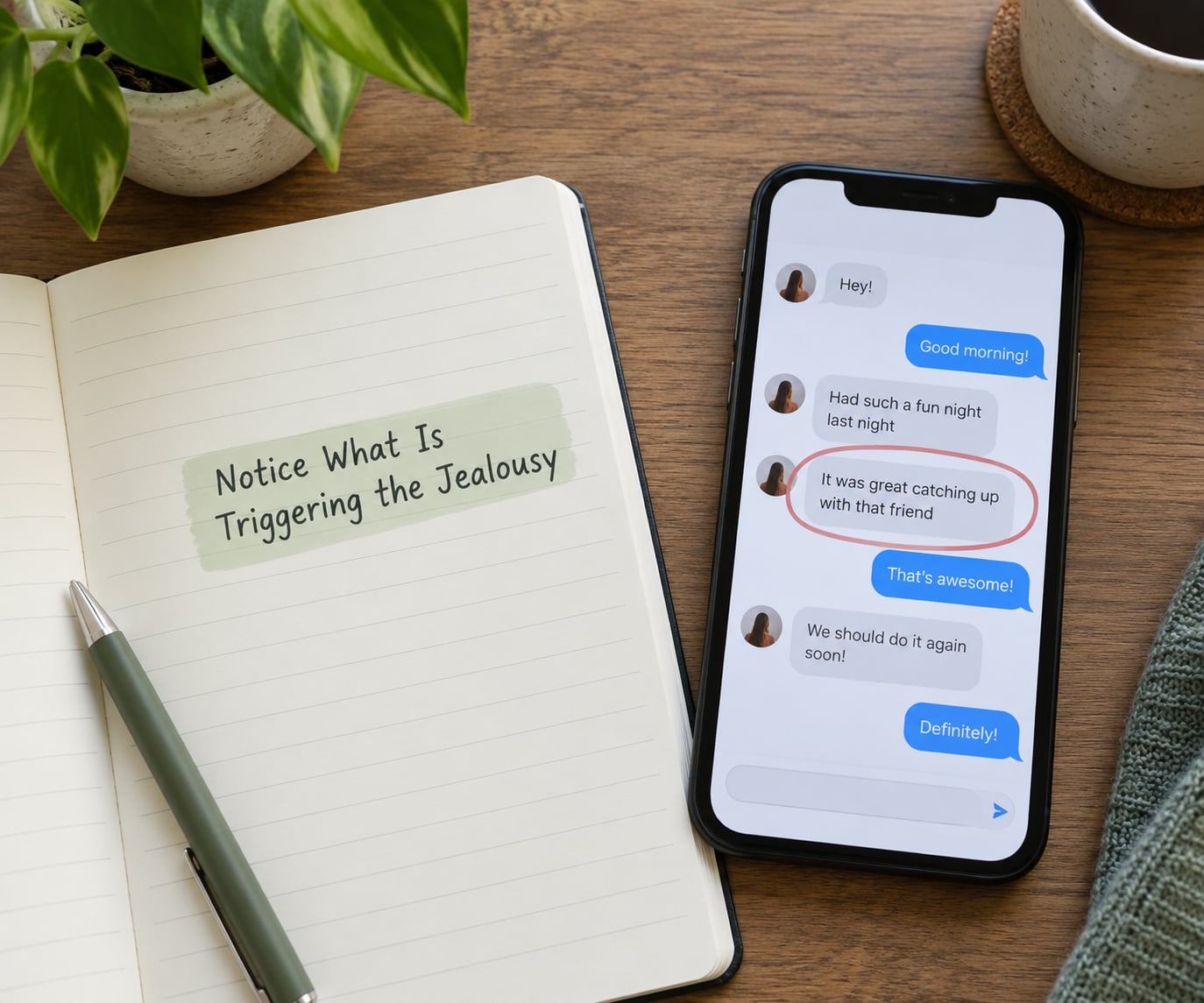
Name the exact behaviour, not the vague feeling. “I felt jealous” gives the other person nothing to work with, while “you posted a photo at that party on Friday and she was in it” gives them something specific.
Then separate what happened from what you concluded. He was at a party. He tagged her in a story. He has not mentioned her at all in six weeks. That last line matters, because in early dating people rarely have the shared history that would settle the question for you.
There is usually a fear underneath the jealousy, and the fear is more useful than the feeling. Fear of being left. Fear of not being chosen. Fear that someone better-looking or more fun is about to arrive. Fear that you are the temporary option.
When the feeling hits in the moment, do something small first. Put the phone face down and go for a walk, or finish the drink of water before you reply. Ten quiet minutes is usually the difference between an honest sentence and a text you would rather take back.
2. Check Whether the Threat Is Real or Imagined
Write your assumptions in a column and the evidence in another. Most of the time the evidence column has one line and the assumptions column has four.
Ask yourself what you have actually seen versus what you have inferred. You inferred that she is flirting because her reply came back in four seconds. You have seen a fast reply from someone you consider a threat.
Then ask whether this is a boundary concern or an anxiety one. A boundary concern is specific and reasonable: an open relationship, a partner who cannot stop contacting an ex, someone who is still dating other people while expecting exclusivity from you. Anxiety is vague and swallows everything: every friend, every coworker, every late reply.
3. Choose a Calm Time to Talk
Raise it when neither of you is rushed, angry, drinking, already arguing, or in a crisis. If one of you is, write the topic down and bring it up the next calm moment instead of raising it at eleven at night to get it out of your system.
Ask rather than ambush. “Do you have twenty minutes to talk about something I have been chewing on?” gets a yes far more often than starting with the accusation.
Say it in the first thirty seconds that you want to talk about your own reaction. That single framing change removes most of the defensive posture before it forms.
4. Describe Your Feelings Without Accusations
First-person language is the whole trick. Describe the behaviour, name your reaction, state the effect, make one request.
“When you replied to her at midnight, I felt a spike of anxiety and I checked my phone eleven times afterward. Could we talk about what is comfortable for us right now?” That sentence is hard to argue with because it contains no claim about his character.
Compare it with the version that usually goes badly: “You are obviously still talking to her, and honestly it is embarrassing that you would do this.” That sentence makes the conversation about his loyalty and his character, so he defends those instead of answering the question.
Some scripts worth keeping in your back pocket for early-dating jealousy:
- “I am not accusing you of anything. My stomach dropped when I saw that photo and I would rather say it out loud than sit with it.”
- “I want to tell you how I am feeling, and I am not asking you to change anything yet.”
- “Is it fair to say we are not quite a relationship yet? I want to know where we actually are.”
- “I am going to tell you once, so you know it is on me, and then I am going to stop bringing it up.”
- “Can you give me a real answer? If you need ten minutes, say that, but please do not tell me you are fine.”
Advice threads on this exact problem keep landing in the same place. Naming the specific behaviour works better than asking “are you jealous?”, which reliably produces a flat no and ends the conversation in thirty seconds.
5. Listen and Ask Clarifying Questions
His explanation is probably incomplete and partly defensive, and you can accept that while still asking neutral questions. What did she say? How long have they known each other? Does he still have feelings for her? Why was that particular photo posted?
Watch for the shutdown that forum readers complain about most: the reply goes late, replies get shorter, and everything comes back as “I’m fine”. Naming the pattern works better than asking about feelings.
“You went quiet after I mentioned the dinner and that came across as punishment rather than a conversation. Is there something bothering you about it?” That kind of naming is what usually gets the other person to recognise their own behaviour instead of insisting there was nothing to recognise.
Keep asking, not to score a point but because you may be hearing something new. Sometimes the answer reveals real information you did not have.
6. Agree on Boundaries and Reassurance Early In Dating
A conversation that ends in nothing changes nothing. Turn it into something specific: how you describe the relationship, what happens with the app, what each of you is comfortable with, what continued dating requires.
The ask-versus-demand test below is the part most people skip, and it is where learning how to handle jealousy early in dating actually pays off.
Test your own request with one question: am I asking for information and comfort, or for compliance? Information and comfort sound like a conversation. Compliance sounds like a condition on your continued presence.
That test matters most for the request everybody fights over: “block that person.” Blocking a specific person who has been harassing your partner is a reasonable boundary. Blocking everyone, or demanding passwords and location sharing, is control with a security cover.
Early in dating, certain things are not on the table, and saying so early is cheaper than untangling it in month six. You do not have to give up your friends, your family, your work contacts, or access to your phone. You also do not have to accept being asked to.
Dating-app mechanics deserve their own paragraph because nobody mentions them. A profile still live three weeks in, a visible match list, someone still swiping, and read receipts that make a two-hour gap look like a choice — those are engineered to produce exactly the jolt you are feeling.
The workable ask is usually simple. Take the profile down while you are dating. Delete the app if you have agreed to be exclusive. Turn off read receipts for a fortnight and see how everyone feels.
7. Watch Trust Rebuild Through Consistent Actions
One good conversation does not fix insecurity. It starts the repair, and the repair happens over weeks of small follow-through.
What you are watching for is boring and specific: does he answer the same question the same way on Tuesday as he did on Friday? Does he mention the coworker himself, unprompted? Does the profile stay down?
Emotional safety has a texture you can actually feel. It shows up as not rehearsing conversations in the shower, not needing to open his location to settle a question, and not doing mental arithmetic about what he might be doing right now.
If three months in you are still checking and still guessing, the pattern is not a trust problem you can talk your way out of. It is information about how the relationship works.
Common Mistakes
Here is the checklist. Read the left column as the version that builds trust, and the right one as the version that costs you the relationship.
| Situation | Jealousy (a feeling you can talk about) | Control (a behaviour that limits you) |
|---|---|---|
| Tonight’s plans | Asks what you are doing | Tells you to cancel |
| Your phone | Admits he feels uneasy and asks | Inspects it or demands the password |
| Your friends | Is uncomfortable and says so once | Requires you to cut people off |
| Exes | Mentions a worry once, hears your answer | Interrogates you about your past repeatedly |
| Your boundaries | Disagrees, negotiates, moves on | Treats every boundary as rejection of him |
| When you say no | Asks why, then accepts it | Punishes you with silence or coldness |
| Accusations | Admits he is insecure | Invents incidents you never did |
| Speed | Eases as trust accumulates | Tightens week by week |
With those eight in front of you, the mistakes become easier to name.
Testing instead of asking. Posting a flirty story to see who reacts is a test, and it always fails. You learn nothing about him and you teach him that your words are negotiable.
Checking the phone. If you have to go through someone’s messages to feel safe, the relationship has already lost. Say that plainly.
Demanding reassurance on a loop. One question, one real answer. Then the subject closes until something new happens.
Bringing it up mid-argument. Using jealousy as a weapon in a fight about something else teaches both of you that the fight is the point.
Threatening to leave to win. “Give my friend back or I am gone” turns a preference into leverage.
Over-apologising. You are allowed to have the feeling without treating yourself as defective for having it. Over-apologising hands the other person the whole problem.
Using jealousy as control. This one runs the other direction. If you are the jealous partner, saying less and choosing more deliberately is the actual assignment, not asking other people to shrink.
A minority of readers reach one of these threads and read it as a verdict: severe jealousy and isolation attempts in the first months are deal-breakers, and no conversation fixes them. That is a reasonable read. Know which camp you are in before you sit down to talk.
Frequently Asked Questions
Is it normal to feel jealous this early in dating?
Yes. Almost everyone feels some jealousy in the first weeks of dating, because the relationship is new, its status is undefined and no trust has been built yet. What matters is not the feeling but what you do with it. Feeling it and naming it plainly is healthy. Using it to control your partner’s friendships, phone or schedule is not, and researchers link that pattern to breakdown and, at its extreme, abuse.
What are the early signs of controlling behavior in a relationship?
Watch for requests that shrink your world rather than expressions that reveal a feeling. Early signs include telling you to cancel plans, requiring you to cut off specific people, inspecting your phone or asking for passwords, treating every boundary as rejection, punishing you with silence when you say no, inventing incidents you never described, and asking about your past over and over. The pattern is the issue, not any single incident.
Is jealousy a controlling behavior?
Not by itself. Jealousy is an emotion and controlling behavior is what someone does with it, so the same person can be jealous and still behave respectfully, or be controlling about something that is not jealousy at all. Ask one question of any request: am I asking for information and comfort, or for compliance? Reassurance and conversation are normal. Conditions attached to your continued presence are control.
What is the difference between envy and jealousy?
Jealousy always involves a perceived third party and the fear of losing someone you already have a connection to. Envy has no third party: it is wanting what another person has, such as their confidence or their easier social life. Compersion sits on the other side of jealousy, feeling glad that your partner is close to other people. Naming which one you feel usually makes the conversation far shorter.
How do I deal with jealousy about my partner’s ex?
Say it once, ask one real question, and then stop. Across the retroactive-jealousy communities that grew around this exact problem, the recurring advice is that repeated interrogation about a partner’s past reliably makes the feeling worse without producing new information. Retroactive jealousy is common enough to be named out loud as its own thing, and most people find it easier once they know it is not a character flaw.
How do I ask for reassurance without pushing my partner away?
Ask once, be specific about what you want, and give a real deadline for the answer. Say what you observed, how it landed in you, and what would settle the question: “when I saw that photo I got anxious; can we talk about what we are comfortable with right now?” Accept the answer, however imperfect. A second and third request for the same reassurance is what turns reassurance into pressure.
Conclusion: Start With One Calm Conversation
Pick the one thing that triggered the most recent jolt. Write down what you observed and what you assumed, choose a quiet moment within the next day or two, and say those two sentences out loud: what happened, and what you want to know.
That is the first action, and it is enough to move things. Handling jealousy early in dating is less about eliminating the feeling than about turning it into one clear conversation instead of a month of guessing.
Healthy jealousy is information worth hearing. It is not a command to control another person’s friendships, phone or time, and you are allowed to say no on both sides of that sentence.