
Hard conversations go wrong because the topic sets off a threat response in both of you, not because the topic itself is unsolvable. The fix is to lower the threat first: pick a calm moment, ask permission, name the feeling underneath the complaint, then talk about the actual problem. Give it 30 to 45 minutes, in person, with the phone face down.
Most couples already know what to argue about. What they lack is a structure for saying it without the talk turning into a trial, a shutdown, or a rerun of an argument from two years ago.
This guide walks through that structure step by step, gives you word-for-word lines for the topics that cause the most damage, and covers what to do when your partner refuses to engage at all. If you want the short version: one issue, one feeling, one request, one agreed next step.
What You Need
A hard conversation needs almost nothing physically and a great deal emotionally. Before you book the time, you need four things sorted.
One specific concern. Not the whole relationship, not seven grievances from March. One issue, described in terms you could write down and read to a stranger. If you cannot write it in a single sentence, it is probably three conversations wearing a coat.
A window of time with no audience. Both people rested, fed, not mid-argument, not about to leave for something. Twenty minutes minimum. If either of you is exhausted, irritated from work, or has been up with a sick kid, postpone rather than push on.
A setting that is neutral and private. The car on a long drive works. The kitchen table works. The sofa in front of a show does not, because the television gives both of you somewhere to look and an easy way to call it a day.
A desired outcome. Decide in advance what a good result looks like. Usually it is not agreement. Usually it is being understood, agreeing on one action, or learning that you see the problem completely differently.
Step-by-Step: How to Have a Hard Conversation With Your Partner
1. Prepare one clear issue
Write the issue as an observation plus a request, not a character assessment. The difference is enormous: observations can be discussed, character verdicts can only be fought.
Try this instead of “you never help around here”: “The kitchen has been my job alone for the last three weeks. I’d like us to split the dishes and bins on weekdays.” That sentence is arguable. “You’re useless with the house” is not, and it will take the next forty minutes somewhere useless.
What success looks like: your partner could repeat the issue back to you accurately. If they can’t, you haven’t defined it yet.
2. Choose the right time and setting
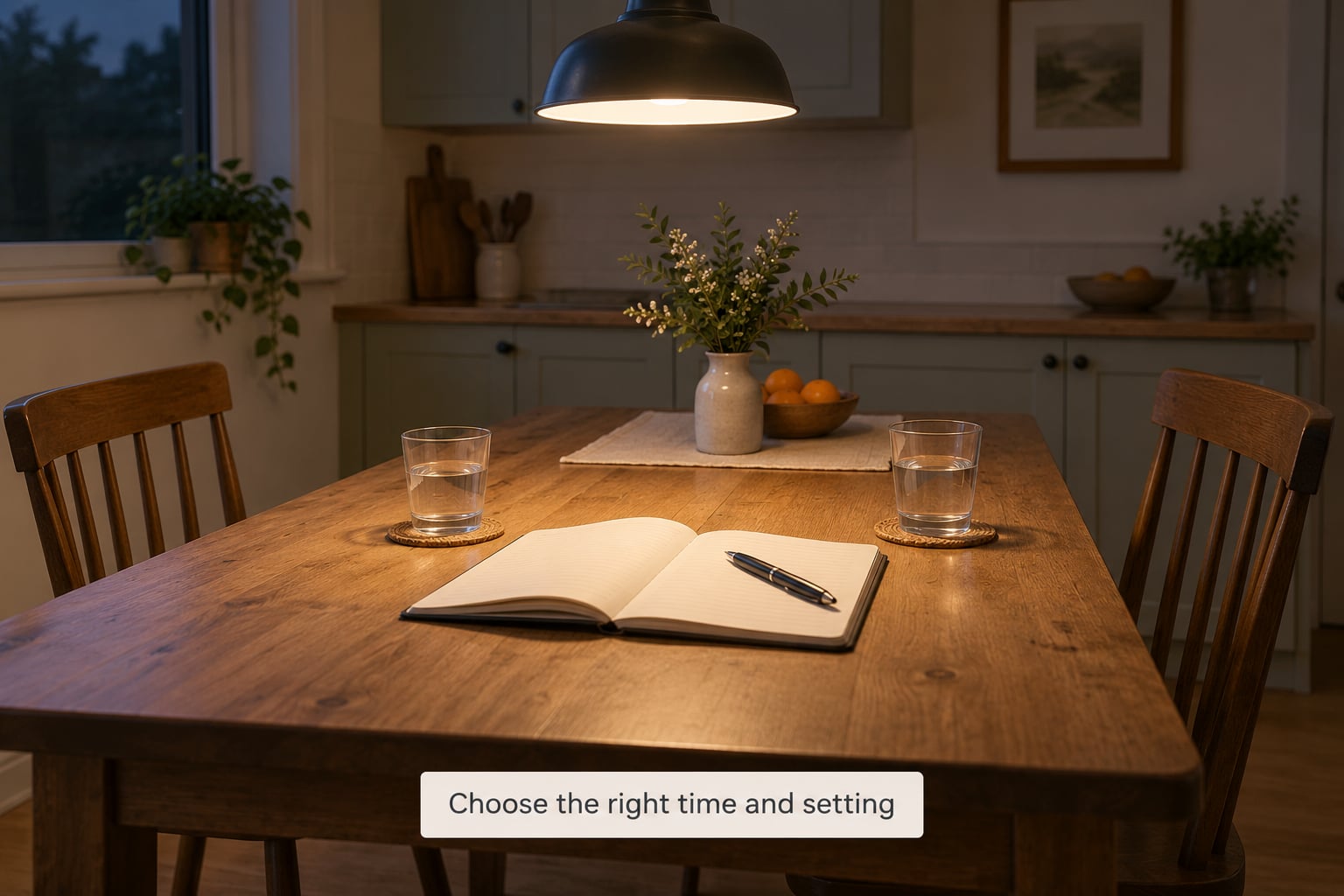
Ask for the conversation rather than announcing it. The single most useful sentence in this whole guide is: “Is now a good time to talk about something important? It’s about how we’re splitting the bills.” Previewing the topic takes the ambush out of the room and lets the other person actually choose a moment they can handle.
Do it in person. Text strips out tone, timing and body language, and it gives both of you the option to not reply for four hours while the other person reads the message eleven times. Use text only to arrange the time.
When to postpone: either person is drunk, exhausted, mid-crisis, or has something happening in the next hour they cannot miss. A conversation postponed to tomorrow is a delay. A conversation postponed for six months while resentment piles up is avoidance, and it changes the subject entirely.
What success looks like: both of you are sitting down, unhurried, with nothing scheduled right after it.
3. Start without blame or judgment
Lead with the feeling before the facts. People can argue with a complaint; they very rarely can argue their way out of hearing that you have been lonely.
“I’ve felt alone in this relationship for a couple of months, and I miss us. Can we talk about where we’re going?” lands completely differently from “you never plan anything and I’m sick of it.” The first invites your partner in. The second puts them on the defensive before you have finished the sentence.
The blame-free formula is simple: I feel [specific emotion] when [observable behaviour], and I need [specific request]. Stick to behaviour you could have recorded on video. “When you cancel on me twice in a row without telling me” survives scrutiny. “When you don’t care” does not.
What success looks like: your partner nods or asks a question instead of interrupting with a counter-charge.
4. Listen to understand, not to defend
This is the hard one, because listening without arguing feels like losing. Resist the counter-argument for sixty seconds and you will usually learn something that changes the shape of the problem.
Three moves do most of the work:
- Ask open questions. “What’s that like for you?” beats “Why do you do that?”
- Reflect back what you heard. “So the money feels like it’s not yours to spend without checking in. That’s how it sounds.”
- Validate before you disagree. “That makes sense, and I still think we’re spending too much on subscriptions.”
You will also hear something you did not expect. In most couples, the surprise is not the money or the chores, it is a much older thing: a feeling of not being chosen, of being managed, of being unimportant.
What success looks like: you can state your partner’s position well enough that they agree with your summary.
5. Clarify the disagreement and find common ground
Most fights are two people answering different questions. “I need you to be more present” and “I need you to stop criticising me” are not opposing positions on one issue; they’re two separate grievances that both arrived dressed as one argument.
Separate the need from the solution you have in mind. Behind “we should take a bigger holiday” is often “I want you to want something with me.” Behind “you never plan date nights” is often “I don’t feel desired.” Say the underlying need out loud and the solution stops being a hill to die on.
Then name what you both agree on. Usually there is more of it than either of you expects: we both want less debt. We both want to stop fighting on Sundays. We both want to feel appreciated. Build the next step on that shared ground, even if the rest stays unresolved.
Disagreement is a fine outcome. Two people can leave a conversation still disagreeing and still on the same team, provided the disagreement is about the issue and not about each other’s character.
What success looks like: you can each state the other’s view in a way they’d accept.
6. Agree on specific next steps
Vague commitments are how the same conversation gets had again in six weeks. “We should communicate better” has no owner, no date and no definition, so nobody can tell whether it happened.
Better: “I will move the recurring card charges to our joint account. You will move the three subscriptions you forgot about. On Sunday night we look at the statement together for ten minutes.” Specific, checkable, done.
Pick one or two actions, not seven. If the issue is a pattern, name a trial period: try the new split for a month and check in on a set date. That takes the pressure off while giving both of you a real chance to see whether it works.
What success looks like: you both know who does what, by when, and when you’ll check whether it worked.
7. Check in afterward
Ten minutes the next day matters more than the entire evening. Ask directly: “How did last night land for you? Anything you didn’t get to say?” Most of the time, one of you left with a sentence you never got to finish.
If emotions are still raw, say so and set a time. “I’m still a bit wound up about this and I’d like to finish it. Tomorrow after dinner?” keeps the thread alive without forcing it in the moment.
When a conversation goes badly, repair is separate from the argument, and it is its own skill. Say what you did, skip the “but”, name the impact, and state the change: “I raised my voice last night. That wasn’t fair and I’m sorry. I’ll call a break before it happens again.” An apology with a specific change attached gets received very differently from “sorry if you were hurt.”
What success looks like: both of you feel like the other person tried, even if you still disagree.
Common Mistakes
Most hard conversations don’t fail because the topic is unsolvable. They fail because of one of these seven habits.
Stacking five issues into one conversation. You open with money and end up discussing the in-laws, the holiday and your mother’s birthday. Nothing gets resolved because everything gets muddy. Fix: one issue. Literally say “there are two other things, and I want a separate conversation for each.”
Building a case file. Listing every instance since March to prove a point doesn’t persuade anyone, it makes your partner feel like a defendant in their own kitchen. Fix: use two recent examples, then describe the pattern.
Absolutes. “You always,” “you never,” “you don’t care.” They read as verdicts and they invite a counter-list. Fix: date and count instead. “The last three times we made plans, they got cancelled.”
Reopening old fights. Nothing ends an argument faster than discovering a second one underneath it. Fix: keep a note of the topic you set aside, and deal with it on its own date. Agreeing to park something without agreeing to deal with it later is just postponing.
Ultimatums. “You do this or we’re done” turns a solvable problem into a referendum on the relationship. Fix: state the impact honestly, then let your partner choose. “If nothing changes by Christmas I’ll need to make a decision about the relationship.” That’s a boundary. The other thing is a threat wearing a mask.
Timing it badly. Opening a hard conversation at 11pm after a bad day, during a fight about something else, or in the ten minutes before anyone leaves. Fix: ask for a better moment and wait for it. Delay by a day is fine. Delay by six months is not.
Never actually starting. The most common one, and the hardest to admit. You rehearse the conversation in the shower, on the drive, at 2am. You know exactly what you’d say. Then you decide it’s not that serious. Fix: pick a date and a time, and treat it like an appointment.
A few ground rules keep things workable: one person talks at a time, whoever wants a break says so out loud with a return time, and neither of you brings up anything the other person hasn’t raised first.
Frequently Asked Questions
How do I communicate when my partner gets defensive?
Name what you see instead of what you think. Try: “I notice you go quiet whenever money comes up, and I don’t know what that means.” Defensiveness is usually fear of being judged, so reassure first: “This isn’t about blaming you.” Then make one small request and stop talking. Let silence sit for a minute rather than filling it with more justification, which reads as pressure. If the defensiveness keeps happening, say so outside the argument: “I want these talks to feel safer for both of us.”
What if my partner refuses to talk about it at all?
This is common and it is not automatically a bad sign. Ask for a smaller ask: fifteen minutes instead of a full conversation, a walk instead of a table, or writing it down instead of saying it aloud. Choose a date and hold the date. If your partner agrees to talk and then repeatedly doesn’t follow through, name the pattern outside the argument. If a topic stays permanently off the table after several attempts, that is worth raising as its own conversation, and it may be worth raising with a therapist present.
Should hard conversations be in person or over text?
In person, almost always. Text removes tone, facial expression and timing, so the same sentence can read as neutral or as an accusation. It also gives you an easy out: not replying. Text is useful for one thing, arranging the time: “Are you free to talk about money at eight? Nothing urgent tonight.” One exception: writing out a thought ahead of time can help if you know you will freeze or spiral when put on the spot. Read it out loud in person rather than sending it.
How long should a hard conversation take?
Thirty to forty-five minutes is the useful window. Shorter and you touch the surface without resolving anything. Longer and both people tire, attention wanders, and the careful first twenty minutes gets eroded. Take a break before either of you hits your limit, and set a specific time to come back, like “twenty minutes, then eight o’clock.” Ending without agreement is a legitimate outcome. What matters is that you understand each other better than you did an hour ago.
When should a couple see a therapist?
Consider couples therapy when the same argument repeats every few weeks with no change, when one of you has stopped raising things at all because nothing ever shifts, or when a serious issue has gone unaddressed for months. It is also worth trying before a big decision, like marriage, a move or having a child, if you want a neutral third set of eyes. Therapy is not a last resort and it does not mean your relationship is failing. It means you want a different outcome than the one repeating on its own.
Conclusion: Take the First Step
The whole method compresses into three sentences you can say tonight: one observation you could actually prove, one honest feeling underneath it, and one request small enough to agree to. Ask for the time first, put the phone in another room, and let the other person talk longer than feels comfortable.
It is worth saying plainly that the aim is not to win. A productive hard conversation leaves you both clearer than it found you, even when nobody agrees on the answer. That clarity is what makes the next one easier.