
Put both phones in another room at 9pm and charge them there overnight, then protect dinner and the first thirty minutes of the morning the same way. That single rule, made by both of you rather than demanded by one, fixes most of the everyday damage faster than any app or ultimatum.
Phone addiction in a relationship is not really about hours on a screen. It is about displacement. The time and attention your partner used to give you now goes to an endless feed, and what you are left with is the sense of being ranked below a device that does not even know you are there.
Most attempts fail for a boring reason: the complaining partner is glued to their own phone. Every time you raise it, you get “you do it too,” and the argument collapses into hypocrisy. So this plan starts where the research on this problem consistently starts, with a mutual pact.
Two words you will hear a lot here. Phubbing means ignoring someone in favour of a phone. Nomophobia means the irrational fear of being without your phone. Neither is a diagnosis, and that matters, because a habit gets fixed with rules while a fear gets talked about.
What You Need Before You Start
Five things, and none of them cost money.
- Your own screen time data. Pull it up before you open your mouth. Guessing makes you look like the problem.
- One honest goal. Not “never touch it again.” Pick one window, like 9pm to 7am, or one ritual, like dinner.
- Three or four written rules. Specific times beat general principles every time.
- A charging spot outside the bedroom. This is the single highest-impact change couples report.
- A date to review it. Two weeks out, on the calendar.
Notice what is missing: no tracker, no app, no therapist referral. Those come later, if they come at all.
Step-by-Step: How to Deal With Phone Addiction in a Relationship
1. Discuss Phone Use Without Accusations
Start with the behaviour, then your feeling, then a request. Three sentences, in that order, and the whole conversation changes shape.
“When you check your phone at dinner, I feel like I am waiting for you. Could we both put ours away for the first twenty minutes?” That is hard to argue with because there is nothing in it to defend against.
What to try not to say, because each one ends the talk: “You’re always on it.” “You don’t care about me.” “You need to detox.” And the killer, “you do it too,” which kills your own point along with the conversation.
You know it worked when the conversation ends in something you both agreed to rather than something one of you agreed to because they were tired.
2. Find Your Actual Phone Distraction
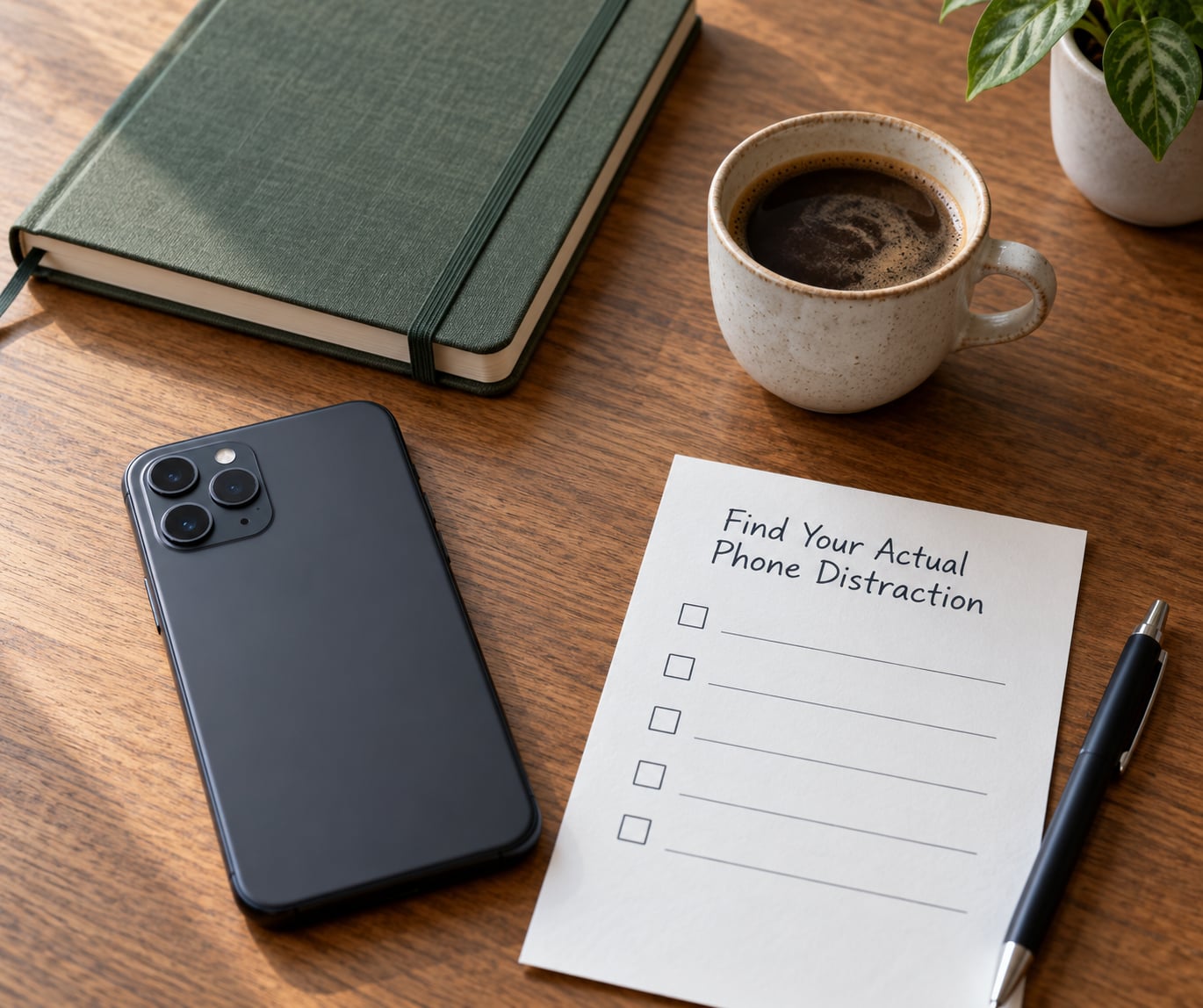
Open the screen time report on both phones. On iPhone it is Settings, then Screen Time, then See App and Website Activity. On Android it is Settings, then Digital Wellbeing, then Screen Time. Look at the weekly average, not today.
Then ask three questions. Which apps eat the most? Which hours are worst? What was happening right before each pickup?
That last question is the useful one. Phone use clusters around boredom, stress and conflict, which means your partner is not choosing the phone over you. They are reaching for a predictable relief, and you are standing where the relief usually goes.
Write down the two or three contexts, not twenty apps. “After work on the couch” is fixable. Naming twelve apps is not.
3. Agree on Phone-Free Connection Times
Pick windows that already exist. Dinner, bedtime, driving together, the first part of the day when one of you is still sleepy. Inventing new rituals on top of a busy week is how this dies by Thursday.
One rule that circulates constantly in relationship advice forums is worth stealing as a starting point: phones off at 6pm every day, two hours together, no exceptions, no doom-scrolling and no “just checking.” Specific, timed and mutual beats vague and demanding.
The mutual part is doing the work. Couples who scheduled device-free time report it lasting far longer than couples who banned phones outright, because nobody is being policed.
Also decide the exception list out loud. Medical or family emergencies, usually. Work calls, defined in advance rather than decided mid-dinner.
You know the rule is holding when neither of you is tracking whether the other is following it. Tracking means it is a supervision arrangement, and those do not last.
4. Change the Phone Setup
Rules about attention fail because the phone is designed to win against willpower. Take away its openings.
- Turn off notifications for everything except calls from family. On iOS: Settings, Notifications, Summary, then schedule it off. On Android: Settings, Notifications, then turn off the categories you do not need.
- Clear the home screen. Keep only the apps you use on purpose. Most people open TikTok, Instagram or a news app because it was sitting right there.
- Switch on grayscale or focus mode for your agreed windows. iPhone: Control Center, then the Focus button. Android: Digital Wellbeing, then Focus mode.
- Move the charger. A visible phone gets picked up. A phone in the kitchen does not.
- Set a real curfew. iPhone: Screen Time, Downtime. Android: Digital Wellbeing, Focus mode with a schedule.
Deleting the worst app usually does more than setting a limit on it. A limit leaves the trigger one tap away.
5. Replace Phone Time With Shared Attention
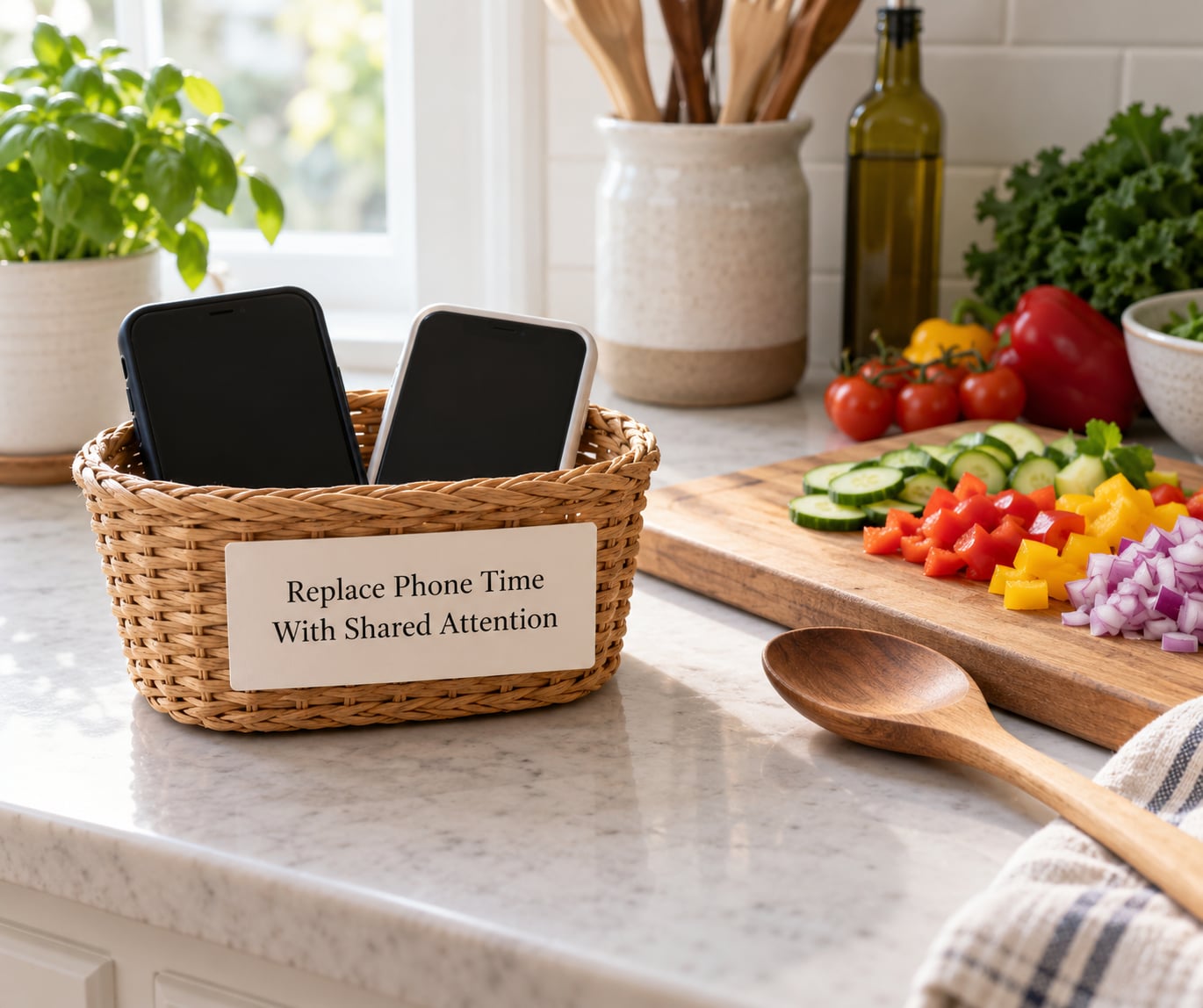
Removing a habit leaves a hole, and an unfilled hole gets filled by the thing you removed. Plan the replacement before you take anything away.
Cooking one meal together works because it has steps, so silence is not awkward. A walk works for the same reason. So does a show you both rewatch, a board game, or one shared project that is not a home repair, because repairs turn into task lists and a task list is not connection.
Expect it to feel awkward for the first week or two. That is not a sign the plan is failing. It is what attention feels like when it has been outsourced for years.
If a window is only ten minutes, ten minutes is fine. Consistency counts far more than length, and it is much easier to protect ten honest minutes than two hours nobody manages twice.
6. Set a Boundary for Conflict and Compulsion
A boundary is not a punishment. It is a statement of what you will do, delivered calmly, followed by what you will actually do.
“If I’m mid-sentence and you pick up your phone, I will get up and go to bed. I am not trying to control you. I am telling you what I do when I feel like I am talking to nobody.” Then you do it, without drama, every time.
Pick one repeated behaviour rather than the whole problem. Texting during arguments, disappearing into the feed the moment tension rises, or answering messages while you are talking are three separate things with three separate fixes.
Add a review date to the boundary. “Let’s see how the next two weeks go” gives the rule an end, which is the only thing that keeps a boundary from becoming a grudge.
Set that boundary while calm. Phubbing during an argument is its own trap, because the phone becomes an escape hatch and the conversation becomes something both of you now want out of.
7. Review Progress and Adjust
Two weeks in, look at the screen time reports side by side. That number is the most honest referee you have.
Then loosen whatever is failing. A rule broken seven nights running is not discipline, it is a badly designed rule. Cut it in half and try again. A window you keep mostly succeeding at is worth more than one you abandon.
Here is the self-check that changes everything: is this a habit or a coping strategy? If your partner reaches for the phone when bored, that is a habit, and rules work. If they reach for it to escape anxiety, to shut down after conflict, to feel wanted by strangers, or to hide something, rules will not touch it. Get a licensed therapist or counsellor involved, ideally someone you both see, and expect this to take longer than a fortnight.
You know the plan is working when you start having conversations you would have missed before, and the resentment stops growing. Not gone. Just no longer gaining ground.
Common Mistakes That Make It Worse
Treating only one person as the problem. This is the most common failure, and it appears constantly in relationship advice forums. The fix is simple and humbling: sign the pact yourself. Put your phone away in the same window you are asking them to.
Ultimatums and phone confiscation. A 30-day total ban handed over as punishment invites a fight every single time it is mentioned. The rule has to be agreed, or it is a power move dressed up as a plan.
Talking about character instead of behaviour. “You are selfish” gets you a denial. “You check your phone four times during dinner” gets you a conversation. Behaviour is observable, and nobody can argue with what they both saw.
Going silent to get even. Retreating to your own phone teaches both of you that disappearing is a legitimate move. That is the opposite of the plan.
Promising a detox with no follow-through. Nothing wrecks the next conversation faster than a broken commitment. Start small enough that you can actually keep it.
Expecting three days to fix years. Most people notice real change in two to four weeks, and the restless phase sits right in the middle of it. Anyone promising you a fast permanent fix is selling something.
A few habits keep it alive. Review the pact once a month rather than daily. Keep one phone-free evening that belongs to nobody’s schedule. Talk to a couples therapist once, even if the problem is small, because it teaches you a vocabulary you will need later. And model it for kids, because children copy the phone behaviour of the adults they can see rather than the rules they are told.
Worth knowing for accuracy: problematic smartphone use is not a formal DSM-5 disorder, and nomophobia is not a diagnosis either. If the pattern includes panic when the phone is missing, sleep loss, or use that continues despite real harm, that is a clinical conversation, and a licensed professional is the right place to have it rather than a rule you impose at home.
Frequently Asked Questions
What is digital addiction?
Digital addiction is the broader name for compulsive behaviour around any digital activity: gaming, social media, streaming, online shopping or endless scrolling. It shares the same core features as phone addiction, meaning an urge you cannot easily control, repeated use despite costs, and use that crowds out sleep, work or relationships. Phone use is simply the most common form, because the device is portable, always on and one tap from a new reward.
Are healthy boundaries the same as being controlling?
No. A control tactic decides for your partner and usually demands to inspect or restrict the phone. A boundary describes what you will do with your own behaviour, such as ending a conversation that keeps getting interrupted, and leaves the choice with them. It also applies to both of you, which is the clearest sign it is not control. If your rule only runs in one direction, it is probably an ultimatum.
How much phone use is too much for adults?
There is no official threshold, and anyone giving you one is guessing. Most research treats the problem as loss of control rather than hours. A clearer test: does phone use crowd out sleep, make you snappy when interrupted, or leave you unable to be present during things you said you wanted to do? If yes, the hours matter less than the pattern. Weekly screen time data is more useful to you than any published benchmark.
What do I do if my partner will not participate?
Ask for one small thing, not the whole plan. Charging phones outside the bedroom, or phones down for the first twenty minutes of dinner, is a low enough bar that most people will try it. Then keep your side visible. Modelling usually works better than persuasion over time, though it is slower. If nothing lands after a few honest attempts, a couples therapist can often open a door that two people stuck at home cannot.
How do I handle urgent work communications?
Agree on the exceptions before they are needed, while nobody is irritated. Define what counts as urgent, and pick a signal for it, like a repeated call or a message to a shared address. Put the phone where it can be heard from another room, or switch on Do Not Disturb during your protected windows. A rule invented mid-argument will always look unfair, so write it down in advance.
How long does it take to break a phone addiction?
Expect two to four weeks before most couples notice a real difference, and expect some wobble in the middle. Week one is usually the hardest because the reflex is still strong. The second week tends to feel easier because the triggers have shrunk. If you are three months in with no change at all and the use looks like escape from anxiety or low mood rather than boredom, that is worth raising with a professional instead of escalating rules.
Start tonight, not on Monday. Both phones go to a kitchen drawer at 9pm, dinner gets twenty quiet minutes tomorrow, and you write down the two contexts where the phone use is worst. That is the whole plan for day one, and it is enough to start.