If you sent money to a romance scammer, do four things today: stop all contact, screenshot every conversation before you block, call whoever moved the money and ask for a recall, then file complaints at ic3.gov and reportfraud.ftc.gov. Speed is the one variable you control, and it matters more than anything else on this page.
For a bank wire, the window is roughly 72 hours. After that, funds that have cleared an international correspondent bank are almost never pulled back. For credit and debit cards you have a different and usually longer path, and for gift cards and cryptocurrency the odds drop the moment the payment clears. So do not wait until you feel ready to talk about it. Waiting to feel ready is what costs most people the money.
The steps below are in order because each one makes the next one more effective. Read the whole thing once before you start calling, then work down it.
Table of Contents→
- What You Need
- Step-by-Step
- 1. Stop Contacting the Scammer Immediately
- 2. Contact Your Bank or Payment Provider Right Away
- 3. Secure Your Financial and Online Accounts
- 4. Preserve Evidence of the Romance Scam
- 5. Report the Scam to the Right Organizations
- 6. Check for Identity Theft and Monitor Your Credit
- 7. Replace Exposed Personal Information
- 8. Get Emotional Support and Avoid Further Contact
- Common Mistakes
- Frequently Asked Questions
- How long do I have to report a wire transfer fraud?
- Can I get my money back if I sent it to a romance scammer?
- I paid with Zelle, Venmo or Cash App. Can that be reversed?
- What if I paid in cryptocurrency or with gift cards?
- Does reporting to IC3 or the FTC actually get my money back?
- What if someone offers to recover my money for me?
- Conclusion
What You Need
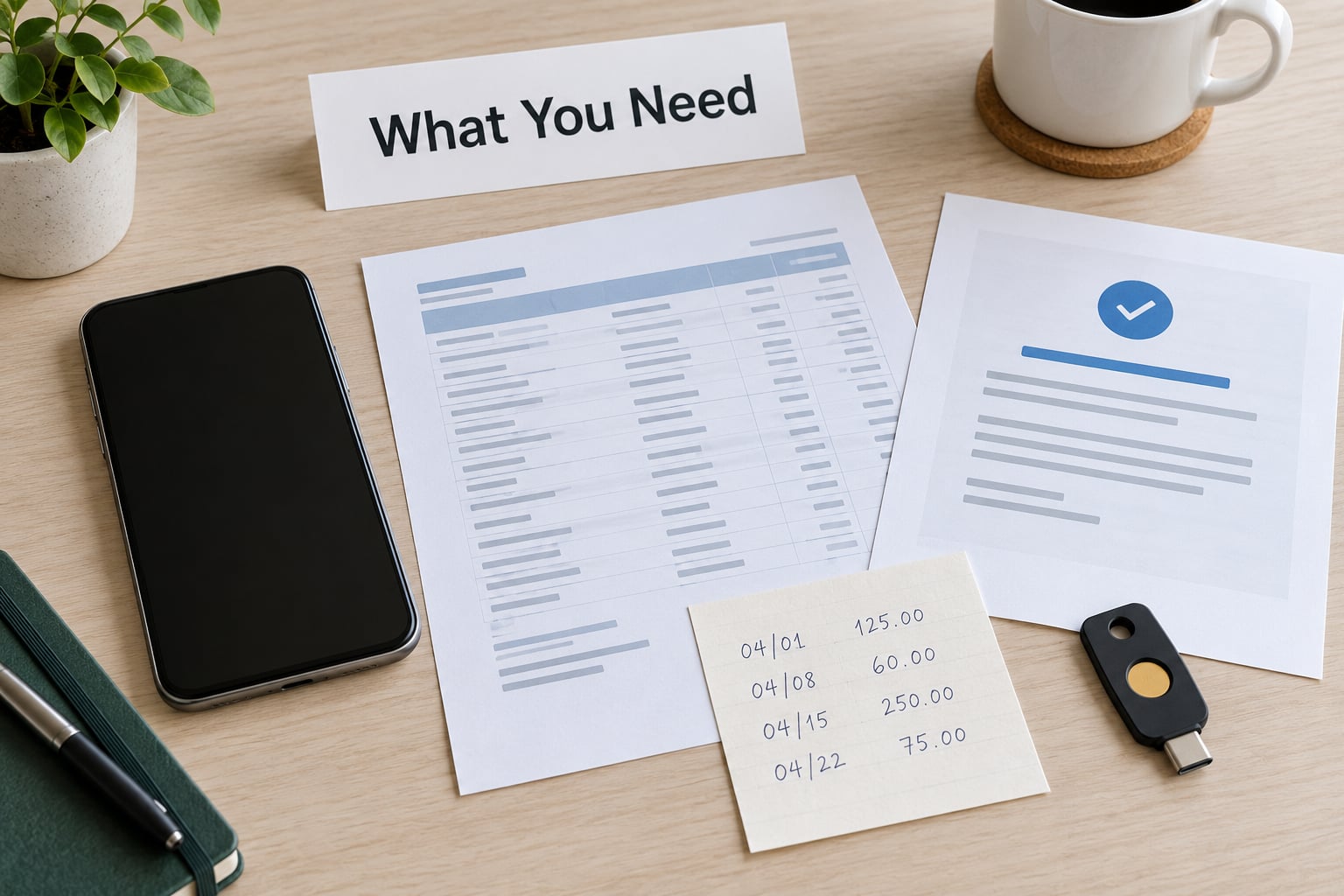
None of this needs to be perfect or complete before you start. Ten minutes of gathering gets you most of the way, and anything you miss now you can go back and pull later.
- The fraud number for whoever moved the money. Most banks have a 24-hour fraud line on the back of the card, and payment apps keep one inside the app under Help or Report a problem.
- Your transaction records. Dates, amounts, confirmation numbers, and the exact recipient details for every transfer, card payment, gift card and crypto transaction. Pull the receipts, not your memory of them.
- Your login details. Bank, email, the dating or social account, and any account that shares a password with one of those. Email is the master key here.
- Identity documents. Copies of whatever you shared with the person: passport or driver license pages, selfie photos, bank statements, utility bills, and any images of your cards.
- Proof of the relationship. The profile link, username, phone number, platform name, and any email address or wallet address they gave you.
- Device details. The phone number they contacted you from, and the device the conversation happened on. These end up in the police report.
- A safe place to store everything. One folder, one drive, one email draft addressed to yourself. Keep it in one place so a copy survives if a device is lost or wiped.
One warning before you go further. Photographing your own documents into a folder is fine. Emailing them, posting them in a group chat, or uploading them to a case file on a site you found in a search ad is not. There are fake case portals built specifically to harvest exactly these files from panicked scam victims.
Step-by-Step
1. Stop Contacting the Scammer Immediately
End the conversation and send nothing else. Not a warning, not an accusation, not a demand for the money back. Arguing gives a practiced manipulator a fresh opening, and most of them escalate the moment a victim pushes back.
Stop payment immediately too. The most dangerous moment in this whole situation is not the first transfer, it is the second. Scammers routinely follow a loss with a demand for a supposed clearance fee, a customs charge, a verification payment, or a refund deposit they insist you have to send before they release your money. Paying again is the single most common way a bad loss becomes a catastrophic one.
Do not delete anything yet. Blocking comes after you have captured the evidence in the next step, because once you block, the profile, the messages and sometimes the payment history vanish with it.
2. Contact Your Bank or Payment Provider Right Away
Call the fraud line for whoever moved the money. Not the general customer service number, not a chat window, not an email. A phone call gets a live case reference number, and that number is what you will need for every complaint you file afterwards.
Your recovery options depend almost entirely on how the money moved, so find your row before you call.
| How you paid | Who to contact | Realistic chance of getting money back |
|---|---|---|
| Bank wire or ACH | Your bank’s fraud line, then the receiving bank | Worth trying inside 72 hours. A wire reported while it is still pending can be frozen. Once it has cleared internationally, recovery is very unlikely. |
| Credit card | The card issuer, using the number on the back of the card | The best odds of any method. Ask about a chargeback under the card network’s rules. Expect questions about why you authorized it. |
| Debit card | Your bank’s fraud line, then the card issuer | Usually treated under the same electronic transfer error rules as an ACH dispute, with a written error notice as a deadline worth protecting. |
| Gift card | The issuer’s fraud line, with the card number, receipt and time of purchase | Worth calling within minutes. Some issuers can freeze an unredeemed card. Once the code is read, it is usually gone. |
| Cryptocurrency | The exchange or wallet provider you sent from, with the transaction hash | Lowest of all. Exchanges can freeze an account that is still on their platform, but a transfer to a wallet they do not control is generally final. |
| Payment apps like Zelle, Venmo or Cash App | Both the app’s in-app report flow and your linked bank | Limited. Fraud reports get considered; a person-to-person transfer you authorized deliberately is treated as final by most of these services. Report anyway. |
| PayPal goods and services | PayPal resolution center | Depends entirely on whether you marked the payment as goods or services. Person-to-person payments have far less protection. |
| Western Union or MoneyGram | The transfer company’s fraud line | Possible only if the money has not been paid out or collected. Minutes matter more than hours here. |
Policies change, and each provider has its own rules, so treat this table as a starting point and ask for the current terms when you call. The honest summary is that most of these payments cannot be reversed. People in scam recovery forums reach the same conclusion, and the most useful action they report taking was calling the fraud line immediately and getting a claim reference number in writing.
Say it plainly when you get through. Something close to this works well:
I made a wire transfer of 4,200 dollars on 12 September to a person I met online on a dating app. I have not stopped the payment yet. I believe the person was using a false identity and I want to request a recall and a freeze, and I need a claim reference number for this call.
Three things to ask for specifically: a recall or reversal request, a hold or freeze on any destination account your bank can reach, and a written case reference number. Write the number down where you will find it again.
If the transfer is cross-border, your bank can sometimes pass a rapid recall request through a national financial intelligence unit. FinCEN runs a Rapid Response Program for this, and it has returned more than a billion dollars in criminal proceeds since 2015. It works on a minority of cases, and the window is short, which is exactly why the first hour matters.
3. Secure Your Financial and Online Accounts
Assume the person you were talking to may have tried to access your accounts. In many cases they ask for a bank’s login or a card number under some pretext, and they may also have tried to register accounts in your name.
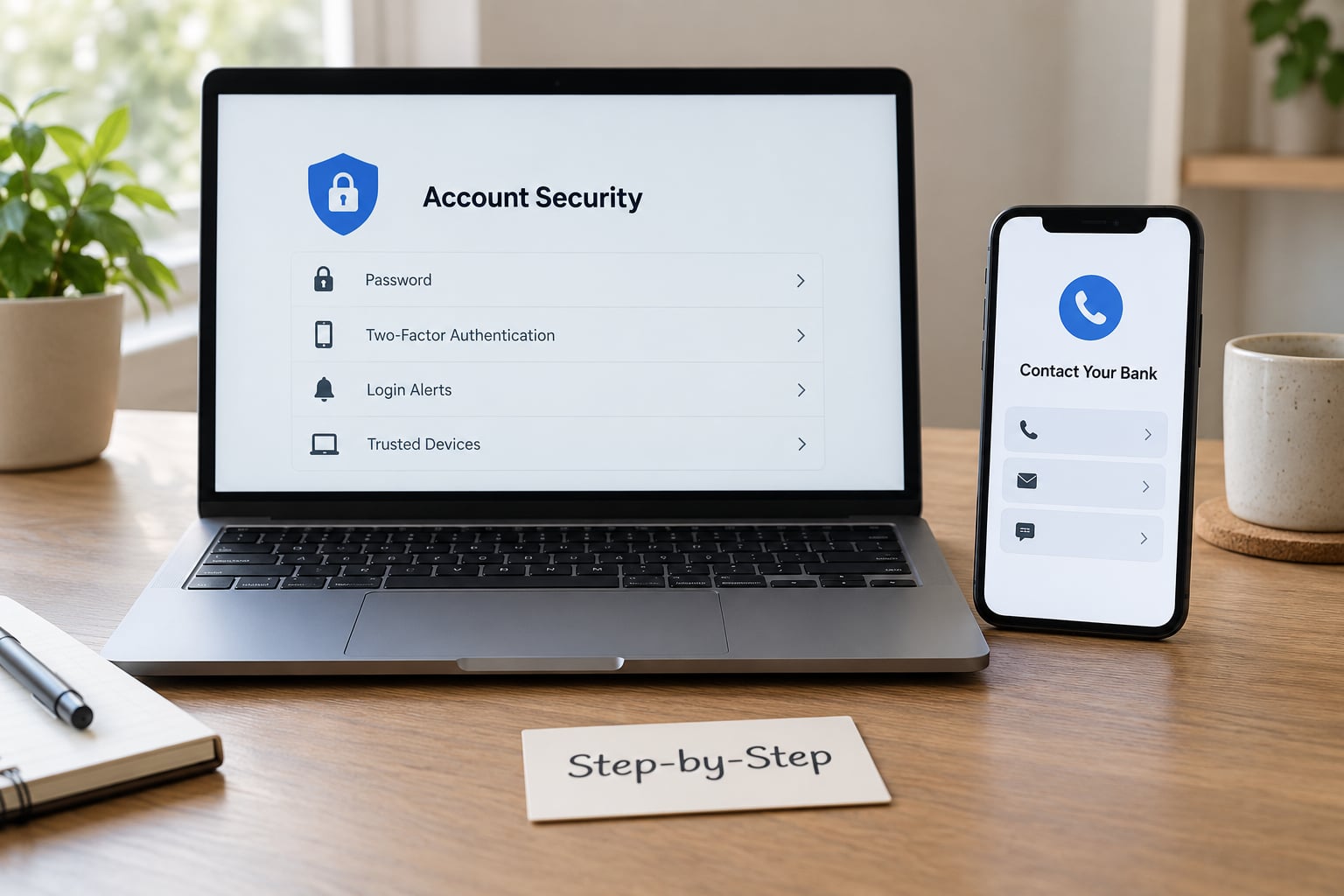
- Change your email password first, because everything else resets through email.
- Change passwords on banking, the dating or social account, and anything sharing a password with those. Make each one unique.
- Turn on two-factor authentication, and use an authenticator app rather than SMS where your accounts offer a choice.
- Review recent logins, changed passwords, new payees and new devices in your banking app. Unknown payees are the giveaway.
- Check your payment apps for linked accounts and linked cards, and remove anything you did not set up.
- Remove saved payment details from the dating or social account and change its password. If that platform offers a login history view, read it.
Then set a calendar reminder for 60 to 90 days out. Scammers often test old credentials months after the conversation ends, and monitoring only helps if it is scheduled rather than left to memory.
4. Preserve Evidence of the Romance Scam
Capture everything before you block, and do it in a way that leaves the original intact. These are the items an investigator or a bank actually uses.
- Full conversation screenshots including the profile picture, username, timestamps and platform name at the top of the screen.
- The profile link and any linked accounts, including handles on other social platforms.
- Phone numbers, email addresses, wallet addresses and payment handles they gave you.
- Bank receipts and confirmations with dates, amounts, reference numbers and recipient names.
- Crypto transaction hashes if you paid in cryptocurrency. These are the blockchain receipt and they are the whole basis of an exchange request.
- Any photos or documents you sent, kept as a list so you know exactly what was exposed.
- Photos you sent that are intimate in nature. Note that these exist and where they were shared. This matters if you are being blackmailed.
- Your own notes in your words, written the same day while the details are fresh.
Work from the original device and screen rather than re-recording or editing anything. Altered screenshots get discounted, and a short phone video scrolling through the messages is often accepted alongside stills. Once you have copies, then block.
5. Report the Scam to the Right Organizations
File everywhere that applies. These bodies do very different things, and none of them will refund you.
- The FBI’s Internet Crime Complaint Center at ic3.gov. File with a full narrative, the loss amount, the dates, the payment method and the scammer’s identifiers. You get an IC3 complaint number. IC3’s Recovery Asset Team works with financial institutions on asset freezing in some cases, mostly on recent wire transfers involving domestic accounts.
- The FTC at reportfraud.ftc.gov. Use ReportFraud.ftc.gov; the FTC does not operate a live consumer phone line, so this is the right channel rather than a call you will never get answered.
- The dating platform or app. Report the profile through the app’s own reporting flow. Platforms feed these into a shared database used to detect repeat scam accounts, and removal protects the next person.
- Local police, if there was an immediate threat, if you were coerced into receiving money, or if you need a police report number. Banks and platforms often ask for one as supporting paperwork even when it does nothing on its own.
- Your state attorney general or consumer protection office, which is useful when a local business or payment provider appears in the chain.
- Outside the United States: file with Action Fraud in the UK, the Canadian Anti-Fraud Centre, Scamwatch in Australia, and your local national police or cybercrime body. You can still file with IC3 as a resident of another country.
Keep every complaint number. Banks ask for them, and the practical value of a report is that it builds the pattern that helps agencies act on the network instead of one victim at a time.
6. Check for Identity Theft and Monitor Your Credit
Most romance scam victims did not hand over their Social Security number, so full identity theft is not the typical outcome. Checking is still worth doing because a percentage of scammers use the details you shared to open accounts, and a freeze costs you nothing.
Pull your credit reports from annualcreditreport.com and read them line by line. Look for accounts you did not open, hard inquiries you did not authorize, and any address listed that is not yours. A first free credit freeze at each of the three bureaus blocks new accounts in your name and does not affect your ability to borrow, though it does affect your own credit checks, so unfreeze temporarily when you apply for something.
If you already sent identity documents, go to IdentityTheft.gov and use the recovery plan there. You will get an affidavit of loss that some institutions accept in place of the original documents you no longer have. Never send a copy of that affidavit to a stranger claiming to be an agency.
7. Replace Exposed Personal Information
Work through what actually left your hands. Where you reused a password anywhere, change it everywhere, not just on the account you think was exposed. Where you sent a card image, call the issuer, confirm the account is still yours, and ask whether a fraud alert can be placed.
Watch your mail for anything you did not expect. Incoming mail at an address you do not recognize, or a sudden notice from an lender about an account you never opened, are the early signals. If a document you sent turns out to be in someone else’s hands, report it to the issuing agency and ask what they need from you to invalidate it.
Your email address is the one to watch most closely. Many of these accounts use the same handle across platforms, so search your own email and your name against the username and phone number they used.
8. Get Emotional Support and Avoid Further Contact
Say out loud what this is, because most people who get here will not: romance scam losses are measured in trust as well as dollars. Victims describe the aftermath honestly in victim forums, and the loneliness and shame show up harder than the money. Scammers are unusually good at this, because the relationship was real to you and entirely manufactured for them.
Tell one person you trust. That single step is the one people most often skip and the one that changes the most. It breaks the secrecy the scam depends on, and it gives you someone to hand the calls to when a recovery agent comes calling.
Two specific situations need their own handling. The first is a request to receive money and pass it onward. If the person asks you to accept funds from someone else and forward part of it, stop and get advice before touching anything. Accepting and forwarding funds makes you the one holding the money, and that is the exact fact pattern that turns a victim into a money mule with real legal exposure.
The second is recovery contact. Within weeks, often within days, you will likely be approached by someone claiming to be an investigator, a lawyer, or a specialist who can get the money back for a fee upfront. Not one of them is real. Real IC3 and FBI staff never call victims, never ask for payment to recover funds, and never need your bank credentials. Anyone who does has simply found a new victim: a secondary victim, and the most painful kind because it takes your money a second time while you are at your lowest.
On support: a therapist, a victim-support group, a faith community, or a national helpline can all help. If you are having thoughts of harming yourself, treat that as an emergency and contact emergency services or the 988 Suicide and Crisis Lifeline in the US and Canada.
Common Mistakes
Every one of these shows up repeatedly in scam recovery threads, and each one costs money or time.
- Paying a second time to recover the first payment. Fees, taxes, customs charges and refund deposits are the standard escalation. The safer response is to stop all payments and read the recovery-scam warning above.
- Deleting the messages before copying them. You lose the transaction history, the profile details and the timestamps you will be asked for. Capture first, block second.
- Arguing or threatening the scammer. It rarely produces money and sometimes produces doxxing, harassment or threats involving your photos. Block, report, disengage.
- Paying an upfront fee to a recovery agent. Any agency that guarantees recovery of scam funds for a fee in advance is running a recovery scam. Real recovery is rare, slow and never for sale.
- Posting your documents or report details online in exchange for advice. Public advice from strangers is fine. Uploading your passport, statements or a case number is not.
- Waiting until you are ready to make the calls. Shame is the reason many people wait days, and days is exactly how the wire recall window closes. Make the calls before you have processed anything.
- Assuming a payment app means there is nothing to do. Reports to payment apps and linked banks do get reviewed. Silence guarantees nothing; a report costs you fifteen minutes.
- Assuming the loss is tax deductible. Scam losses generally are not deductible as a casualty loss, and if you withdrew retirement money to pay, that withdrawal is still a taxable event. A local tax professional can check your specific situation, which is worth one consultation before tax season.
Frequently Asked Questions
How long do I have to report a wire transfer fraud?
Call your bank’s fraud line immediately, because a wire reported while it is still pending can sometimes be frozen or recalled. The practical window people hear cited is around 72 hours, and after the money clears an international correspondent bank recovery becomes very unlikely. Same-day reporting is the only window that reliably matters. Ask for a recall request, a freeze on any reachable destination account, and a written claim reference number in one call.
Can I get my money back if I sent it to a romance scammer?
Sometimes, depending entirely on the payment method. Credit card chargebacks have the strongest consumer protections, unredeemed gift cards can sometimes be frozen, and wires reported within hours can occasionally be recalled. Person-to-person payment apps treat authorized transfers as final, and cryptocurrency sent to a wallet the exchange does not control is usually gone. Call whoever moved the money before anything else, and set your expectations honestly.
I paid with Zelle, Venmo or Cash App. Can that be reversed?
Rarely. These services treat person-to-person payments you personally authorized as final transfers, so there is no chargeback right like there is with a credit card. That does not mean you should skip reporting. File through the app’s in-app report flow and notify your linked bank, because funds still sitting in an account can sometimes be frozen and reports contribute to the pattern used against repeat accounts. Write down the case numbers you receive.
What if I paid in cryptocurrency or with gift cards?
Report it anyway, quickly and in the right place. For gift cards, call the issuer’s fraud line with the card number, the receipt and the exact time of purchase, because some issuers can freeze a card that has not been redeemed yet. For cryptocurrency, contact the exchange you sent from and give them the transaction hash, since only they can act on funds still inside a platform they control. A transfer to an outside wallet is usually final.
Does reporting to IC3 or the FTC actually get my money back?
No. The FTC does not refund anyone, and IC3 does not investigate individual cases or hand out money. Neither sends status updates on a specific complaint either, which is the honest limit of both. Reporting still matters: it feeds the law enforcement picture, it supports asset freezing in some recent wire cases, and it builds the pattern used against the network. Report the profile on the dating platform too, since that protects the next person and produces removal.
What if someone offers to recover my money for me?
Treat any offer of recovery as a scam in itself. Real IC3 and FBI staff never contact victims directly, never charge a fee to release recovered funds, and never ask for your bank login. Anyone who does is a secondary victim targeting you precisely because you have just been scammed, usually within days. Do not send an upfront fee, do not share credentials, and do not meet anyone who claims government authority. Walk away and keep reporting to the legitimate agencies.
Conclusion
Three things matter most, and the order matters. Stop all contact and stop sending anything, including a supposed fee to unlock the first payment. Call whoever moved the money the same day and ask for a recall, a freeze and a case reference number. Then capture the evidence, secure your email and banking accounts, and file with the bank, IC3, the FTC and the dating platform.
Most of these payments cannot be reversed, and any article promising you a refund is either wrong or selling something. Reporting quickly still improves your odds, protects the next person from the same profile, and gives law enforcement something to work with. Doing all of it in the first 24 hours is achievable, even on the worst day of your life.
Agency process details checked against agency guidance in October 2026. Rules, deadlines and provider policies change, so confirm current terms when you call.