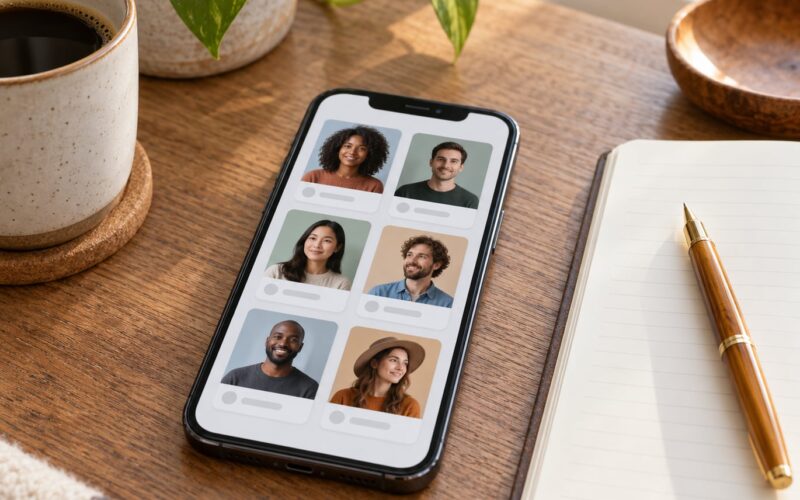
Yes, but never as your main photo. Whether you use group photos on a dating profile depends on one thing: is anyone able to tell who you are in half a second? Put one group photo in the last third of your set, make yourself the obvious focal point, and ask everyone in the frame before you upload it.
That is the whole argument. Dating apps show your first photo at the largest size while someone is deciding whether to swipe, and that decision happens faster than you can read a sentence. Later slots get opened deliberately, on purpose, by someone who already decided you were worth a look.
The forum consensus lines up with that. In the r/Bumble and r/OnlineDating threads on this, the repeated line is blunt: people swipe left when the first picture is a group, because they cannot tell who they are swiping on. Once the same threads get to later slots, the mood changes. A group shot at the back is read as proof that you have a life.
Table of Contents→
- Should You Use Group Photos on a Dating Profile?
- When Do Group Photos Work on a Dating Profile?
- What Makes a Good Group Photo for a Dating Profile?
- Should Your Main Photo Be a Group Photo?
- Group Photos vs. Solo Photos for Dating Profiles
- How to Make a Group Photo Easier to Evaluate
- Common Group Photo Mistakes to Avoid
- What Photo Mix Works Best on a Dating Profile?
- Frequently Asked Questions
- Are group photos good for dating profiles?
- Should a group photo be the first photo on my dating profile?
- How do I know which person I am in a group photo?
- Can I use a group photo if I am not the main focus?
- What if my friends look better than me in the group photo?
- How many solo and group photos should I use?
- Bottom Line, One Group Photo in the Back Half
Should You Use Group Photos on a Dating Profile?
The direct answer, in five rules you can act on tonight:
- Never slot one. Your main photo is a solo shot of your face, shoulders in, mid-frame, recent. No exceptions to this rule, including the group photo you genuinely love.
- Keep exactly one, placed in the back half. With five or six photos, slot five or six is the safe spot. A second group photo adds nothing new and starts to look repetitive.
- Be the focal point. Front, centre, closest to the camera, or clearly separated by height or position. If a stranger would hesitate, skip the photo.
- Cut anyone your date would ask about. Exes, exes’ partners, your boss, anyone whose presence sends you into a paragraph of explanation. Blurring a face does not fix the body standing next to you.
- Ask first. A text asking permission takes thirty seconds. Posting without it is the one genuinely irreversible mistake in this whole guide.
Break those five and the answer flips to no. Keep them and one group photo is probably the most efficient image in your set, because it does the job of three solo portraits at once: it shows context, personality and proof of a social life.
When Do Group Photos Work on a Dating Profile?
A group photo earns its slot when it shows something a solo portrait cannot. The best ones capture an activity, a relationship or a place that explains how you spend your Saturdays.
Shared activity is the strongest version. Cooking for four people, a climbing wall, a run club finish line, six friends around a table with plates in the middle. The eye reads it in a beat: here is what this person does on a Tuesday.
Family photos work differently and they work well, provided the framing is unambiguous. A photo of you with a parent or sibling tells someone you are close to your family, which is real information about long-term compatibility. On Hinge, where prompts invite questions about family and upbringing, this travels well.
Children and pets add warmth and signal caregiving, though a photo of you buried behind three children is a bad photo regardless of how much you love them. Frame it so your face is the largest thing in it.
Travel and event shots work when the place is doing the talking. A beach, a mountain, a wedding where you are laughing with three people. Skip the photos where the location is more memorable than your face, because that is what people remember.
Why people swipe past group photos on a dating profile
Three reasons come up over and over. First, the identification problem: the swipe is a visual search, and a group photo turns it into a puzzle. Second, attention theft: the eye lands on the most conventionally attractive person in the frame, which is rarely the profile owner. Third, the context read: a night out, a wedding with an ex in it, a christening from a few years back, all of which raise questions the profile cannot answer in a bio.
None of that is a problem when the photo sits in slot five. By then the person already knows you are you, and the shot gets to do what it is good at instead of what it is bad at.
How Hinge, Bumble and Tinder handle your photo order
The advice generalises well across apps, but the mechanics differ.
Hinge shows roughly six photos, with the first appearing largest and the rest in a scrollable row underneath. Hinge users browse prompts as much as photos, so a group photo in the back half reads as one more layer of personality rather than a hurdle.
Bumble shows photos in a row and profiles tend to run four to six images. Because the first image is the one visible before any scrolling, the same rule applies without exception.
Tinder runs one key photo at scale, with additional photos revealed only when someone opens the profile. That makes the group photo decision simpler in one way, since the main photo carries everything, and stricter in another, since there is no scroll to save you.
What Makes a Good Group Photo for a Dating Profile?
Six criteria separate the shots that work from the shots people scroll past.
| What to check | Strong group photo | Weak group photo |
|---|---|---|
| Recency | Taken within the last year | Four-year-old holiday snap you keep re-using |
| Face visibility | Your face is unobstructed and unblurred | Turned away, sunglasses on, mid-laugh with a hand over your mouth |
| Focal point | Front, centre, or clearly nearest the camera | Background row, partly hidden, same size as everyone else |
| Background | Simple, uncluttered, recognisable place | Blur, clutter, or a wall of unreadable signage |
| Expression | Genuine smile or a natural, engaged look | Stiff, mid-blink, or mid-shout at a party |
| Who’s in frame | Friends who support the picture’s story | An ex, an ex’s partner, a colleague, nine strangers |
Lighting beats resolution every time. A phone shot in open shade at a park will outperform a high-resolution image taken in a dim bar, because the app’s grid compresses everything and faces in bad light disappear first.
Sharpness matters too. If the group photo is soft, cut it. A slightly soft solo shot is forgivable; a soft group photo reads as an old photo, which sends the reader back to the recency problem.
Should Your Main Photo Be a Group Photo?
No. Your main photo should be a solo shot where your face is the first thing in the frame, not the second or third.
The reason is mechanical. The main photo is the thumbnail used in the discovery grid, the card in search results, and the image shown to someone already deciding about you. At that size, a group of five becomes four indistinct faces. Users describe the reaction consistently as an instant swipe, and no amount of good prompt text or bio recovers a swipe that never happened.
There is a second reason people get this wrong. A group photo feels more fun and more like you at your best, so it goes first. That instinct is about how you want to be seen rather than how you are being evaluated, which is worth noticing before you build any profile at all.
The exception is narrow. If you have no recent solo photo worth using, a group photo in slot one beats a profile with a blurry bathroom mirror selfie in slot one. But fix that before launch rather than after; taking a fresh solo photo takes five minutes with a friend and a window.
Group Photos vs. Solo Photos for Dating Profiles
Neither type wins outright. They do different jobs, and the answer depends on which job the photo has to do.
| Criterion | Solo photo | Group photo |
|---|---|---|
| Identifiability | Instant | Requires a beat of effort |
| Shows personality | Limited to expression and styling | Strong, through context and interaction |
| Shows appearance clearly | Best possible | Depends entirely on the framing |
| Conversation starter | Few obvious hooks | Built-in questions about the occasion, place or people |
| Signals a social life | No | Yes, when the shot is clear |
| Serious-intent signal | Clean and neutral | Depends on who else appears |
Read that table as a job description. Slot one is an identification task, and solo photos win it. Slot four onward is an invitation task, and group photos win it there. Dating coaches tend to land on the same mix: a smiling headshot, an outdoor shot, one full-body, one doing something you love, one social.
If you only take one piece of advice from the whole set, take that one. Most profiles that look flat online are not missing more photos, they are the same photo five times.
How to Make a Group Photo Easier to Evaluate
Most problems with an existing group photo are framing problems, and framing is fixable without changing a single thing about your appearance.
- Crop to three people or fewer. A frame of two or three keeps faces large enough to read in a thumbnail. Crop in from the original file rather than from the version already compressed by another app.
- Place yourself at one edge or the centre. Edge placement works well because it reads as intentional rather than accidental. Centre works too, as long as nobody is closer to the lens than you are.
- Use the original, not the forwarded copy. If a friend sent it through a messaging app, ask for the full-size original. Compression is the usual reason a group photo looks muddy.
- Straighten and lift shadows only. Crop, exposure, white balance. Skip anything that changes a face, and skip sharpening that adds halos around cheeks.
- Blur faces sparingly. Blurring one face in a photo of six looks worse than not blurring anyone. If you need to hide two or more people, drop the photo.
- Test the thumbnail. Shrink it until it is thumbnail-sized and look at it. If you hesitate, they will too.
On filters: a light touch is fine, heavy retouching is not. If you would not send the same version to someone you already know, do not upload it. AI-generated or heavily enhanced group images are a bad bet, because the mismatch between the photo and the person on the date is exactly the kind of thing people describe as a red flag in dating advice forums.
Common Group Photo Mistakes to Avoid
You are in the back row. The fix is to crop or to find a different frame from the same day. If the only version has you in the background, that is the wrong photo.
The photo contains an ex. More common than people admit, especially for people who have just come out of a relationship and are reusing old photos. Cut it. Cropping so the ex is half out of frame reads as avoidance, and an ex’s new partner in the frame reads worse than either.
Someone else looks better than you. Straightforward advice: choose the shot where they do not. If that leaves you nothing, take a new photo. This is the objection that comes up most often in advice threads, and the honest answer is that no crop fixes it.
Party shots, night shots, and blurred faces. Low light, motion blur, drinks in hand. It signals a night out, which may be fine, but it is not the image that earns a conversation.
A crowd of twelve. Everyone in the background becomes noise, and you shrink. Six is already pushing it. Three is comfortable.
Very old photos dressed up as current ones. Group photos from a few years ago are the hardest to catch, because the picture is sharp and recent-looking. The giveaway for a matcher is the hair, the shirts, or the fact that everyone in it looks exactly as they did then.
Posting without asking. Everyone in the frame gave you permission to be photographed, not permission to be profiled. This is the one mistake with real consequences rather than just fewer matches.
What Photo Mix Works Best on a Dating Profile?
A six-photo set gives you room for one group shot without crowding it out. Here is an order that works on Hinge, Bumble and Tinder alike.
- Slot one: smiling headshot. Shoulders in, mid-frame, natural light, no sunglasses, no hat, recent. This photo does the identification work.
- Slot two: full-body shot. Standing, relaxed, in ordinary clothes. This one answers the question people actually ask about a first date, which is what you look like in a normal outfit.
- Slot three: activity photo. Cooking, hiking, playing something, fixing something. A solo version if you have one; this slot is where a hobby shows rather than a face.
- Slot four: a second look. A different outfit, a different location, a candid that reads as relaxed. Variety keeps a profile from looking like one good afternoon.
- Slot five: the group photo. One only. Clear focal point, recent, no ex, everyone having a decent time.
- Slot six: optional extra. A pet, a landscape with you small in it, or a second social shot if the first one was group-based.
If you only have four photos, drop slot four and keep the group shot. Four good photos beat six padded ones.
One last practical note on dating profile photo order: apps reward profiles that get opened, and profiles get opened because the first photo was clear. The rest of the set determines whether a conversation happens. Order your photos around that split, and the group photo question answers itself.
Frequently Asked Questions
Are group photos good for dating profiles?
Yes, as a supporting photo. A group image communicates sociability, context and personality faster than a solo portrait can, and it gives someone an easy opening question. It works best in slot five or six of a five or six photo set, where you are already the clear focal point and the viewer knows who they are looking at.
Should a group photo be the first photo on my dating profile?
No. The first photo is shown at the largest size and gets judged in a fraction of a second, so it has one job: making it obvious who the profile belongs to. Users say repeatedly that a group shot in slot one triggers an instant swipe because they cannot tell which person they are swiping on. Keep it in the back half instead.
How do I know which person I am in a group photo?
You may not, and that is the answer. Shrink the image to thumbnail size and check. If you hesitate for a second, your viewers will too. The same test rules out photos where you are in the back row, partly hidden, blurred, or smaller than the people beside you. If nothing in the set passes that test, it is not a dating profile photo yet.
Can I use a group photo if I am not the main focus?
You can, but only if you are still findable. Front or centre, closest to the camera, or clearly separated by height or position all work. Being one face among twelve in the back does not. Cropping is a fair fix when you can cut the frame down to three or four people and still read your own face at thumbnail size. Otherwise drop the photo.
What if my friends look better than me in the group photo?
Then use a different group photo, or take a new one. This is the most common objection in dating advice threads and no editing trick solves it, because cropping someone out of a moment you shared is obvious and blurring one face among several looks worse than not blurring anyone. Choose the shot where you are at your best, not the one where you are most comfortable.
How many solo and group photos should I use?
Four to six photos total works best, with one group photo. Five solo photos and one group photo is a good balance, as is four photos with the group shot in the last slot. A second group photo rarely adds new information and makes a set feel repetitive. If you only have four strong photos, use them rather than padding to six.
Bottom Line, One Group Photo in the Back Half
Do not make group photos the centrepiece of your dating profile. Use exactly one, place it fifth or sixth, check that your own face is the first one the eye finds, and ask everyone in the frame for permission before you upload.
Start with slot one. Replace it with a recent solo shot of your face in natural light this week, then check whether you already have a group photo worth keeping. Most people do, and most people have it in the wrong place.