
The texting mistakes that kill attraction are usually quiet ones: chasing a reply that isn’t coming, replying in one word, treating every chat like a job interview, and reading slow responses as rejection. Nothing dramatic happens. The conversation just quietly dies, and you’re left wondering what you did wrong.
Most of the time, it isn’t charm or looks that sank it. It was anxiety showing up in your thumbs. I’ve watched the exact same person get a date after a rewrite and go silent after the old version, and the difference was almost always how much pressure the messages carried.
This guide, updated for 2026, covers twelve patterns, the signal each one may send, and a realistic replacement you can copy today. It’s written for everyone, regardless of gender, because both sides of a text thread mess this up in the same ways.
Table of Contents→
- Texting Mistakes That Kill Attraction at a Glance
- 1. Sending Double or Triple Texts Without a Reply
- 2. Turning Every Question Into an Interview
- 3. Texting Like You Already Have a Relationship
- 4. Overthinking Every Delayed Reply
- 5. Sending Walls of Text
- 6. Using Negativity, Criticism, or Pessimism Early On
- 7. Playing Hard to Get or Competing for Attention
- 8. Disagreeing With Everything They Say
- 9. Bringing Up Heavy Topics Too Soon
- 10. Ignoring Context, Boundaries, or Cues
- 11. Being Too Vague or Giving One-Word Answers
- 12. Disappearing After a Good Conversation
- Frequently Asked Questions
- Conclusion
Texting Mistakes That Kill Attraction at a Glance
| Mistake | What it may signal | Quick fix |
|---|---|---|
| Double or triple texting | Anxiety, not interest | One follow-up with something new, then wait |
| Interview questions | Demanding, one-sided | Share something about yourself first |
| Texting like a couple already | Pressure, no buildup | Match the pace they set |
| Overthinking reply delays | Negativity and anxious energy | Judge the pattern, not the pause |
| Walls of text | Heavy, hard to answer | Two or three sentences max |
| Negativity and criticism | Emotional weight | Be neutral or funny instead |
| Playing hard to get | A game, not sincerity | Show real interest plainly |
| Disagreeing with everything | Ego over curiosity | Ask why before correcting |
| Heavy topics too soon | Burden, oversharing | Share gradually, ask first |
| Ignoring cues and boundaries | Not listening | Read the room, then pause |
| One-word answers | Boredom or disinterest | Add a detail or reaction |
| Vanishing after a good chat | No intent to meet | Name the next step |
1. Sending Double or Triple Texts Without a Reply
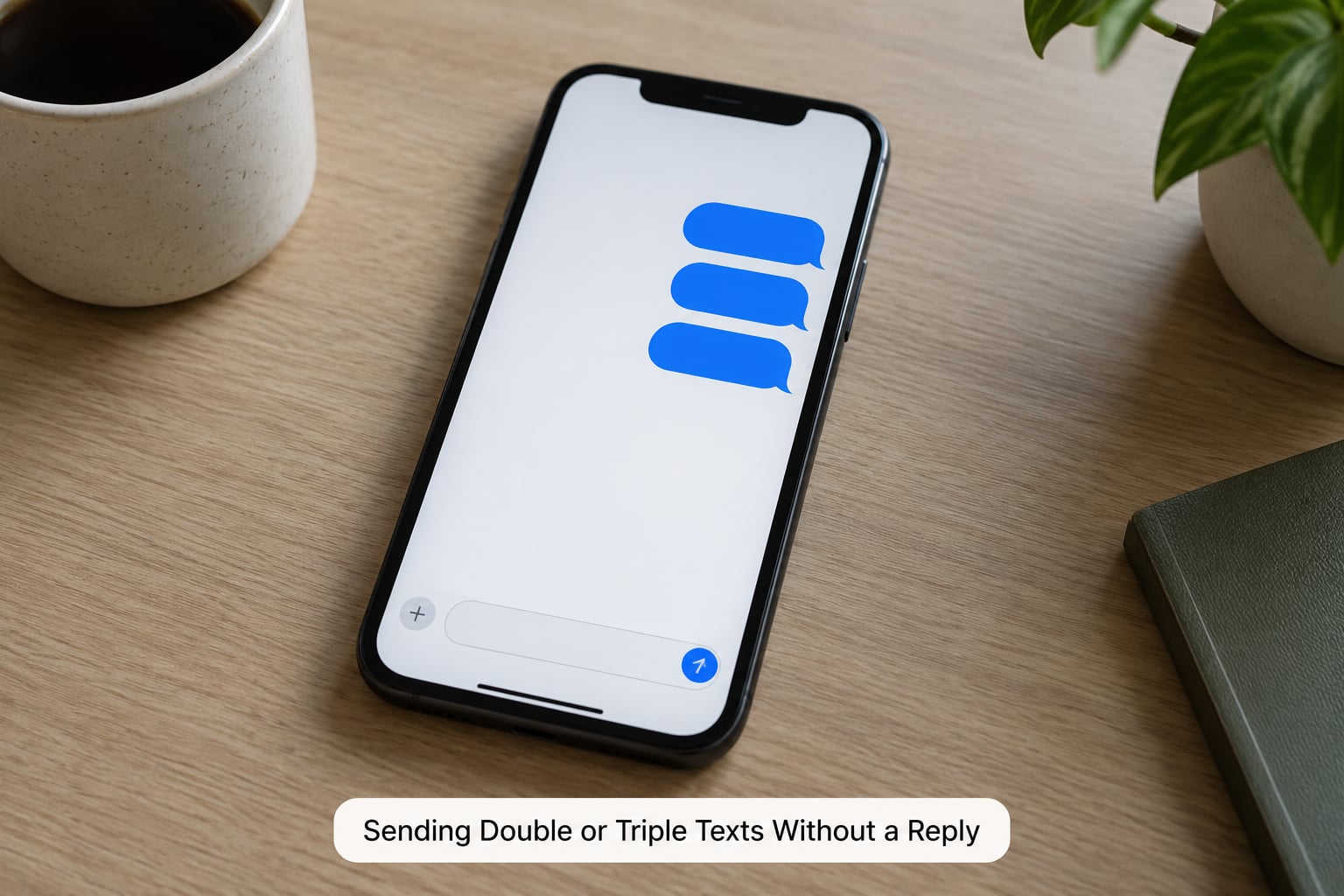
The second and third message after silence is where a lot of interest quietly dies. One unanswered message is a fact. Two more usually turn it into a problem you are asking someone to solve for you.
What makes it land badly isn’t the words, it’s the pressure. “Okay” and “hello?” after four hours of quiet reads as bookkeeping. The other person now has a small obligation hanging over them, and most people respond to that by withdrawing.
It feels different from the sender’s side, which is worth sitting with. Waiting feels like a series of small rejections, so the second message tries to fix a feeling rather than advance a conversation. That intention is obvious to the reader and completely invisible to the sender.
When a follow-up is actually fine
There are reasonable cases for messaging again. You asked a direct question and it got buried under other texts. You had a concrete plan in the air, like confirming Saturday coffee. Or several days passed and you have something genuinely new, not just a reminder that you exist.
Keep it to one message. Give it context so it does not read as a demand for attention, then let it sit.
Instead of “Hey”, “You there?”, “Did I do something wrong?”, try: “That Thai place you mentioned is the one with the green door, right? I want to get there before the weekend crowd.”
That version tells them you were listening, moves the conversation forward, and gives them an easy thing to answer. It also sounds like someone with plans, which is more attractive than someone with feelings about a silence.
People ask about this all the time, so here is the direct answer: the 3 text rule is an informal texting guideline that says you shouldn’t send more than three messages in a row without getting a reply. It’s a loose social convention, not a law. One follow-up with new content is fine. Three unanswered messages in a row usually is not.
The rule exists for a practical reason rather than a romantic one. Unanswered messages create a decision for the other person, and unflattering ones. They either reply, which they may not want to do, or they ignore you again, which starts to feel like a chore. Neither option feels good, so many people just drift.
A couple of real cases where double texting is completely fine: they asked you something and you genuinely need the answer, or you already had one date planned and a detail changed. A message that carries information isn’t chasing. A message that carries feelings about a silence is.
Read receipts make this harder than it used to be. The knowledge that someone saw your message and chose not to answer is genuinely uncomfortable, and it’s why the third text so often sounds accusatory. Turning read receipts off is a small thing that removes a lot of pressure from both sides.
2. Turning Every Question Into an Interview
When every message from you is a question, the chat stops being a conversation and starts being a screening process. Questions demand answers. Answers get short. Short answers feel dry. And then you conclude the other person is a dry texter.
Look at a typical exchange. What do you do for work? How long have you lived there? Do you have siblings? Where did you go to school? Each question is fine alone. Stacked together, they ask someone to prove they’re interesting before you’ve given them a single reason to be interested.
The fix is reciprocity. Answer your own questions before you ask them, and turn some of them into statements that invite a response without demanding one.
Instead of “Where did you go to school?”, try: “I went to a tiny college in Ohio where nobody had ever heard of it. I picked it for the mascot, which tells you what my priorities were at 18.”
That does more work. It gives them something to tease you about, react to, or ask a follow-up on, and they can do it without feeling tested. Keep roughly a one-to-one ratio: something you share, then something you ask.
There is one exception worth making. If they are answering you well, opening up, and asking things back, you can ask a couple of questions in a row without breaking anything. Interviews only happen when the ratio is one-sided, and one-sided is easy to spot after four messages.
The other half of the fix is reacting to what they give you. They mention a stressful week, and you answer with a question about their job. They send a photo of a dog, and you send a question about your job. The question could be identical and land completely differently.
This is one of the texting mistakes that kill attraction fastest because it cannot be repaired by being charming later. The whole thread starts to feel like a form to fill out.
3. Texting Like You Already Have a Relationship
Premature intimacy is a confidence trick that doesn’t work. Pet names, plans you haven’t made, or messages that assume you’ll see each other that night all signal that you’ve skipped the part where attraction is supposed to build.
The underlying belief is usually that showing how much you like someone makes them like you more. It works occasionally. Mostly it makes them feel watched, because every reply now carries a question: do they still want this, and did I set it up wrong by replying?
It also shows up as constant availability. Replying instantly at every hour, narrating your day whether or not you were asked, treating every spare minute as evidence of your interest. People read that pattern one way: no life, no other options, a lot of pressure.
Slow down to roughly the pace they set. If they write two messages a day, two messages a day is plenty. If they write at midnight, you don’t have to be there at midnight.
The over-familiar version is easy to spot. Texting someone you met on Hinge like you’ve shared a kitchen for six years skips the small courtesies that make early conversations feel safe. “Miss you” lands differently after two weeks than after two years, and nobody misses a person they met last Tuesday.
Nicknames are the exception that proves the rule. A nickname they gave you, or one you earned by being funny for three weeks, is inside the joke. A nickname you assigned yourself on day two is a declaration of intimacy you haven’t earned, and it’s hard to walk back.
The same goes for logistics you haven’t earned. Sending detailed overnight plans the night after meeting, or texting goodnight every night for a week, builds a routine faster than either person can sustain. You’ll find the thread feels obligatory on a day when you’d rather have stayed home.
Being a little warmer than comfortable is attractive. Being a lot warmer than comfortable is just pressure with better branding.
Emoji use follows the same logic. A few, placed with the joke, read as tone and warmth. A string of seven faces on a two-line message reads as nervous energy, and used as a substitute for actual content it makes you look like you had nothing to say. There’s no fixed number. Look at whether they use them, and match roughly.
4. Overthinking Every Delayed Reply
Response time is one of the worst measures of interest there is, and it is the one most people check first. A six-hour gap on a weeknight means almost nothing. People work, study, sleep, drive, and put their phone in a drawer.
The spiral is predictable and worth naming. Silence arrives, you check the timestamp, you check it again, you draft three replies, you decide the first one sounded needy, and by the time you send anything the message is about proving you’re not bothered rather than saying the thing you meant.
What the delay tells you is close to nothing on its own. What the pattern tells you is plenty: who starts every conversation, who carries the questions, who writes paragraphs in reply to one-word answers. That’s the signal worth reading.
On r/dating_advice, one woman described six dates in three weeks with a man who was warm in person and nearly silent by text. She’d met his friends and still couldn’t tell if he liked her. The community read it back to her the same way: judge the pattern, not the single text. Busy people, bad texters, and people who just prefer calling all look identical in one message thread.
Common consensus in those threads is that when you notice you always start it, always ask, and always chase, that’s the moment to stop and let the other person carry a conversation for once.
Sorting the three explanations is easier than people think. A busy person still answers eventually, and they sound like themselves when they do. A bad texter sends short messages but shows up when you make plans. Someone who isn’t interested sends short messages and doesn’t show up. Only the first two are texting problems, and only the first two are fixable by you.
The 72-hour rule for texting is the matching piece of folk wisdom: it suggests waiting about three days before following up after a conversation dies out. Like the 3 text rule, it’s a rough social signal rather than a rule with evidence behind it. Three days is a reasonable ceiling for a casual re-open, not a deadline you should count down to.
5. Sending Walls of Text
A seven-paragraph message is hard to answer. It asks the other person to react to your mood, your story, your opinions, and your punctuation all at once, and most people pick the easiest option, which is silence.
There’s also an impression problem. Long unprompted messages read as intense, and intensity early on reads as pressure. A message that runs four lines for a simple question can make someone feel like they’re being studied.
Trim to the part that matters most and let the rest wait. Short doesn’t mean cold.
Instead of a full recap of your day, your work stress, and your feelings about your roommate, try: “Long day, the good kind. My roommate tried to cook and we now own four new smoke detectors.”
You kept the voice, kept the detail, and made it easy to reply. Length should roughly match theirs when you’re unsure. Short replies to long messages are data, not rudeness.
There’s a useful test before you hit send: could someone answer this in one line without doing you a disservice? If no, it’s too long. A message that needs paragraphs to address will go unread, and unread is the same as not sent.
Long messages also expose you. Every paragraph is another chance to say something slightly off, over-share, or invite a correction you didn’t ask for. Three sentences leave room for them to add something of their own.
6. Using Negativity, Criticism, or Pessimism Early On
Complaints about strangers, cynical takes on other people, and a running scorecard of everyone who’s wrong with your life all read as emotional weight in a very light context. You met this person three days ago and you’re sending them your landlord problems.
Complaining isn’t the problem itself. Timing and target are. A complaint shared with humor reads as warmth and self-awareness. A complaint aimed at the person you’re talking to, their friends, or their hometown reads as a warning.
Negativity aimed outward at yourself gets judged hardest of all. Self-deprecation that’s obviously a bid for reassurance asks the other person to comfort you while they’re still deciding whether they like you.
Try converting the same energy into something lighter. Instead of “Everyone at my job is so useless, I might quit”, try “My team has decided meetings are the only way to say good morning, so we’re all just getting along about it.”
Same complaint, same information, entirely different signal. This is one of the texting mistakes that kill attraction because early conversations are supposed to feel like relief from other people’s problems, not a preview of them.
Bragging hides in the same neighbourhood. Listing accomplishments, dropping the car model or the salary bracket unprompted, or announcing that you’re “not really a casual person” reads as a sales pitch to someone who hasn’t asked for one. Let them be impressed by the size of your life instead. That’s easier than it sounds, and it works better.
7. Playing Hard to Get or Competing for Attention
Artificial scarcity is the most obvious tell in online dating. Hinting at other dates when there aren’t any, disappearing on purpose, or delivering a compliment so backhanded it barely qualifies all say the same thing: I’m managing your impression of me.
Sincere interest is more attractive than the performance of restraint. Saying you’d genuinely like to see someone again is not desperate. It’s just accurate, and it saves everyone a lot of guessing.
The reason games fail is that they’re legible. Once someone sees the delay is scheduled, every earlier message gets re-read as a script. It retroactively flattens the whole conversation, including the parts that were real.
You can be interested without being available. One clear message saying you’d enjoy doing something, sent once, leaves plenty of room for them to meet you half way.
This is worth separating from the advice to play it cool, because they’re opposites. Play it cool is about hiding what you want so you can’t be hurt. Being direct is about saying what you want and letting the other person decide. The first protects you. The second respects them, and it’s the one that builds something.
Instead of waiting three days to answer “I’d love that”, try: “Yes, definitely. Thursday or Sunday both work for me.”
Confidence here is about knowing what you want and saying it plainly. It’s not about manufacturing scarcity.
8. Disagreeing With Everything They Say
Reflexive contradiction turns a conversation into a debate nobody signed up for. Correcting their film opinion, arguing with a restaurant take, or adding “well actually” to most of what they type is a fast route to being tiring.
Disagreement early on reads as a contest, and contests are a terrible way to build intimacy. Curiosity does the same work without the friction, and people can tell which one you’re doing.
Ask before you correct. What made you like that one? Have you been? That’s a question, not a verdict, and it opens a door instead of slamming it.
You can also agree partially and add something. “Oh I’ve never tried that, is it actually good?” gets you a real answer. “No that’s terrible” gets you a debate, and probably a shorter next message.
Real differences are fine. Attraction isn’t built on agreement, it’s built on feeling like the other person can say something without getting dismantled. If your texting mistakes that kill attraction list includes winning, you might notice the thread gets shorter every time you’re right.
9. Bringing Up Heavy Topics Too Soon
Trauma dumps, money complaints, ex stories, and relationship history belong to later conversations, and “later” is usually a lot later than people think. Depth is attractive. A weight you haven’t agreed to carry is not.
The ex conversation is the most common version. Describing a past partner in detail, listing what they did wrong, or using them as a punchline turns someone you just met into an audience for a story they had no part in.
There’s a simple test for whether something is too soon: would you say it out loud on a first date, in a public place, to someone you’re still getting to know? If not, it doesn’t belong in a text thread yet.
When heavy stuff is genuinely part of you, share it small and let them ask for more. “Work has been rough this year” is an opening. The other person decides whether to go deeper. That gives them control, which is exactly what you want.
Good timing isn’t about hiding who you are. It’s about letting people opt into depth instead of getting handed it.
Money deserves its own note, because it gets treated casually in a way that isn’t casual at all. Salary, debt, and rent are tied to security, and people don’t think about that when they’re enjoying a new conversation. Save the specifics for someone you’re actually dating.
Commitment talk has the same issue in reverse. Saying “we should do this again soon” on a first date puts pressure on a relationship that hasn’t been defined yet, and it usually lands as an assumption rather than a compliment.
10. Ignoring Context, Boundaries, or Cues
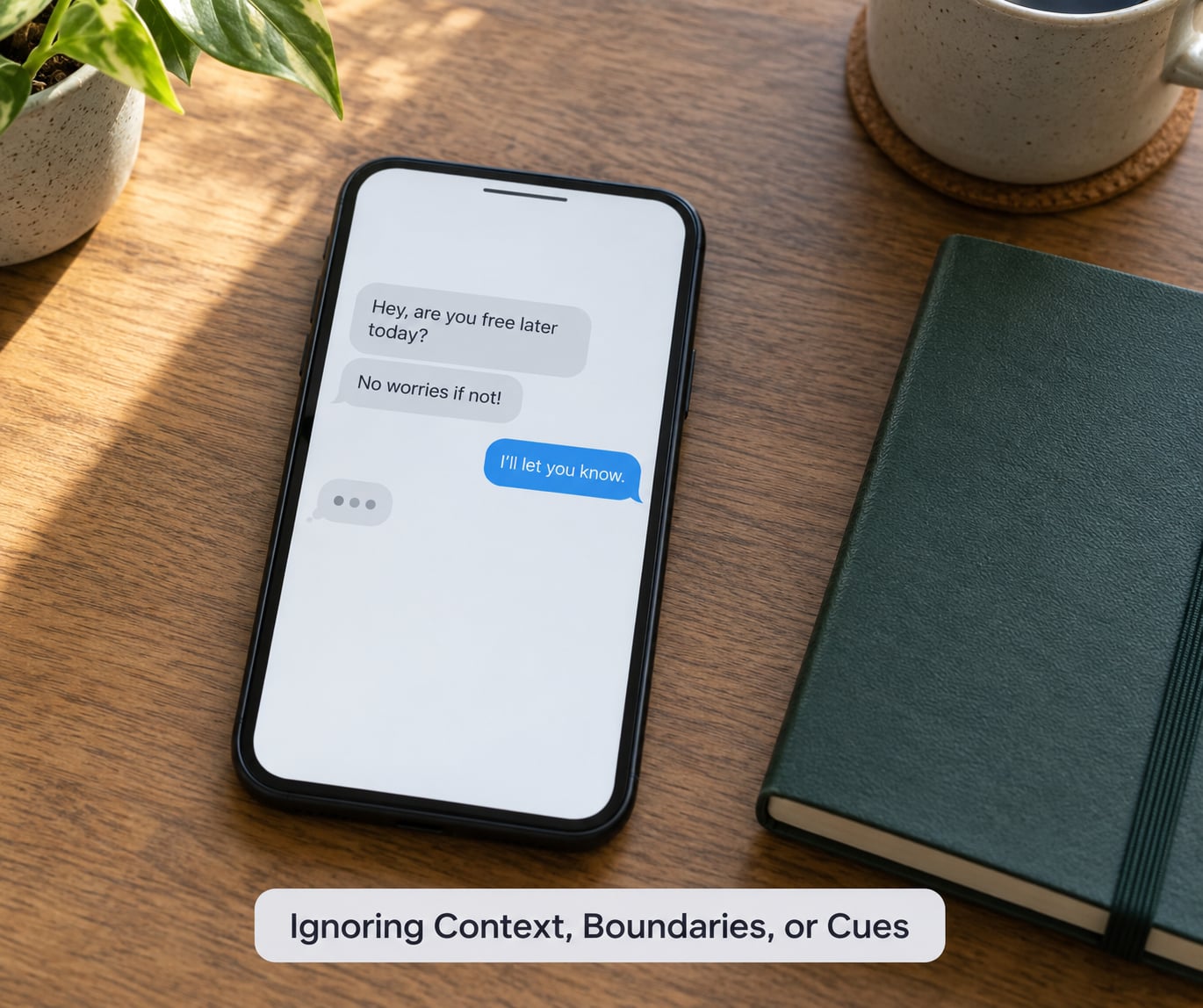
Cues are cheap signals people send all day: shorter answers than usual, a topic change, “haha” with nothing after it, three days of quiet. Ignoring them because you’re enjoying the conversation is one of the texting mistakes that kill attraction fastest, because it turns charm into pressure.
Voice notes have their own etiquette. A four-minute voice note on a walk to the bus is a small demand. If they send them, you can send them back, and if you can’t listen now, say when you will rather than ignoring it.
The same applies to arguments. When someone asks for space, continuing to send messages doesn’t get your point across faster. A short “okay, I’ll leave it with you” does more than four more paragraphs.
Boundaries also apply to volume. You don’t have to reply to every single message within a conversation, and you don’t have to respond to a read receipt at all. Treating every notification as an obligation is how people end up texting at work with one hand.
Why Texting Mistakes That Kill Attraction Are Hard to Notice
Because they rarely look like mistakes in isolation. One long message is fine. One unanswered follow-up is fine. A dry “k” from someone who had a bad day is fine. Judgment needs repetition.
I use a three-context test before deciding anything. What actually happened, how often it happens, and how the other person responds when you change it. One data point is noise. Ten data points is a pattern.
The third question is the useful one. Change one habit for a week and watch what shifts. If the thread gets longer and warmer, you found the problem. If nothing changes, the issue was probably pace, timing, or something that has nothing to do with your texts.
The people who get hurt fastest by these mistakes are usually the ones convinced they’re good at texting. A confident texter isn’t measured by speed or charm, they’re measured by whether the other person wants to keep talking. Nobody can see that from inside their own thread.
11. Being Too Vague or Giving One-Word Answers
One-word replies kill conversation flow because there’s nothing to push back against. “k”, “cool”, “lol”, “yeah” all close a door that was still open, and after two rounds of that, most people stop bringing things up.
Adding one small thing fixes it. A detail from your day, a reaction to what they said, an observation, or a question that costs them nothing to answer.
“Cool” becomes “Cool, I’ve been trying to get into that show everyone keeps mentioning, is it worth it?” Same energy, but now they have somewhere to go.
You also don’t have to keep a dead thread alive forever. Six signs it’s time to stop replying: you’re always the one starting, your messages go unanswered for days at a time, you rewrite everything four times, you find yourself explaining yourself, you know every detail about their life and none of theirs is about you, and you feel relief when the phone stays quiet. That last one has never once been wrong.
Stepping back isn’t a strategy. It’s just what happens when one person has been doing all the work.
If you think you’re on the receiving end, the fix is different from the fix above. You can’t make someone write more. What you can do is stop adding, see whether the conversation survives, and take that as your answer either way. A thread that only exists when you feed it wasn’t mutual, and no change to your own typing style would have made it mutual.
There’s a matching move for the person receiving the dry texts. Warmth added to a short reply does more than any clever comeback. “Rough day, sounds like you need a drink about now” gets a longer answer than a paragraph about how dry they are.
12. Disappearing After a Good Conversation
A warm exchange that ends with no next step leaves the other person doing all the interpreting. The thought that lingers isn’t the fun part, it’s whether you were actually interested or just being polite.
Naming a next step is not over-eager. It’s the clearest thing you can do with a good conversation. A specific suggestion makes you easy to plan with, and easy to plan with is a very attractive quality.
Instead of letting a great night fade, try: “That was genuinely fun, we should do it again. I’m free Thursday or next weekend if you want to pick one.”
On dating apps the same logic applies to profile chat. If someone puts effort into an opener, answering with a real question beats three lines of flirting that lead nowhere. The chat exists to get you both to a coffee, not to collect compliments for a week.
If you want to see someone, say so in plain language and give them one or two options. That’s what moving from texting to asking someone out looks like, and there’s no clever version of it that works better.
Plan for a weak end and nobody has to win anything. Suggest a specific time rather than “sometime this week,” because “sometime” gets a polite answer forever. And if they suggest something, say yes even if it’s not the activity you’d have picked. The activity matters far less than the second and third time you see each other.
People on r/dating_advice have revived plenty of stalled threads with a low-effort, specific message: hyping the upcoming plan, telling someone to wear something they like, or admitting they were looking forward to it. Plain excitement is more effective than any technique, mostly because it’s rare.
Frequently Asked Questions
Should I text first after a good date?
Yes. Nobody expects you to wait for an invitation, especially after a date that went well. Send something the same evening that references the date itself, so the message has a reason to exist. A specific detail you talked about works better than a generic check-in.
How long should I wait to text after a first date?
Waiting is mostly confidence theater rather than strategy. The same night is fine, and the next morning is fine. What matters more than the timing is whether the message asks for a second date, because that turns a nice exchange into a real next step.
Is texting every day too much at the beginning?
Not if it’s reciprocal, and not if there’s actually something to say. Daily check-ins with nothing new usually read as a habit rather than interest. Look at the balance: if they message daily too, you’re matching. If not, let a few days pass between empty exchanges.
What if the person I like takes hours to reply?
Put the phone down and go do something. Reply latency is not a measure of interest, and treating it like one is the fastest way to send an anxious message. Judge the whole thread over a week or two instead of one slow afternoon.
How do I move from texting to asking someone out?
Ask earlier than feels comfortable. Build the conversation to a natural pause, then make a specific suggestion with two options, like a coffee on Saturday or a walk after work. Specific beats smooth, and a clear no is easier to recover from than months of slow signals.
Can a dry sense of humor make someone lose interest?
Dry humor is a style, and some people love it. It turns into a problem when it’s aimed at them, their friends, or anything that isn’t yourself. If they stop laughing at your jokes, test it once by warming up a message and see whether the thread improves.
Conclusion
Texting mistakes that kill attraction all share one root: pressure. Whether it comes from chasing a reply, arguing every point, or sharing too much too soon, it makes the other person feel like they owe you something.
Pick the one mistake you repeat most, find its rewrite above, and use it for a week. Then answer the next invitation or question honestly instead of playing it cool.
Good conversations survive plain interest. Start there.