
You cannot read anyone’s mind, and no single cue settles it. But if you want to know how to tell if someone likes you but is shy, look at patterns over weeks rather than moments: attention that keeps returning to you, effort that continues despite visible discomfort, and messages that stay warm even when in-person conversation goes quiet.
Shyness behaves like a filter on the bold moves, not on all of them. The confident version of liking you — the direct compliment, the easy eye contact, the first move — gets suppressed. The involuntary version keeps running: orientation toward you, memory of small details, nervous energy you can see but they cannot control.
That is why the useful question is never “is this one sign real.” It is whether three or four weak signals keep pointing the same direction, and whether the person takes steps when you make it easy for them to. This guide covers the nine signs worth tracking, the honest alternative explanation for each, and how to respond in a way that makes an honest answer possible.
Everything here applies to any gender, in any context: a new crush, a coworker, a classmate, a long-time friend, or someone you have only ever spoken to online.
Table of Contents→
- What Shy Behavior Can Mean
- 9 Signs Someone Likes You but Is Shy
- 1. They remember small details nobody else would catch
- 2. They make an effort even though they are visibly uncomfortable
- 3. They find low-risk reasons to be near you
- 4. How to tell if someone likes you but is shy through text
- 5. They show curiosity about parts of your life nobody else asks about
- 6. They linger, or manufacture reasons to extend time together
- 7. They notice you in a group setting
- 8. They treat you differently than they treat everyone else
- 9. They make future-oriented suggestions, even vague ones
- What their friends do
- How to Tell the Difference Between Shyness and Interest
- How to Respond Without Making Them More Nervous
- How to Suggest a Second Date or Clearer Conversation
- When the Signs Are Not Enough
- Frequently Asked Questions
- Can a shy person like you even if they never make the first move?
- How long should I wait before asking a shy person if they like me?
- Does a shy person who replies slowly probably lose interest?
- How can I tell if someone is nervous around me or not interested?
- What should I say after a first date with someone who was very quiet?
- Conclusion
What Shy Behavior Can Mean
Four different things produce the same quiet behavior, which is why one evening of silence tells you very little.
Shyness is a nervous response to unfamiliar or judged situations. It rises with new people and shrinks as familiarity grows, which is why the same person can be quiet on day one and warm by day ten. Introversion is about where energy comes from, not about interest. Someone can be introverted and still be very enthusiastic about you specifically. Social anxiety is a clinical condition and a heavier version of the same wiring, and it is not the same thing as disinterest. Some people simply do not know you well yet.
There is also a distinction worth holding onto: most shy people hide it well. They are what researchers sometimes call privately shy, quiet in front of you but full of interest nobody can see. So the absence of visible nervousness is not evidence of absence of feeling, and the presence of nervous energy around everyone tells you nothing about you specifically.
So interpret behavior as a cluster, not a clue. Two or three signals in one conversation are noise. The same signals repeating across weeks, combined with a willingness to spend time with you, is a pattern.
Three words to keep straight
Attention is where their eyes and body go. Effort is what they do about it. Reciprocity is whether they respond when you reach back. Interest usually shows up in all three. Politeness shows up mostly in the first.
9 Signs Someone Likes You but Is Shy
Each sign comes with the behavior, what it may mean, and the alternative explanation that keeps you honest. Weight the pattern, not the item.
1. They remember small details nobody else would catch
They mention the name of your sister’s dog, the injury you had six months ago, the fact that you hate mornings. What it may indicate: attraction, because storing and retrieving details about someone is effort, and effort costs something. Alternative explanation: a genuinely good memory, or someone who is naturally attentive and remembers details about everyone.
2. They make an effort even though they are visibly uncomfortable
They arrive slightly early, ask a question to keep the conversation going, stay longer than their comfort level suggests. What it may indicate: interest strong enough to override their own preference for avoidance. Alternative explanation: politiveness, or not wanting to seem rude.
3. They find low-risk reasons to be near you
Their desk drifts toward yours in an office, they pick the seat with the better view of you in a café, they volunteer for the task that involves working with you. What it may indicate: proximity-seeking without exposure. Alternative explanation: practicality, convenience, or simply not wanting to move.
4. How to tell if someone likes you but is shy through text
Over text they are warmer, funnier and more talkative than they have ever been in person. Replies arrive faster than their pace suggests, messages get longer and more specific, and they initiate conversations that did not need to happen. What this may indicate: this is the clearest signal most shy people give, because a screen removes eye contact, live reactions and the pressure to respond instantly. Alternative explanation: being more expressive online is a habit for some people regardless of who they are talking to. Check whether the tone changes when the conversation is only about logistics.
5. They show curiosity about parts of your life nobody else asks about
What they do with their weekends, what you argue about, what you want to do next, whether you are seeing anyone. What it may indicate: interest, since shy people often prefer gathering information to putting themselves forward. Alternative explanation: a naturally inquisitive friend.
6. They linger, or manufacture reasons to extend time together
A hug lasts a beat too long, the goodbye conversation keeps finding new topics, they suggest one more drink just to extend the evening. What it may indicate: interest, because ending the interaction means facing the risk of rejection. Alternative explanation: friendliness, or simply enjoying your company.
7. They notice you in a group setting
In a room with six other people, their attention keeps finding you and then breaking away, and their volume and posture shift when you are nearby. What it may indicate: heightened self-consciousness, which usually arrives when the person matters. Alternative explanation: you are the new person, so everyone is watching you.
8. They treat you differently than they treat everyone else
More patience, more effort, more questions, or a slightly softer version of themselves. What it may indicate: this is the one most easily missed, because people are usually polite to everyone and generous to almost no one. Alternative explanation: friendship, or a general warmth that they extend to everyone in the group.
9. They make future-oriented suggestions, even vague ones
“We should hang out sometime,” “next time I’ll show you that spot,” “you’d like this place.” What it may indicate: interest, because talking about a shared future is a small risk. Alternative explanation: it is just how some people talk, and vagueness can be a way of avoiding commitment.
What their friends do
Friends give the game away more often than shy people do. Teasing that stops the second you walk in, sudden silence, someone else covering for them, or a friend asking questions they clearly already know the answer to. People rarely hide from their friends for months.
How to Tell the Difference Between Shyness and Interest
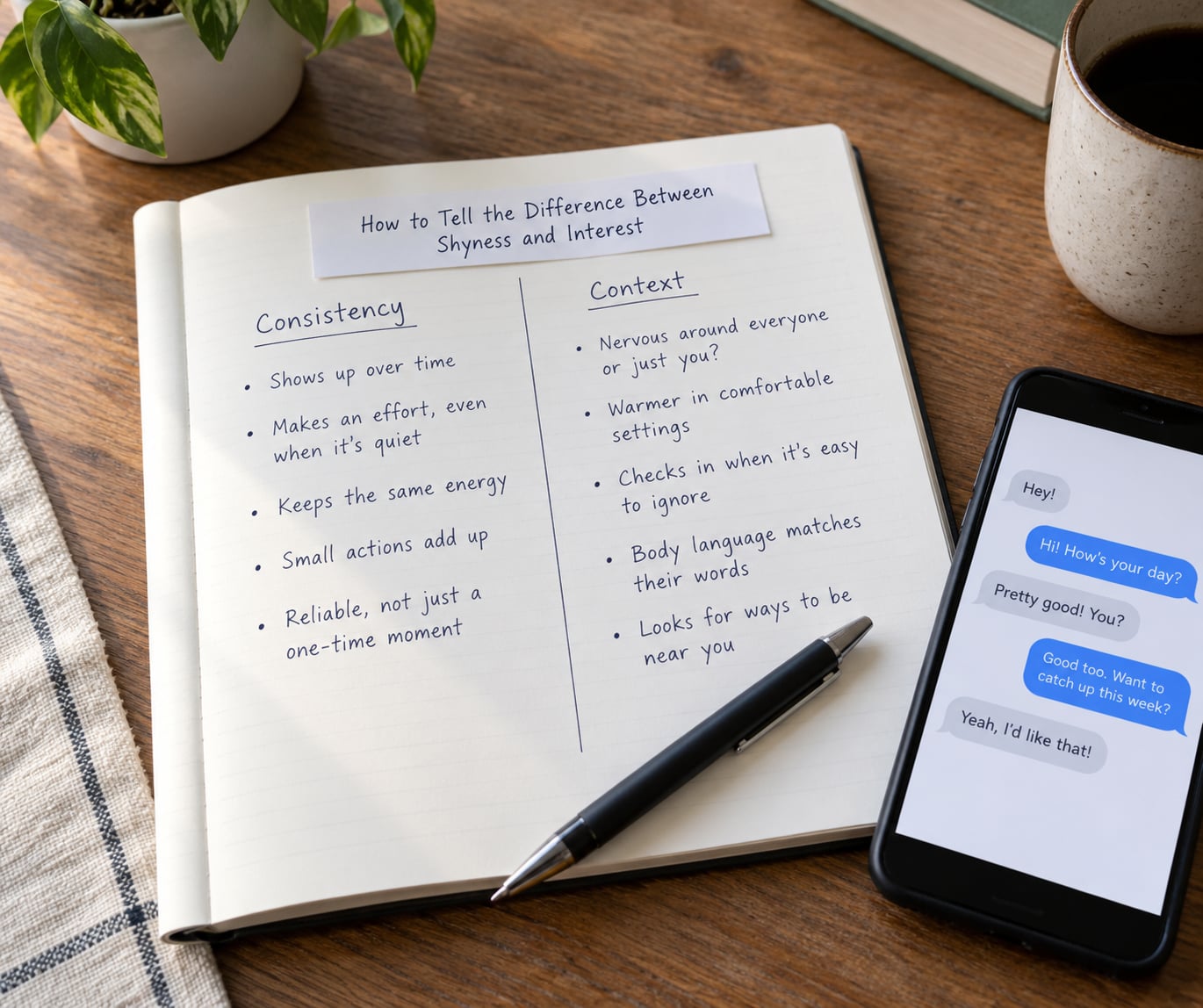
Run the six dimensions below across several weeks instead of one encounter. Read the row, not the single cell.
| Dimension | Shy and interested | Polite or not into you |
|---|---|---|
| Attention | Returns to you even when you are not the most interesting option available | Steady and pleasant, roughly equal for everyone else |
| Initiative | Starts things, usually in a low-risk format like text | Responds when you start things; rarely starts them |
| Conversation quality | Asks follow-up questions and builds on what you said | Cheerful, agreeable, ends without extending |
| Responsiveness | Replies reliably, and faster when the topic matters to them | Replies politely with no urgency |
| Follow-through | Keeps small promises: remembers, follows up, asks again | Enthuses about a plan, then goes quiet |
| Willingness to meet | Accepts, sometimes needs you to make it easy | Keeps the relationship in a low-effort format |
Follow-through is the row people skip, and it is the heaviest one. Anyone can send a good text at midnight on a good mood. Someone who twice reschedules and then actually shows up has decided something.
Then add context. Interest tends to get more specific over time: the questions get better, the shared references pile up. Politeness stays generic. And watch for asymmetry. If the effort is entirely one-directional for more than a few weeks, that is information, not a puzzle to solve.
How to Respond Without Making Them More Nervous
The strongest move is reciprocity. Self-identified shy people consistently say the same thing: show that you are interested too, or they assume rejection and withdraw. Waiting for the shy person to go first is a strategy that mainly punishes you.
Match their pace rather than raising it. If they write two paragraphs, do not reply with six questions. Keep answers warm and easy. A slow reply from you costs nothing; a demanding one can end things quietly.
Ask open questions that have a wide opening. “How was your weekend?” closes fast. “What did you end up doing with the weekend?” lets them pick the door.
Accept short replies as complete. “Not bad, you?” is not a brush-off. Sometimes it is just a person managing how much they are revealing.
Be specific in your interest. Instead of “you’re great,” try “you’re the only person who ever asks me about that project.” A precise observation is much harder to deflect than a general compliment, and shy people feel the difference immediately.
Give an easy exit in every invitation. “No pressure, I just thought of you” does more work than confidence ever will.
Three things that make shy people retreat
Demanding an immediate explanation turns a slow pace into a problem you created. Overanalyzing every delay does the same thing, because delay is their normal operating speed. And turning a conversation into a confession gives them something to say no to; a low-stakes question is far easier to answer honestly than a high-stakes speech.
How to Suggest a Second Date or Clearer Conversation
Make the invitation specific, easy to answer and small in apparent stakes. Specific dates and concrete plans outperform open-ended hanging out, because there is nothing to interpret.
After a first date over text: “I had a good time and I want to do it again, no pressure if you’re not feeling it. There’s a place near me I think you’d like, Thursday or Saturday?” That last sentence does the real work — two named options and an explicit off-ramp.
In person, keep it short and calm. “I like spending time with you. Want to do it again next week?” Say it, then let the silence exist. Filling that silence with qualifiers is what turns a simple question into pressure.
Over text, send the invitation the same day rather than three days later, which by then reads as deliberation about whether you meant it.
If the answer is a polite maybe — a warm response with no follow-through — treat it as a no for now. One polite maybe is noise. Two, in a row, is a decision. Thank them, keep the door open, and stop being the one who always initiates.
When the Signs Are Not Enough
No single sign confirms interest, and honestly, no amount of signs does. Behavior is a sample, not a reading. Some people need an explicit question before they can say anything true, and that is worth accounting for.
Ask yourself whether the contact is consistent. Warm one day and unreachable the next, with no stable pattern, usually means something other than shyness. Watch whether the initiative is one-sided. Check whether vague plans ever turn into actual dates, and how many times you are the one arranging it.
Stop and clarify if you notice a pattern of discomfort rather than nervousness. Shyness produces awkwardness, not retreat from the specific person. If someone pulls back further each time you reach out, treat that as an answer.
Also stop if the other person is in a relationship. Every hopeful signal becomes a dilemma rather than a question, and you deserve clarity before you spend more energy.
After a long stretch of genuine uncertainty, say one honest sentence. Something like “I enjoy talking to you, and I’m curious where this goes — if you’re not interested, I’d rather know” gives a shy person permission to answer truthfully without being cornered. Then let the response decide the next step, and accept it either way.
Frequently Asked Questions
Can a shy person like you even if they never make the first move?
Yes. Shyness suppresses exactly the move most people read as proof: starting something. Plenty of interested people hold their feelings because a rejection would cost them a friendship or a job they share a building with. Look instead for sustained attention, effort that continues despite discomfort, and warmth over text. Then make the first move yourself, gently, so the decision is not entirely theirs.
How long should I wait before asking a shy person if they like me?
Long enough to have a pattern, not a moment. Three to four weeks of regular contact usually reveals whether attention, follow-through and willingness to meet point in your direction. After that, waiting mostly benefits the person who wants to avoid a clear answer. A calm, low-stakes invitation ages better than an escalating campaign of hints that will not be picked up.
Does a shy person who replies slowly probably lose interest?
Not usually. For many shy people, typing feels like exposure, so every message gets drafted, revised and reread before it goes out. Slow replies matter more when they are paired with short, generic answers and no questions back. Consistent delay with real content and questions attached usually means caution, not cooling off. Judge the whole pattern rather than the gaps.
How can I tell if someone is nervous around me or not interested?
Compare them to how they act around other people. Nervousness with you specifically, alongside effort and curiosity about your life, points to interest. Distance with everyone, no follow-up questions, and enthusiasm that vanishes the moment you appear points the other way. Shyness tends to intensify around people who matter; disinterest tends to stay flat no matter who shows up.
What should I say after a first date with someone who was very quiet?
Skip the verdict about how it went and mention something specific from the conversation, then keep the door open. Warm messages over text after a quiet date work well because typing removes the pressure. If you want clarity sooner, ask directly and gently that you enjoyed it and would like to see them again, with an easy out attached. Quiet is not the same as uninterested.
Conclusion
Start with the pattern, not the moment. If you have been trying to work out how to tell if someone likes you but is shy, look at what has repeated: attention that returns, effort that continues, warmth over text, and follow-through on small promises.
Then do one thing: make a warm, specific invitation with an easy exit, and watch the response instead of the shyness. Their answer, not their nervousness, is the real signal. And either way, respect the boundary you get back — a clear no closes a door cleanly and keeps you out of months of waiting.