
To handle family questions about being single, prepare one short answer in advance, say it in a single calm sentence without overexplaining, and then turn the conversation toward the person who asked. Most follow-up questions come from the reaction, not from the question itself.
That is the whole method, and it takes about ten minutes of preparation before a birthday dinner or a Sunday lunch. The hard part is not finding words. It is keeping your face and voice steady while someone asks why you are still single in front of the whole table.
Most guides to this topic are written for Christmas. They are not much help in March, when the question arrives at a birthday, a wedding, or a Tuesday group chat. The advice below works year round, and it includes what to do when the question comes from a parent rather than a great-aunt.
Table of Contents→
- What You Need
- How to Handle Family Questions About Being Single: Step by Step
- Common Mistakes
- Frequently Asked Questions
- What if my family keeps asking why I am still single?
- How can I answer without hurting my family’s feelings?
- Should I tell relatives that I am using dating apps?
- How do I handle these questions from a parent or grandparent?
- What if my family believes I am purposely avoiding relationships?
- How do I stop the conversation when the question becomes rude?
- Conclusion
What You Need
Three things, and none of them cost money or take more than a few minutes to set up.
A personal boundary. Decide in advance what you are willing to talk about and what you are not. Something as simple as “I am not going to discuss my dating life at dinner” gives you a line to stand on. Without it, every answer feels improvised.
One or two calm answers. Not a speech. One sentence you can deliver without thinking, in a warm and level tone. If you have two, the second one is for when the first gets followed up.
A redirect question. A question about the person who asked, ready to go the moment your sentence ends. That is what closes the exchange.
If you want phrasing for the relatives who ask most often, the difference is mostly in how personal the question is allowed to get. With a parent or grandparent you can say, “Nothing to report, and I will let you know when there is.” With an aunt, uncle or cousin, “Ask me something more interesting” usually works. With a sibling, “So when are you upgrading the kitchen?”. With a partner’s family, keep it shorter still: “I am enjoying being single, thanks.”
How to Handle Family Questions About Being Single: Step by Step
1. Decide What You Want to Share
Not answering and setting a limit look different to the person asking, even though both can be brief. A polite nonanswer is warm and vague: “Not much, how are you?” A boundary is clearer: “I would rather not talk about that.” Both are fine, but use the second one when you are tired of the subject rather than simply unprepared.
What you share should also depend on where you actually are. Being newly out of a relationship, actively dating, or single by choice all need different answers. A person who has been single for years can say “I am happy as I am.” A person six weeks out of a breakup saying the same thing usually gets pushed on, because it sounds like a claim rather than a fact.
2. Stay Calm and Acknowledge the Question
Pause before you speak. Half a second of silence makes a reply sound considered instead of defensive, and it stops you filling the gap with an explanation you did not intend to give.
A neutral acknowledgement covers most cases: “I know you ask because you care, but I am doing fine.” It takes the sting out without apologising. People in online forums say over and over that naming the asker’s real worry defuses a question better than a clever comeback.
Tone matters more than words here. Keep your volume even, uncross your arms, and do not speed up at the end of the sentence. A fast, clipped answer reads as anger even when the words are polite.
3. Say Your Piece in One Short Sentence: Handling Family Questions About Being Single
Here are lines for the three situations that come up most. Adjust the wording until it sounds like something you would actually say out loud.
Casual questions (“Anyone special?”, “How’s your love life?”): “Not at the moment. I am enjoying the extra sleep.” Then ask about their holiday, their trip, or their garden.
Persistent questions (“Why are you still single?”, “When are you settling down?”): “I am not in a rush, and I do not discuss it.” Say the same words every time. Changing your line each time keeps the door open.
Overly personal questions (“Are you seeing your ex?”, “When are you having kids?”): “That part of my life is private, and I would rather talk about something else.” No apology, no explanation of why you are single, no mention of an ex. In many families a single ex name will be repeated at every gathering for the next five years.
4. Redirect the Conversation
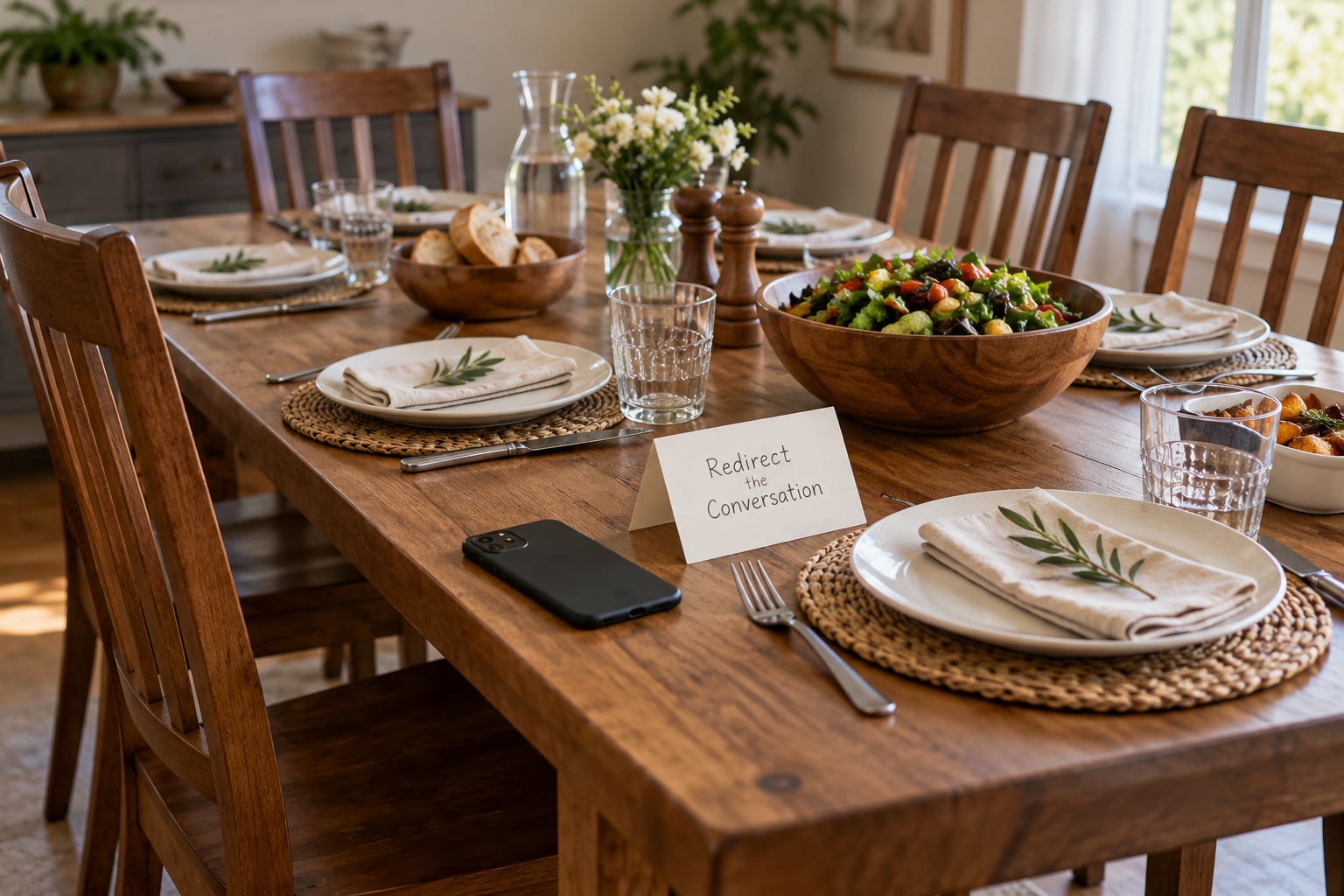
The redirect takes three moves: acknowledge, deflect, then ask about them. Say “no news, but I have got a story about the neighbour”, then ask “how is your sister doing with the new job?” The follow-up question does the heavy lifting, because people generally prefer talking about themselves.
Have three subjects ready for the person most likely to ask: their work, their health, or a trip they took. If the same relative comes at you twice in one sitting, move physically — get up, clear plates, sit somewhere else. No explanation is required.
Group chats work differently. Text needs one line and no follow-up energy: “Wild week. Anyway, how was the flight?” then a photo of something unrelated. Long explanations in a chat thread are how arguments start.
5. Set a Boundary With Trusted Family
Casual answers handle the moment. Some conversations need more, and doing them privately is what stops the question from recurring at every holiday.
Pick a good moment: in the car afterwards, on a walk, or a phone call when neither of you is distracted. Use an I-statement, state the topic plainly, and do not explain your whole life. “When you ask if I am seeing anyone, it makes me feel like my life is not good enough, and I would rather you did not ask.”
Then say what you will do instead if it keeps happening: “I will just change the subject.” Naming a consequence in advance, calmly and without a threat, is what makes the boundary real.
Expect it to be met with “we only ask because we care”. That is usually true, which is why a direct request works better than a joke: “I know you care. I am still asking you not to ask.”
6. Prepare for the Question to Repeat
It will come back, especially from the same relative, and often within a month. Do not treat the second time as a failure of your first answer.
The long game is repetition. The same sentence, in the same tone, every single time, is what eventually registers. People learn from repetition, and most family questions stop when the answer stops being interesting. If your second answer is longer than your first, you have probably answered the complaint rather than the question.
Some readers take a different route entirely, and it is a legitimate one: reducing exposure. Attending one holiday a year, staying in a hotel rather than the family house, setting a time limit, or declining an invitation where you would be travelling four hours to be questioned. Control over transport and lodging is what makes leaving possible without an argument.
Common Mistakes
Overexplaining. A long answer gives the room more than you wanted it to have, and it invites “but what happened with him?” Fix: cut the answer to one sentence and delete the second draft.
Inventing a partner.</strong; It works once and sets a problem for every gathering afterwards. Fix: say something true and dull instead, like “no news.”
Getting visibly upset.</strong; Frustration hands the group something to discuss, and it gets repeated to you by well-meaning relatives later. Fix: pause, breathe, and answer later in the car if you need to.
Lecturing the relative. “You only ask because you’re bored” rarely lands and rarely stops anything. Fix: keep it about your own boundary, not their motives.
Deflecting with a joke every time. Humour works well once or twice, then it becomes the price of entry. Fix: mix one light answer with one firm answer, so the joke is not the price of admission.
Apologising for being single.</strong; “Sorry, I know you all want to know” implies there is something wrong. Fix: state it as a fact, not an apology.
Two habits help more than anything else. Say your sentence at the same speed you would use for anything else, and leave immediately after the redirect, because silence after the answer is where follow-ups live.
Frequently Asked Questions
What if my family keeps asking why I am still single?
Repetition is normal and it is rarely about you. Prepare one sentence and repeat it identically every time: I am not in a rush, and I do not discuss it. Change the subject immediately afterwards. Over time most relatives stop asking, because the answer no longer changes. If it continues for months, have one private conversation with the person and tell them plainly that you would rather they did not ask.
How can I answer without hurting my family’s feelings?
Keep the tone warm and leave the reason out. A short answer with a kind ending does the job: No news, but I am doing really well, how is your week going? Most families are asking because they are nervous, not because they are disappointed. Naming that out loud, such as I know you ask because you care, usually takes the sting out before anybody gets defensive.
Should I tell relatives that I am using dating apps?
Only to people you would tell about anything else in your life. For family questions, it is more detail than the question asked for, and it tends to produce a new set of questions about why it has not worked yet. Saying I am dating when you are dating is enough. Keep app talk for friends who would find it interesting rather than stressful.
How do I handle these questions from a parent or grandparent?
Parents ask more often because they worry, so the answer can carry a little reassurance without becoming an explanation. Something like Nothing to report, and I will let you know when there is works well. Say it warmly, then redirect to them. If it keeps going, a private conversation works best: explain that the question makes you feel your life is not good enough and ask them to leave it alone.
What if my family believes I am purposely avoiding relationships?
If that is your situation, address it directly rather than letting the question loop. Say plainly that you have been dating and it has not worked out, or that you are choosing this for now, and give one reason at most. Then change the subject. People usually stop speculating once they have a real answer, and they rarely ask the follow-up question if your answer is calm and final.
How do I stop the conversation when the question becomes rude?
End it with a boundary and a redirect, in that order. Say that part of my life is private, I would rather talk about something else, and then ask them a question. If it carries on, leave the room or the table without explaining yourself. You do not owe an audience for a rude comment, and stepping away is not rude, it is simply ending a conversation that has stopped being useful.
Conclusion
Start with one sentence and use it every time. Pick the answer that is true and dull, decide in advance what is off limits, and then redirect to the person who asked before anyone can follow up.
If the same relative keeps asking, have that one private conversation, calmly and once. And if the question is genuinely costing you more than it is worth, attending less often is a legitimate answer, not a failure.