
If you keep choosing partners who share the same personality, the same emotional distance, or the same ending, the reason is usually not a curse. Early caregiving shaped a coping style, and that style acts as a filter: it decides who you notice, who you approach, who you idealise, and who you tolerate. Familiar dynamics then register as chemistry, while healthy ones read as flat.
That last part is the bit nobody warns you about. The people who are genuinely good for you can feel boring for months before they feel safe, and that gap is where most repeat cycles live.
This is general information about relationship patterns, not diagnosis or therapy. If a pattern is costing you sleep, money or confidence, a licensed therapist or psychologist is the right person to work through it with you.
Table of Contents→
- Why do I keep dating the same type of person?
- What counts as dating the same type of person?
- What psychological and emotional needs shape partner selection?
- 7 signs you are repeating the same dating pattern
- How to recognize the pattern in your dating history
- How dating apps can reinforce the same type of person
- How to stop choosing the same type of person
- How to keep healthier relationship patterns from repeating
- Frequently Asked Questions
- Conclusion
Why do I keep dating the same type of person?
Because your attachment style filters your attention before your conscious preferences get a vote. You developed a way of managing closeness early on, and that way now decides which partners feel exciting and which feel suspicious.
Your coping style became your taste
Children figure out what to do with a need that is not being met. Some kids learn to chase and protest. Some learn to withdraw and go it alone. Some learn to be helpful enough that nobody asks them for anything. Whatever worked at the time becomes a default, and defaults are quiet but stubborn.
As an adult, that default does two things. It shapes who you find attractive, and it shapes how you behave when things get difficult. Both feed back into each other, which is why the same partner keeps reappearing in a different body.
Partner clustering is a documented pattern, not a mystery
Researchers at UC Davis looked at more than 1,000 couples and reported that people end up partnered with others who share their backgrounds, values and attitudes more than chance would predict. The study, published in the Journal of Personality and Social Psychology, is usually described as evidence of partner clustering.
One popular reading of this is that your type is fixed essence. That reading misses the useful half: the people you meet are largely a function of where you live, where you work, who your friends are, and which apps you open. Change your exposure pool and the clustering changes with it.
There is no magnetic type pulling you in
You will see this explained online as a soulmate frequency or a trauma magnet. Nothing in the research supports that. What does show up, in forum threads on r/lawofattraction and r/dating_advice, is people describing the same emotional template with startling specificity, often in very different-looking people. Repetition with a shared shape points to a filter on your side, not a force pulling from theirs.
Different people, same relationship
The fastest way to see the pattern is to compare endings rather than beginnings. If three relationships with three very different people ended in the same fight, the same silence, or the same slow fade, the common factor is not them. It is the dynamic, and the dynamic is yours too.
What counts as dating the same type of person?
Same type means the same relational shape, not the same appearance. A shared jawline is not a pattern. A shared response to closeness is.
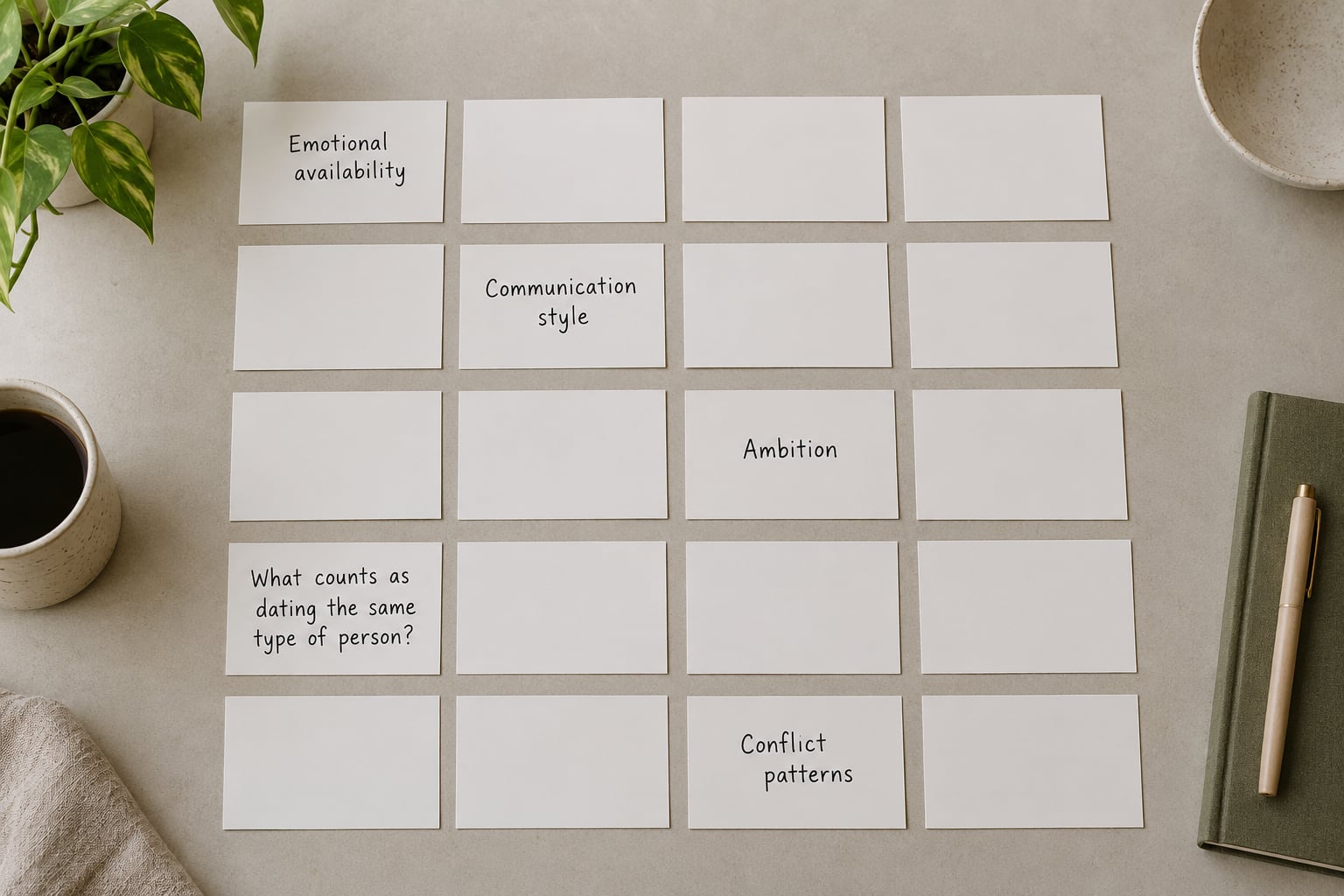
Most people notice physical repetition first because it is the easiest thing to describe. It is also the least useful thing to change, since attraction to a look has no relationship to whether a partner will call you at 11pm when something is wrong.
The table below splits what people usually notice from what actually predicts how a relationship runs.
| Superficial repeat | Deeper pattern | What it predicts |
|---|---|---|
| Similar looks or height | Similar family background | Shared assumptions about money, family and obligation |
| Same career or industry | Same ambition level and work-life balance | Who does the emotional labour at home |
| Same humour | Same emotional availability | Whether you can have a hard conversation without panic |
| Same taste in music | Same communication style | How disagreement gets handled in month three |
| Same political or religious outlook | Same family goals | Whether you want children, where you live, how you handle money |
| Texting rhythm | Same conflict pattern | Pursue and withdraw, stonewalling, silent treatment |
| Shared interests | Same view of commitment | Whether you are dating someone who wants what you want |
Take three or four of your more serious relationships and read only the right-hand column. If the same answers keep appearing, you have found the pattern that matters.
What psychological and emotional needs shape partner selection?
Everyone picks partners partly to get something they need. The trouble starts when the need was formed under pressure and never got updated. An unmet need from age nine still runs on nine-year-old logic in a bar at 11pm.
Familiarity is read as safety
Your nervous system does not rank partners by objective quality. It ranks them by how predictable the response will be. Predictability lowers the alarm, and a lowered alarm gets mistaken for attraction. This is why the person who never texts back on a Tuesday can feel more exciting than the person who texts back every Tuesday.
Attachment style shapes the filter
Attachment styles are a working model, not a diagnosis, and most people sit in a mix rather than a clean box. The table is a shortcut for spotting your default under stress.
| Style | Usually formed when | Shows up in dating as | Triggered by | A partner feels like |
|---|---|---|---|---|
| Secure | Caregiving was mostly reliable | Direct asks, easy repair, comfortable with space | Ordinary conflict | Calm and boring, at first |
| Anxious-preoccupied | Attention was unpredictable | Reassurance seeking, protest behaviour, jealousy | Distance, delay, ambiguity | Exciting, then suffocating |
| Dismissive-avoidant | Emotions were punished or ignored | Withdrawal, minimising needs, sudden deactivation | Pressure, demands, intensity | Comfortable, then unreachable |
| Fearful-avoidant | Care was inconsistent and frightening | Approach and retreat in the same conversation | Any real closeness | Intense and unpredictable |
Anxious and avoidant tend to find each other
An anxious person chases to reduce a fear of abandonment. An avoidant person withdraws to reduce a fear of engulfment. Each move amplifies the other one’s alarm, so the pair escalates. The result is a very intense relationship that looks like the opposite of a calm one.
Gottman’s conflict coding work with newlywed couples is usually cited here: how couples handle disagreement in the early years predicts later outcomes better than how much they like each other. Your conflict style is a selection criterion worth as much attention as your chemistry.
Fear of change is a motive too
Choosing the familiar type protects you from a specific dread, which is that the unfamiliar person will require you to be different, more capable, or less in control. Sticking with the pattern feels like safety and gets confused with liking the person.
Preference versus repetition
A conscious preference is flexible, specific and survives losing one candidate. A repetition compulsion is rigid, vague, and reactivates the moment the current relationship gets uncomfortable. Ask which one you are describing before you try to change it.
7 signs you are repeating the same dating pattern
If you tick four or more of these, you are probably running a pattern rather than being unlucky. None of them prove anything about your partners’ character.
1. You notice the same trait set every time
You can describe your type in a few adjectives and the description has not changed in years, including the parts that annoyed you. Changing the adjectives but not the pattern is common and worth watching.
2. Your partners share a background, not just a vibe
Same family shape, same region, same financial bracket, same politics. People on r/AuDHDWomen describe falling hardest for very specific categories, often neurodivergent partners, and genuinely cannot tell where wiring ends and choice begins. The honest answer is that both matter, and you can still look at how narrow the filter is.
3. Comfort arrives instantly, before you know them
You feel at ease in the first hour, which is lovely and is also a red flag if you have no data. Ease this fast usually means you recognise a familiar script, not a compatible person.
4. The same fight keeps happening
Different partner, same argument: the one about texting, the one about plans, the one where you raise a need and they go quiet. One recurrence is a coincidence. Three is a script.
5. You keep overriding dealbreakers
You decided early that drinking was a no, or that being contradicted in public was a no, and then you explained it away. On r/ChristianDating, threads keep circling the same version of this: the profile type was not what the person wanted, and the person was not what they needed.
6. A break-up fills you with panic
Relief and terror in the same hour, then a rush to get back to the same shape. Fear of being alone is not evidence the relationship was good. It is evidence of how you tolerate being alone.
7. Every new person arrives as a comparison
You describe your date by what they are like compared to your ex, and the comparison is always flattering. You are not evaluating this person. You are checking whether they resemble the last one.
How to recognize the pattern in your dating history
Recognition is a five-stage exercise you can do in one sitting. It works better with a notebook than with memory, because memory softens.
1. Sample
Pick four relationships of at least six months. Include one that ended well. Write three facts about each person that were true early and stayed true to the end: how they handled a no, how they behaved when tired, who made the plans.
2. Map
Put the traits in a list and mark the ones that appear three or four times. Family background, emotional availability, communication style and ambition usually cluster. Look at that list twice before judging it.
3. Role
Write your own behaviour in each relationship in one sentence. Pursuer, people-pleaser, the reliable one, the one who fixes things, the one who leaves first. Most people have one role and play it every time.
4. Turn
Find the moment you first felt uneasy and write what you did next. Usually the answer is reassurance seeking, apologising, going quiet, or leaving. That response is the hinge.
5. Rule
Convert the audit into one rule you can apply to the next person. Rules have to be behavioural and testable. “I want someone emotionally available” is a wish. “If I ask for reassurance twice in a week and get none, I stop explaining what I need” is a rule.
The table is the version to keep beside you while you work through it.
| Observed fact | Possible belief or need | Question to test |
|---|---|---|
| I can tell within a week whether it will work | Familiarity reads as safety | What would I have to learn in the slow version? |
| I keep dating people who work long hours | Availability means they cannot leave | Would a free weekend feel like an opportunity or a threat? |
| I argue the relationship into shape | If I fix enough, it holds | What did I say, and did anything actually change? |
| I get bored around steady people | Calm registers as low effort | Am I bored, or just un-anxious? |
| I choose people who need caring for | Being needed is how I stay | What happens when someone needs nothing from me? |
| I leave right before they do | Leaving on my terms feels safe | Have I ever stayed past the first rupture? |
| I rehearse conversations for days | Conflict is danger | What would I say if I believed I would be heard? |
Readers on r/datingoverthirty describe the exact moment the pattern became legible: a long relationship ending and the same dynamic showing up in the next one. Nothing dramatic happened in between. That gap is usually where the reflection belongs.
How dating apps can reinforce the same type of person
Apps did not create your pattern, but they run it at a volume dating used to. The structural point is worth making plainly.
Your filter is the product
Range sliders, age and distance settings, and dealbreaker toggles narrow a pool of millions down to a few hundred. Repeat those same settings and you get the same few hundred, refreshed. That is not a conspiracy. It is a funnel you set yourself.
Swiping trains the eye, not the head
A ten-second decision on a photo rewards pattern-matching at its fastest and laziest. Your eye learns what you have always approved and approves it more cheaply each week. You are not becoming less discerning; you are becoming faster at a standard you never questioned.
Availability shapes your options
Who is actually on the app near you, at your age, in your orientation, in your city? Research on partner clustering suggests a lot of your type is circumstantial. Move cities, change age range, join a different kind of group, and the apparent type changes with the pool.
What personalization controls do and do not tell you
Recommendation settings can widen who you see. They cannot tell you whether you are compatible with anyone. A better feed increases the number of candidates; it does not tell you whether you can meet a healthy person calmly. Widening the feed is useful, and it is not a fix on its own.
Profiles are curated arguments
You read a hundred profiles through the template you already hold. Someone outgoing and attentive reads as interesting. Someone quiet and attentive reads as dull. Both descriptions are being filtered through your prior, which is the same prior that got you here.
How to stop choosing the same type of person
You are not going to change your taste by deciding to. You will change it by changing when and how you decide. Work through these in order.
1. Slow down the moment it feels right
The rush is a feeling, not information. Most people describe the strongest pull in the first three weeks, which is exactly when the data is thinnest. Deliberately extend the gap between meeting and committing. Wanting to know someone is not a red flag about them; it is ordinary curiosity.
2. Broaden the criteria you actually filter on
Not your looks, not your politics. Your filters on character. Widen one dimension of the range sliders you use, join a different kind of social space, and let exposure do the work. Forum writers on r/dating_advice ask repeatedly how you learn to want people who are good for you; the honest answer is exposure, repeated, over months.
3. Separate attraction from compatibility
Two columns, one page. Left: what you feel. Right: how they behave when it is inconvenient. The right-hand column is where decisions should happen, and most people never write it down.
4. Ask questions that have bad answers
How do you handle it when someone is disappointed with you? When did you last apologise and mean it? What does a normal Tuesday evening look like? People who manage conflict well give specific answers. People managing avoidance go abstract quickly.
5. Watch the defence response, not the answer
Everyone has a polished version of themselves. What gives a pattern away is what happens when you touch a weak point. Ridicule, topic change, sudden tiredness, or a counter-attack aimed at your sensitivity. This is where research on withdrawal in couples shows up in practice: a 2022 study of 175 couples found avoidant attachment predicted lower satisfaction mainly through withdrawal behaviour rather than the label itself.
6. Set non-negotiables before you want anything
Decide your dealbreakers while nothing is on the line. In the middle of infatuation you will negotiate them away, and you will call it flexibility. Write them down, put them somewhere you will find them again, and treat changes to that list as a reason to pause.
7. Evaluate over time, not on impulse
A meta-analysis covering 74 studies and more than 14,000 participants found the demand-withdraw pattern, where one partner demands engagement and the other withdraws, is one of the most reliably damaging sequences in adult relationships. It is also entirely predictable at the six-month mark if you look for it.
A worked example. Someone notices they always end up with partners who are warm at the start and unavailable by month four. Instead of swearing off confident people, they do three specific things. They keep a two-column log of feelings versus behaviour for three dates. They set one non-negotiable, direct requests for reassurance rather than testing for it. And they deliberately date two people who are steady and quiet, with no requirement to feel fireworks by date three. The quiet ones are not magically better; they are simply evaluated by a standard that does not change with their mood.
How to keep healthier relationship patterns from repeating
Breaking a pattern once is not the same as changing. These are the habits that hold after the novelty fades.
Refuse the calm person at the gate
Steady, available partners often feel like nothing is happening. One woman on r/datingoverthirty described attending a session about her avoidant pattern and watching it disappear in her partner’s company, which was the most alarming part. Give unfamiliar calm a fair trial, roughly a month, before deciding it is boring. Familiar relief and familiarity with a person are not the same signal.
Boundaries set before exhaustion
A boundary that arrives after you are depleted is a consequence, not a boundary. Decide in advance how many unanswered messages you tolerate, how long you will pursue, and what you will not negotiate. People on r/dating_advice ask constantly how to actually leave. It starts with the limit you set before you are in love, not after.
Reflections between relationships, not just after them
Two weeks after a breakup, write the audit. What you write then is clearer than what you write at month four, when you have built a new story about who they were. Then do it again a year later and compare. That gap is your growth curve and it is more useful than any personality label.
Change the settings, not just the intention
One concrete habit: for three months, expand the social spaces you meet people in. A running club, a language class, a volunteering shift. You are not doing this to find a partner. You are retraining a filter that only sees one kind of person.
Use your body as a data source
Notice what your body does around each person. Tight chest and racing thoughts is information, even when the relationship is objectively fine. Steady breathing and a settled stomach is information too, and most people have never given it any weight.
Nothing about this requires a perfect replacement
Changing your pattern does not mean forcing attraction or dating someone you feel nothing for. It means widening the pool, slowing the selection, and holding a clearer line on behaviour. If the person in front of you does not fit, you can pass, and passing is the skill you were missing.
Know when professional help is the right call
Some situations need a clinician rather than an article. Trauma history that shapes your relationships, a partner who controls or threatens you, symptoms that disrupt your sleep or work, or a decade of the same ending are all reasons to talk to a therapist or psychologist. If you are in an abusive relationship, safety planning comes before pattern work, and domestic violence services can help.
Frequently Asked Questions
Is it normal to have a type in relationships?
Yes. Having a set of preferences is normal, and most people have one without noticing. A preference is fine when it is specific, flexible, and applied to behaviour you actually care about. It becomes a problem when it is rigid, when it overrides your own dealbreakers, or when the same dynamic ends every relationship. The test is not whether you have a type, but whether you would notice and mind if the type stopped showing up.
Should I date someone completely different from my ex?
Different on the surface, yes, because surface differences rarely fix a dynamic. Dating someone with a different background but the same emotional distance gets you the same ending. What actually changes outcomes is shifting the criteria you filter on: emotional availability, communication style, how conflict gets handled, and family goals. Aim for different behaviour over a similar feeling, not a new appearance.
How does attachment style affect who I attract?
Attachment style shapes both who feels familiar and how you behave once you are attached. Anxious-preoccupied styles tend to find dismissive-avoidant partners, because chasing triggers withdrawal and withdrawal triggers chasing. Fearful-avoidant styles can pair with anyone, since they pull toward and away at the same time. Secure styles tend to find secure partners, which is part of why those relationships can feel underwhelming at first.
How long does it take to break a relationship pattern?
Most people notice something within a few months of deliberately tracking their own behaviour, which is usually the realistic timeline to expect. A full shift in who you select takes longer, because it depends on exposure and on tolerating unfamiliar people for longer than feels natural. Expect three to six months of deliberate attention to see consistent differences in your choices, and treat anything faster as a mood rather than a result.
Can attraction to one type be healthy?
Yes, if you can still see clearly. Attraction is a set of preferences, and preferences can be healthy when they point at people who treat you and others well. The warning signs are practical: you cannot name a dealbreaker, you describe partners only by comparison to an ex, or the same dynamic ends every relationship. If attraction still leaves you unable to have a hard conversation without panic, the type is doing something to you.
Is my pattern my fault or is it my ex’s fault?
Both things are true and they are not the same claim. Someone else being controlling, cruel or unavailable is their responsibility, and nothing you did caused their behaviour. The part that is yours is which dynamics you keep choosing and how you respond inside them. Separating those two things usually frees people up, because it removes the guilt without excusing anyone.
Conclusion
Open your notes app and list the last three relationships of six months or more. Write three traits that repeated, the role you played in each, and one rule you will actually apply next time. Then make a single deliberate change before you start dating again: one wider filter, one non-negotiable written down, or one person you go on a second date with despite the calm feeling dull.
That is enough to begin. The pattern did not form in a week, and it will not disappear in one, but a written rule changes what you do on the day it gets inconvenient.