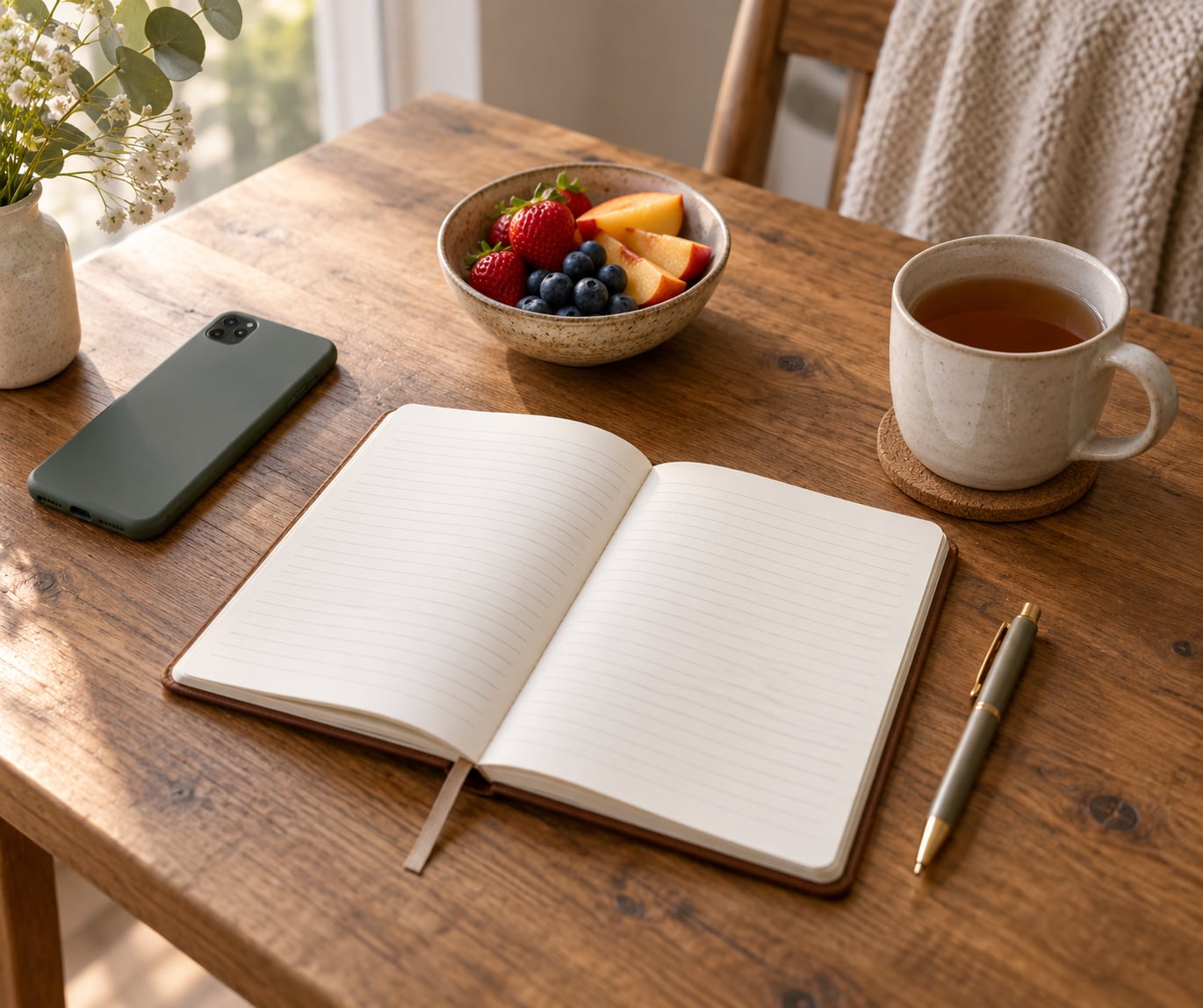
Practicing self care while dating means protecting your sleep, your attention, your friendships and your sense of self across the whole process — from the first swipe to the week after a bad date. It is not about bubble baths or being unshakeable. It is a handful of small, repeatable habits that stop a new connection from consuming the entire life it is supposed to add to. Most of it takes fifteen minutes a day.
I have watched the same pattern repeat among friends who start dating after a quiet few months: dating eats the calendar, the calendar eats the sleep, the broken sleep makes everyone easier to hurt, and then someone says they are tired of dating. The fix is rarely a bigger mindset shift. It is scheduling and boundaries, applied early and without apology.
This guide walks through seven steps you can start this week — checking in before you add more dates, setting boundaries you can actually hold, protecting sleep and food, building a schedule that leaves room for recovery, using small rituals after dates, spotting red flags without spiralling, and keeping a life that stands up without an audience.
Table of Contents→
- What You Need
- Step-by-Step: Build a Self-Care Routine That Fits Your Dating Life
- Step 1: Check In With Yourself Before You Start Dating More
- Step 2: Set Boundaries You Can Maintain
- Step 3: Protect the Basics: Sleep, Food, Movement, and Rest
- Step 4: Create a Dating and Self-Care Schedule
- Step 5: Use Small Rituals to Reset After Dates and Messages
- Step 6: Notice Red Flags Without Spiralling
- Step 7: Keep Growing Your Life Beyond the Dating App
- Common Mistakes
- Frequently Asked Questions
What You Need
You do not need a wellness stack or a budget. Five ingredients cover almost everything, and you probably already own four of them.
- Somewhere to track how you are doing. A notes app, a paper notebook or a calendar block. The point is noticing a pattern before it becomes a collapse, so a ten-second rating beats a perfect system you abandon in a fortnight.
- Time that is already spoken for. Not time you intend to protect, time that is protected. A standing Saturday morning walk or a Tuesday call with a friend counts because it exists before dating gets a vote.
- Two or three boundaries written as plain sentences. Not a list of rules for other people. Statements about your own capacity: I do not do late-night texting on work nights, I am not available Sunday mornings, I am not going to a second date if I was not looking forward to the first.
- Two supportive contacts who get the honest version. Not everyone needs to know everything. You need two people who will hear “that date was awful” without immediately offering solutions.
- One or two low-effort calming activities. Free, repeatable, no preparation. A shower, a playlist, a walk round the block. Things that work on a Tuesday when you have nothing left.
Step-by-Step: Build a Self-Care Routine That Fits Your Dating Life
Step 1: Check In With Yourself Before You Start Dating More
Before you accept another date, rate two things out of ten: your energy, and your emotional capacity for conversation and uncertainty. Most people answer honestly on a good week and lie on a tired one, which is exactly the week the answer matters.
Then name the actual reason you are opening the app. Connection out of genuine interest looks different from swiping because you are lonely, because it is 11pm, or because a friend asked what you are up to. All three are fine. None of them require the same amount of you.
A weekly check-in of fifteen minutes is enough. Three questions: what did I do last week that had nothing to do with dating, how much sleep did I average, and how many times did I check for a reply in the same hour twice. The first question is the important one, because a week with nothing on it that is not about dating is the clearest signal you will get.
How you know it worked: you agree to fewer dates on tired weeks without a guilty aftermath, and the ones you do say yes to are ones you are actually curious about.
Step 2: Set Boundaries You Can Maintain
A boundary you cannot hold is worse than none, because it teaches everyone involved that your words are decorative. The test is simple: could you keep this for six months without resentment? If not, it is too strict.
- Availability. Specific times rather than vague availability. “Not before noon at weekends” is usable; “I need space” is not.
- Texting pace. Name your rhythm. If you write once a day and they write six, say that you reply through the day rather than instantly, and that you are not a phone-in-hand person at 1am.
- Dates per week. Two dates in a week is already a full calendar for most people with jobs and friends. You can hold a boundary on pace without making it a lecture.
- Alcohol. Deciding in advance what you drink keeps a sober choice from becoming a social negotiation at the table.
- Physical pace. Say it early, say it plainly, and match it to your pace rather than someone else’s assumptions.
Communicate a boundary without apologising for having one. Brené Brown’s version of the idea still holds: your boundaries teach people how to treat you, and a boundary delivered with a long preamble reads as a request to be argued with.
How you know it worked: you have said a no without writing a paragraph justifying it, and the people worth keeping in your life adjust without drama.
Step 3: Protect the Basics: Sleep, Food, Movement, and Rest
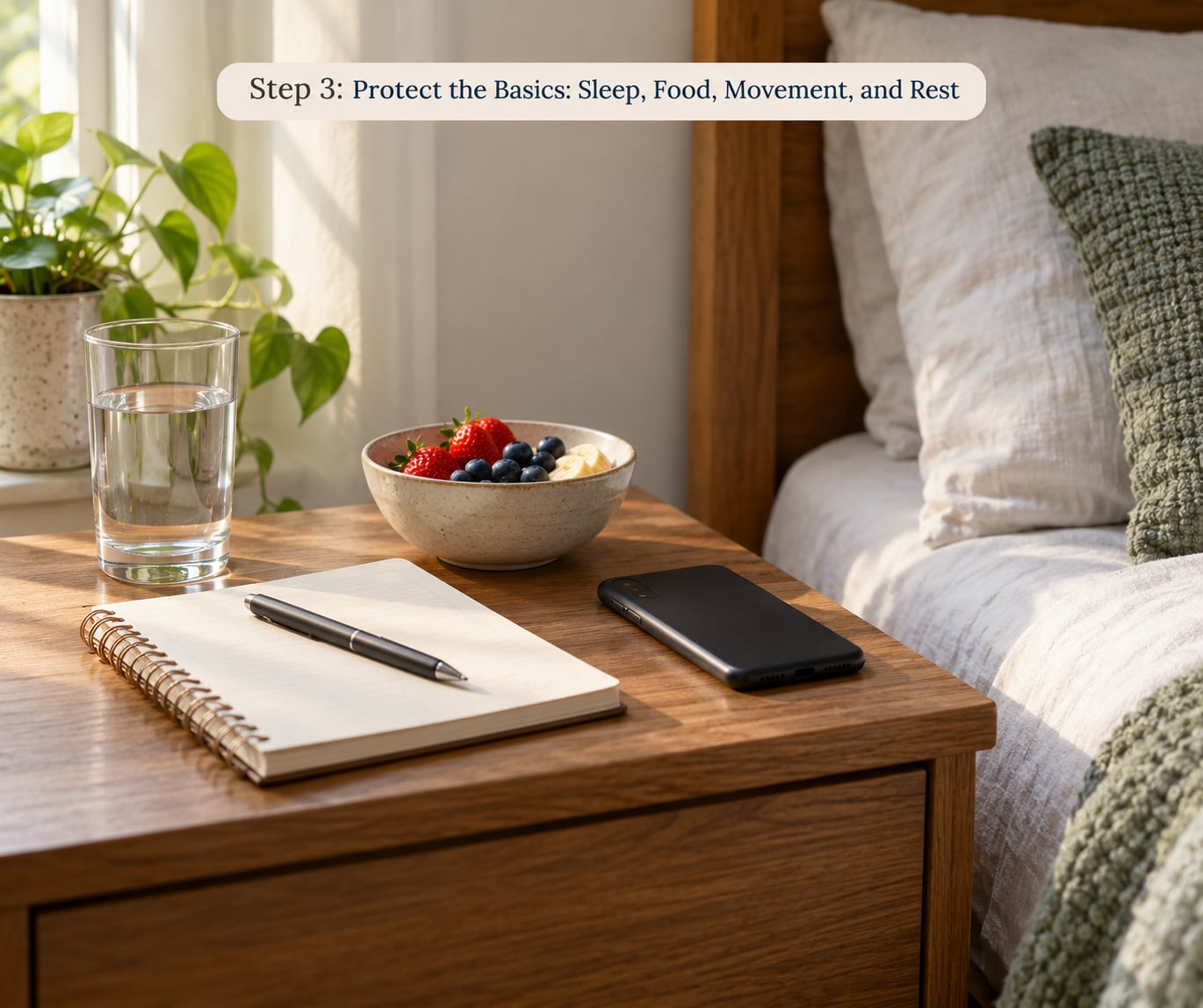
Dating is one of the few activities that spends your attention before the event as well as during it. Anticipating is part of it — rehearsing the conversation, checking the mirror, wondering what they are doing. That background hum costs you more than the two hours at the table.
Sleep is the load-bearing one. A short night does not just make you tired; it makes you more reactive, worse at reading a situation accurately, and slower to notice you are not enjoying yourself. You cannot out-discipline broken sleep with willpower in the moment.
Eat something real before a date. Walking into a restaurant at 8pm having had coffee since noon is a reliable route to making the wrong decision at 10pm and calling it chemistry. It is not about the meal, it is about not running an empty tank.
Movement only has to be a floor, not a project. A 20-minute walk most days beats a plan you abandon in the first week of bad weather. The floor version is the one that survives a dating dip.
For genuinely bad weeks, lower the bar rather than abandoning the habit. Shower, eat one decent meal, go to bed at a fixed time. A minimum you keep is worth more than an optimum you do not.
How you know it worked: you are not the person who snaps at their date on a Wednesday because Tuesday was short.
Step 4: Create a Dating and Self-Care Schedule
The single most destructive habit is treating every free evening as an available date slot. Two free evenings become two potential dates, both of which run long, and the rest of the week is recovery time you never named as such.
A weekly planning routine that works for most people takes ten minutes on a Sunday evening:
- Fix one non-negotiable block first — a gym session, a class, a call with a friend, a morning at the market. This goes in first because it fills first otherwise.
- Add dates around it, never on top of it. One or two, not four.
- Leave the evening after any hard or emotionally draining date completely empty. No second plans, no “let’s stay up” guilt.
- Leave one evening a week with no plan at all, so you always have somewhere to put a cancellation.
- Cap how much time goes to the apps themselves. Twenty minutes of deliberate swiping beats an hour of drifting through profiles for something to complain about.
Money deserves the same treatment. Dates cost real amounts, and nobody tracks them. If your spending on dating has become uncomfortable, treat it as a budget question rather than a willpower question — decide a monthly number and let it be the limit.
How you know it worked: cancelling a date produces mild relief instead of dread, and your weekly non-dating blocks still happen.
Step 5: Use Small Rituals to Reset After Dates and Messages
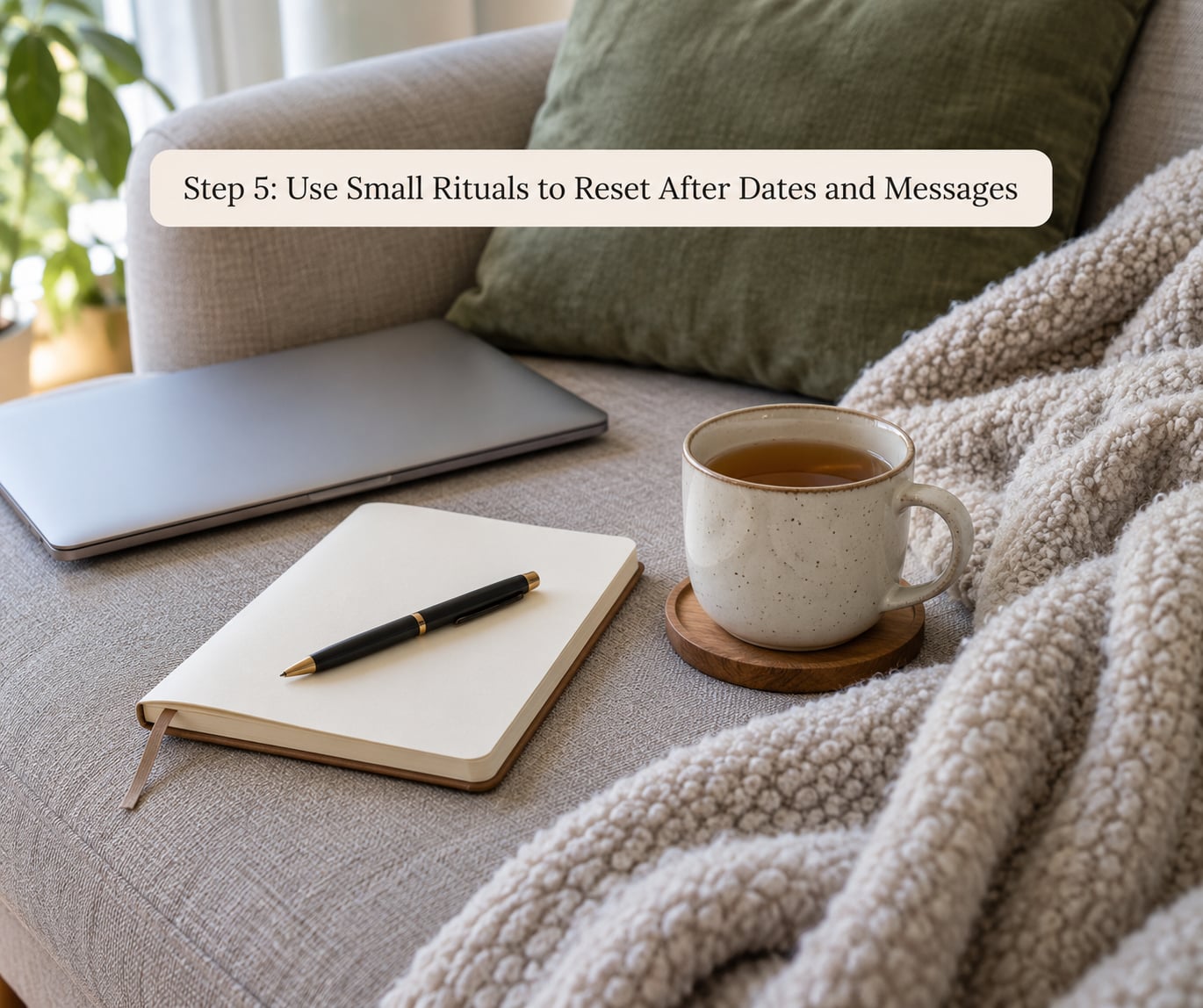
A ritual is a short, repeatable action that marks the end of an interaction. Its job is to tell your nervous system that the thing is finished, which is why closing your laptop and making tea can work when an hour of journalling cannot.
Four that earn their place:
- The three-line note. After a date: what I felt, what I need, what happens next. Ten words each is fine. This is the single most consistent tool people report using for post-date processing, and it takes two minutes.
- The walk. Ten to fifteen minutes, no podcast, no phone. Movement plus the lack of input is the fastest way to stop replaying a conversation.
- The call. Ninety seconds to the friend who gets the honest version. Saying the disappointing thing out loud stops it circulating.
- The shower. A literal reset: water, no checking, done. On low-energy weeks it is the only one of the four you will do, which is why it is on the list.
Pick the ritual that matches how drained you are, not the one you think you should do. A terrible date can take the full version. A good one needs a song and a shower.
Then close the loop. Decide whether you want a second date, a conversation, or nothing, and stop reopening the question. Re-reading a message forty times is not thinking, it is just anxiety with better eyesight.
How you know it worked: you can get through the evening without replaying the date, and you have decided something rather than still deciding.
Step 6: Notice Red Flags Without Spiralling
Most dating discomfort is ordinary. Awkward silences, nerves, mild disappointment. Noticing tension is not the same as detecting disrespect, and treating every awkward evening as a warning means you will eventually stop showing up.
The line worth caring about sits around your time, your safety and your wellbeing. Someone who repeatedly ignores what you said about pace, who pressures you past a limit you already stated clearly, or who makes you manage their feelings at the cost of your evening — that is not chemistry you are overthinking.
A pause-and-assess process that keeps you out of a spiral:
- Write the fact. Not the interpretation. “Replied once in four days” is a fact. “He is not interested” is a story.
- Count occurrences. One awkward evening is noise. The same pattern across four weeks with the same person is a signal.
- Name the pattern, not the person. If this keeps happening with different people, the review is about your setup — where you meet, how much time you give people early, whether you are choosing people because they are available rather than interesting.
- Then decide once. Continue, slow down, or end it. Setting the decision down is what stops the loop.
One last piece, and it belongs here: tell a friend where you are, who you are meeting, and when you expect to be home, especially for a first or second date. Most people frame that as safety caution. It is also self-care — it reduces the background hum of what-ifs and gives someone a reason to check in.
How you know it worked: you act on the second clear instance rather than debating the first one for a week.
Step 7: Keep Growing Your Life Beyond the Dating App
Dating sits badly when it is the main thing you are doing. Not because the rest of your life is better, but because the structure of your week — the things you cannot cancel, the people who do not need you to be charming — is what holds everything else steady.
Keep at least one goal with a deadline that has nothing to do with romance: a qualification, a language, a course, a half-marathon, a language-learning app, a weekly game. Keep at least two friendships that predate the current situation and that you can be normal around. Keep the hobby that has no audience and never did.
People who keep their outside interests tend to be easier to be around on a date, not harder. You arrive with something to talk about that is not the date, and you leave without the evening being the whole highlight.
A monthly review keeps the drift honest. Twenty minutes: what did I do this month that I am proud of, which relationships got thinner, and how much of my attention went to people I have not met yet. If the third answer is uncomfortable, that is the whole point of the review.
How you know it worked: you can miss a date and still have a week in the diary that went well.
Common Mistakes
Treating rest as something you earn. Rest as reward means you get it last, once everything else is done, which is never. Move it first — a scheduled hour of nothing before the week fills, not after. That single reordering fixes more exhausted daters than any new habit.
Accepting every date to prove you are interested. Going because a profile was nice, or because cancelling feels rude, is how a fun month becomes a three-month slog. You do not owe anyone your evening because they matched with you. One clear no, no explanation, no follow-up, is a complete sentence.
Ignoring the first uncomfortable signal. The mild annoyance you explain away at the time is usually the cheapest one to act on. Note it in your tracker and decide then, while it is still small, instead of gathering evidence for three weeks.
Overanalysing every message. Analysing a sentence for two hours is not insight, and the answer you are looking for is never in the words. Put a ten-minute cap on it: read, decide what you want to say, send it, close the app. Whatever happens next is information you cannot control anyway.
Letting friendships fade the moment someone new appears. The friendship does not announce that it is being replaced; it just gets cancelled twice. Put one standing plan in the calendar with each person you actually want to keep. The friends who know you best are also the fastest way to notice you are shrinking.
None of this is complicated. It is a calendar, three sentences about your capacity, and someone you tell the truth to. Start with one.
Frequently Asked Questions
How do I practice self care when dating feels disappointing?
Treat the disappointment as information rather than a verdict. Name the specific part that stung: rejection, a flat evening, or being ignored. Then do one concrete thing tonight that has nothing to do with dating — a walk, a call, an early night. Journaling works well here because long-term journalers describe writing through the spiral until the feelings catch up with the thinking. Decide one practical next step, then stop re-reading the conversation.
Can I take a break from dating without ruining my chances?
Yes. A deliberate pause costs you very little, and an exhausted pause taken badly costs you more. Delete the apps if that helps, or just stop opening them, and give yourself a set period — a month is usually enough to notice whether you want to go back. Put the time into the people and projects already in your life. When you return, you date from a steadier place, which tends to show in how the dates go.
What are healthy boundaries to set with someone I am dating?
Start with availability and texting pace, then add dates per week, alcohol, and the pace you are comfortable with physically. Say them early and without a long apology, and phrase them around your capacity: I am not a late-night texter, or I am not available Sunday mornings. A good boundary can be repeated calmly without becoming a topic of argument, and someone worth keeping will adjust rather than push.
How do I stop feeling anxious about texts and dates?
Anxiety here usually comes from uncertainty, so tighten the loop. Decide what you want from a given interaction, send one clear message, then close the app and do something with your hands. Before a date, use a short ritual that marks the transition: a ten-minute walk, a playlist, a phone left at home. Tell a friend where you are. Anxious daters benefit most from structure; avoidant daters from naming the feeling out loud rather than retreating.
How can I balance dating with work and caring for myself?
Block one non-negotiable personal commitment before you book anything, cap dates at one or two a week, and leave the evening after a draining date empty. Decide your app time rather than drifting, and put a monthly spending limit on dating so cost stops being a surprise. If your non-dating week already has nothing in it, that is the first thing to fix — dating will not stay in the margins until it gets more room.
Start with the fifteen-minute check-in tonight, and pick one boundary to state on your next date. That is the whole thing. Everything after it gets easier because you already built the part that holds the rest together.