
If you want to know how to stay friends with an ex without it turning complicated, the short answer is simple: it works only when the friendship is platonic, mutual, and nobody is waiting for the other one to change their mind. The honest version is that most people who try this right after a breakup slow down their own healing, so a real break in contact comes first. Then you set boundaries you could both repeat out loud.
This guide covers the practical side, since that is what usually goes wrong. How long to wait, what to say in the one conversation that sets the terms, how to behave when they start dating someone new, and when distance is simply the better call. If you are co-parents, share a mortgage, or sit in the same friend group, some version of this is unavoidable, so it is worth doing well.
Table of Contents→
- What You Need Before You Reach Out
- Step-by-Step: How to Stay Friends with an Ex
- Common Mistakes and How to Fix Them
- Frequently Asked Questions
- Can you be friends with an ex if you still have feelings for them?
- Should I be invited when my ex starts dating someone new?
- Why do I feel jealous when an ex spends time with a new partner?
- Is it unhealthy to stay in contact with an ex on social media?
- How long should you wait before trying to be friends with an ex?
- How do you know when an ex friendship is making your healing worse?
- Conclusion: Start With One Honest Conversation
What You Need Before You Reach Out
Four things have to be true first, and being able to tick three out of four is not the same as being ready.
Honest intentions. You want the person in your life as a friend, not as a backup plan. On r/BreakUps, the most common regret is not the friendship failing, it was that the friendship was never what they wanted at all.
Emotional stability. The breakup is not still the main thing you think about most days. Reopening contact while you are still raw tends to reopen the wound, and people on r/ExNoContact describe going quiet again after a few weeks of casual texting.
Specific boundaries. Vague friendship offers are what create the mess. You need concrete answers on frequency, subjects, and one-on-one versus group settings before you start.
A realistic schedule. Some contact is not the same as being available. Decide what you can genuinely do in a bad week, not just on a good one.
Some exes should not remain in your life at all, and being clear-eyed about that is a sign of strength rather than failure. Breakups involving abuse, coercive control, or a partner who will not accept a no are the clear cases for distance. Betrayal is close behind: people on r/Codependency and similar communities describe staying close after cheating as reopening the same wound on a loop. If you find yourself explaining away a boundary your ex keeps crossing, that is information, not a phase.
Step-by-Step: How to Stay Friends with an Ex
Six steps, in order. Rushing the first two is what turns a friendship back into a relationship you never wanted.
1. Confirm Why You Want to Stay Friends With an Ex
Be honest with yourself about the motive, because the motive predicts the outcome more accurately than the breakup does.
Questions worth asking: would you still want contact if they were completely unavailable and refused any future reconciliation? Are you keeping them around because you genuinely enjoy their company, or because the alternative is silence? Do you want to watch their life, or be in it?
A workable version sounds like: I liked being around them, we share a project and real friends, and I want that in a non-romantic form. A version that will not work sounds like: I want to stay close in case things work out, or because I feel guilty, or because I am lonely and they are the easiest person to talk to.
If your honest answer is the second list, no-contact is not a punishment. It is the shortest route to the life you actually want.
2. Have a Direct Conversation About the New Dynamic
Have it out loud, not over text. A short script: I want to stay in touch, and I want it to be a friendship, not a slow way back together. Text and group hangs are fine. I do not want relationship updates or late-night conversations. If either of us feels something shifting, we can stop.
Then listen to how they describe it back. If you say no late-night talks and they say sure, totally fine, but then send a 1am message that runs twelve paragraphs, you do not have an agreement, you have a wish. Boundaries work when both people can describe the same rules in roughly the same words.
It is fair for them to need the same clarity about you. Someone on r/dating_advice described a workable version of exactly this: no daily contact, group hangouts only, no one-on-one dinners in the early months.
3. Agree on Contact Methods and Boundaries

Pick a level that fits both your lives, and name it out loud rather than drifting into whatever feels convenient at 11pm.
The options run from a quick text every few weeks, to group hangouts only, to shared events and nothing private, to a polite permanent no-contact. All of them are legitimate. What does not work is leaving it undefined.
Worth covering explicitly: no flirting and no innuendo, no detailed updates about your current dating life, no late-night emotional conversations, and no expectation of fast replies. Reply speed is a surprisingly common flashpoint, because a slow reply reads as a message to some people.
Mutual friends need the deal too, because they are usually the ones who will invite you both to the same birthday. Saying once, early, that you are keeping things easy, prevents a lot of later awkwardness.
4. Start Small and Let Trust Rebuild Naturally
Do not rebuild the old routines in the first month. Recreating your former dynamic immediately is how people end up back in the same conversation, at the same time of night, about the same thing.
Good early steps: a short text, a reaction to a photo, joining a group dinner, a practical favour that takes twenty minutes. Low stakes, easy to end, easy to look forward to.
The signal that it is working is dull in the best way. Conversations end without either of you trying to extend them. You do not leave every interaction wondering what it meant. Their new partner is mentioned without your chest tightening. That last one is the honest test.
5. Handle Awkward Moments Without Overreacting
Something will come up. Usually it is a new partner, a shared event, or a stray comment about the future. You only need a short response and a way to change the subject.
Scripts that work: good for them, I am happy they are happy, you two sound well suited, or just: so, the group is doing what on Saturday? On being asked about a possible future together: I am not thinking about that, and I would rather not speculate.
If a conversation slides back into relationship territory, reset rather than argue. Something like: this is not where I want our conversations to go, can we talk about something else? You are not obliged to defend a boundary at length. Saying it once, calmly, and moving on is the whole job.
If you are in a new relationship, tell your partner about the friendship before they hear about it from someone else, and frame it as what it actually is: a defined contact with a former partner, with the boundaries you both agreed to.
6. Check In With Yourself and Decide What Feels Healthy
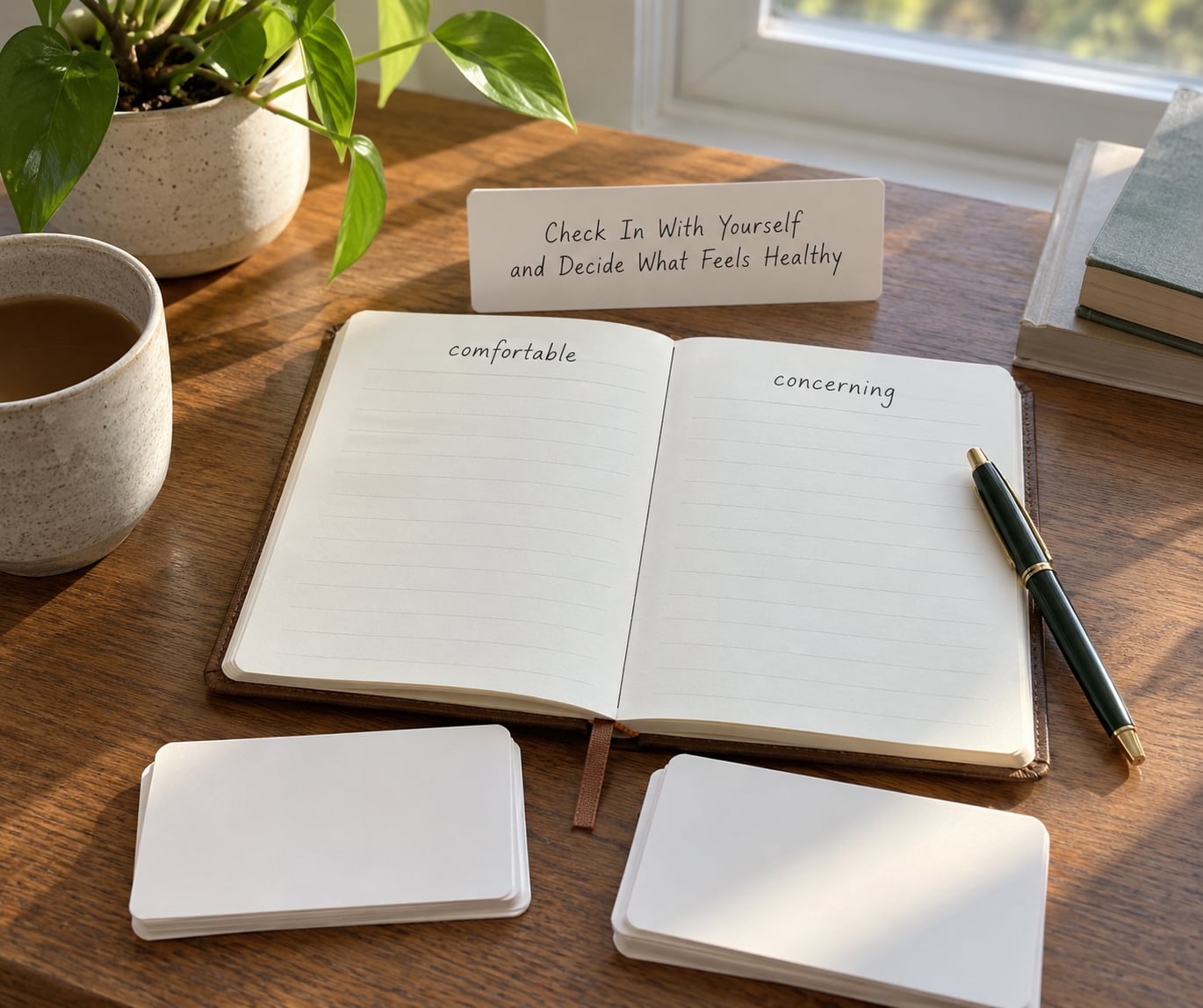
Give it three to four weeks before you judge it. One awkward evening proves very little, and one good dinner can hide a month of dread.
It is improving when you look forward to contact without dreading it, you are not tracking their relationship, and the time you spend with them does not pull you back into old arguments.
It is neutral, and that is fine, when the friendship is pleasant but shallow. Not everyone stays close. Plenty of healthy exes become pleasant acquaintances and nothing more, and nobody is harmed by that.
It is harming you when you compare their new partner unfavourably, you cancel plans you wanted to attend because they would be there, you check their profile more than you used to check theirs, or you find yourself hoping things change with no plan for what happens if they do not. A slow-motion reunion is the quiet version of this: contact that never fully becomes a relationship and never fully lets go.
Co-parents are the exception. There, a working relationship is not optional, and the useful question is how to keep it functional without pretending it is a friendship.
Common Mistakes and How to Fix Them
Ignoring your own romantic hopes. If part of you is still hoping, the friendship will keep that hope alive without ever letting you act on it. Say it out loud to a friend, or write it down where you can reread it. People on r/FemaleDatingStrategy describe this as letting the ex orbit your life, which makes moving on nearly impossible.
Crossing a boundary you agreed to. You set the rule, now you are the one texting at midnight. Write the rules down somewhere visible, and treat a crossing as a signal to reset rather than a small mistake to shrug off.
Using the friendship as free therapy. This is the version that hurts most, because the ex feels bound to listen and you end up rehashing the breakup instead of moving on. If you need to talk about them, talk to a friend who is not in the situation.
Forcing constant contact. Consistency can feel like proof of a real friendship, but obligation is not warmth. Low contact that is comfortable for both people beats regular contact that one of you dreads.
Comparing your ex to your current partner. Nobody wins that comparison, least of all the person you are actually dating. Keep relationship comparisons out of the conversation entirely.
Hoping the friendship will quietly turn into a relationship. It sometimes does, and that is the risk. People who survive this approach tend to do it the boring way: full no-contact, no ambiguity, and a decision made on a clear day rather than a hopeful one.
A few habits help more than the rest. State the rules once, out loud, at the start. Keep the early months to groups and shared settings. Have one person outside the situation who you check in with honestly. And if you cannot describe your arrangement to a new partner without wincing, that is a sign the arrangement needs work, not proof that the new partner is insecure.
Frequently Asked Questions
Can you be friends with an ex if you still have feelings for them?
Usually not, at least not yet. If part of you wants the friendship to become a relationship again, the contact will keep that hope alive and stop you from moving on. The workable test is whether you would still choose contact if reconciliation were permanently off the table. If it would not, take the no-contact period first.
Should I be invited when my ex starts dating someone new?
Only if you can be there without performing. If you spend the evening watching them with someone else and quietly comparing, going is your decision to decline, and you do not owe an explanation beyond something simple like I will sit this one out. If you go, keep it light, do not drink too much, and do not talk to their new partner about the past.
Why do I feel jealous when an ex spends time with a new partner?
Because your nervous system still filed them as a partner, and jealousy is an automatic reaction rather than a failure of character. It usually means you are not as moved on as you hoped, which is information, not shame. Either the contact was too soon, or it is serving as a second chance rather than a friendship. Both are fixable, starting with honesty about which one it is.
Is it unhealthy to stay in contact with an ex on social media?
It depends on what you do there. Seeing a curated highlight reel of their life keeps you updated on things you never asked for, and new partner posts are the most common trigger people report. Muting their stories and unfollowing them usually works, unfriending works too, and blocking is fair when anything they post reliably sends you sideways.
How long should you wait before trying to be friends with an ex?
Long enough that you are not still checking their relationship status. Most of the people who describe a successful version report at least a few weeks of genuine no contact, and longer for longer relationships or messy endings. There is no magic number, because the question is whether you can hear about a new partner without it landing badly. If you cannot, it has not been long enough.
How do you know when an ex friendship is making your healing worse?
Watch for a few patterns rather than one bad evening. You are checking their profile more than before, you avoid things you wanted to attend because they might be there, you compare their partner to yours, or every contact leaves you hopeful and slightly worse. If three or more of those are true after a month, the friendship is a holding pattern, and stepping back is the faster way forward.
Conclusion: Start With One Honest Conversation
Start with yourself, then with your ex. Check your motives honestly, wait until the answer is a clear no, and have one direct conversation about what the contact will and will not look like. Keep it small, keep it light, and review how it feels after a month. How to stay friends with an ex works for some people and quietly holds others back, and the difference is almost always whether the friendship is real for both of you or only for one.