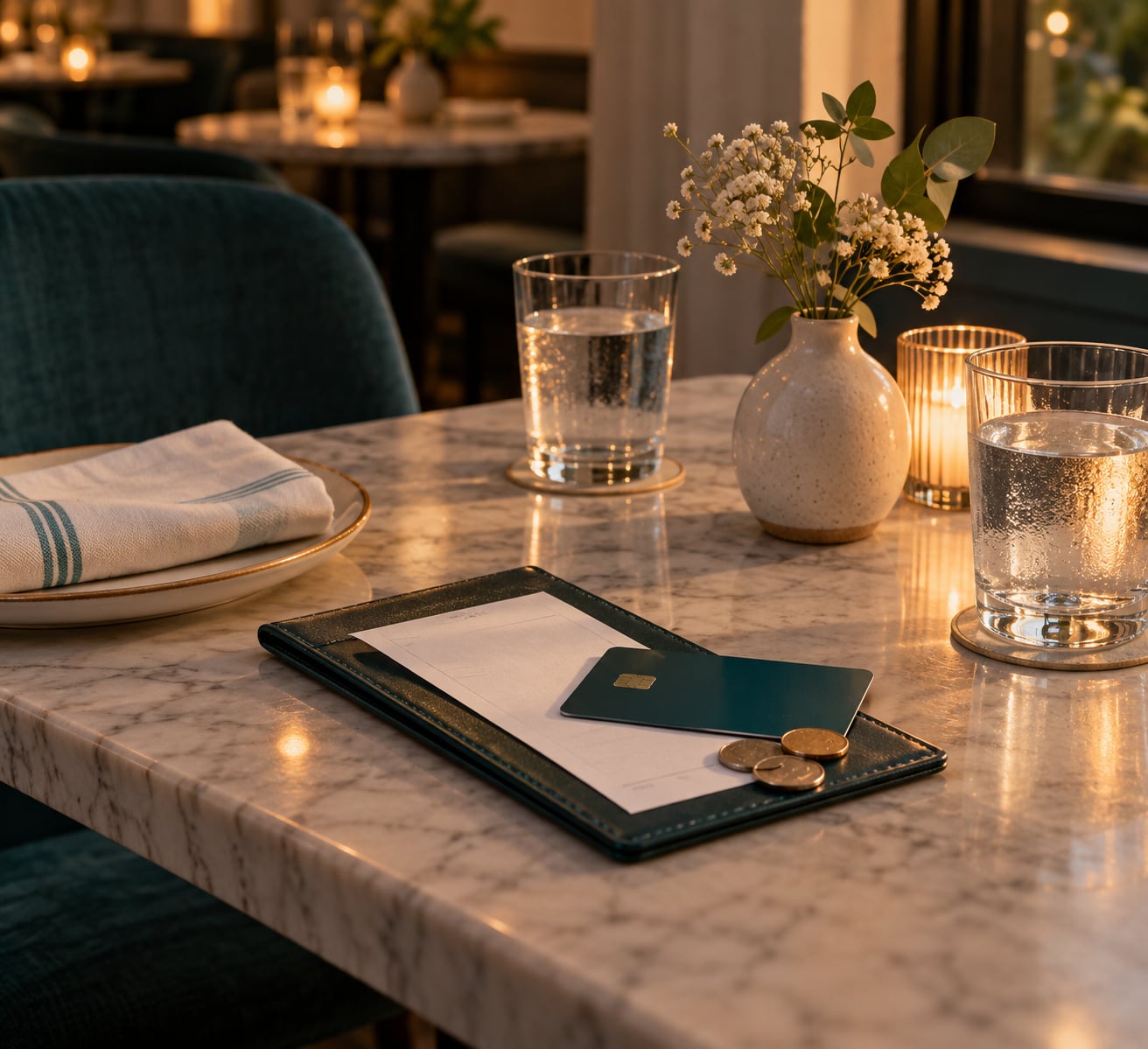
The fastest way to split the bill on a date without awkwardness is to name the plan before the check ever lands: say out loud whether you are going Dutch, taking turns, or covering it, and let the other person answer. Money rarely causes friction over the amount. It causes friction over the surprise, and surprise is the only thing you have to manage here.
Going Dutch simply means each person pays their own share instead of one person covering everything. You will also hear people call the same thing splitting the check, splitting evenly, or paying your own way. Different words, identical move. What makes it feel awkward is not the split itself but the three seconds of silence while two people try to read each other’s intentions.
That silence is well documented in forum threads. On subreddits like r/AskReddit and r/relationships, the same pattern repeats: almost nobody is arguing about principle, they are describing a specific moment at a specific table. The consensus that keeps surfacing is that money on dates stops being a problem the moment somebody says it out loud, including among people who hold firm traditional views about who pays.
So this is a guide about mechanics rather than morals. There is no correct payer here, only the arrangement both people agreed to and a way of raising it that does not make the evening feel like a negotiation.
Table of Contents→
- What You Need — No Equipment, Just Clarity
- Step-by-Step: How to Split the Bill on a Date Without Awkwardness
- 1. Decide What Is Fair for This Particular Date
- 2. Make the Payment Plan Clear Before Ordering
- 3. Check the Bill Without Making It a Test
- 4. Say the Split Clearly: How to Ask Without Sounding Cheap
- 5. Handle Different Budgets Without Comparing Finances
- 6. Avoid Turning the Bill Into a Test of Character
- Five Ways to Handle the Bill, and When Each One Fits
- Common Mistakes at the Check, and the Fix
- Frequently Asked Questions
- Should I offer to split the bill on a first date?
- How do I handle the bill if I ordered something more expensive?
- What if my date expects me to pay every time?
- Is it okay to take turns paying for dates?
- How do I discuss the bill without making the other person feel cheap?
- What should I do if my date says they will pay later but never does?
- Conclusion
What You Need — No Equipment, Just Clarity
Nothing physical is required. What you need is a working answer to three questions before you sit down, and a way of saying that answer out loud without apologising for it.
First, the setting. A coffee shop, a bar with small plates, and a tasting-menu restaurant are three very different financial conversations. Knowing which one you are walking into tells you how much precision the split needs.
Second, a rough sense of the total. You do not need the exact figure. Knowing whether the date lands somewhere around twenty dollars or somewhere around two hundred changes who should reach for their wallet and when.
Third, your payment options. Whether you can pay by card, whether the place splits cards between two people, whether you carry cash, and whether splitting means splitting the bill or splitting the tax and tip too. Restaurants in the United States will split a check, but it is easier for everyone if you know that before the server arrives with the book.
What you also need is your own honest read on money in dating right now. Someone who wants a traditional arrangement and someone who wants an equal one can both be fine, but they cannot both be fine if nobody says which they are. Decide which you are before the date, not at the table.
Step-by-Step: How to Split the Bill on a Date Without Awkwardness
1. Decide What Is Fair for This Particular Date
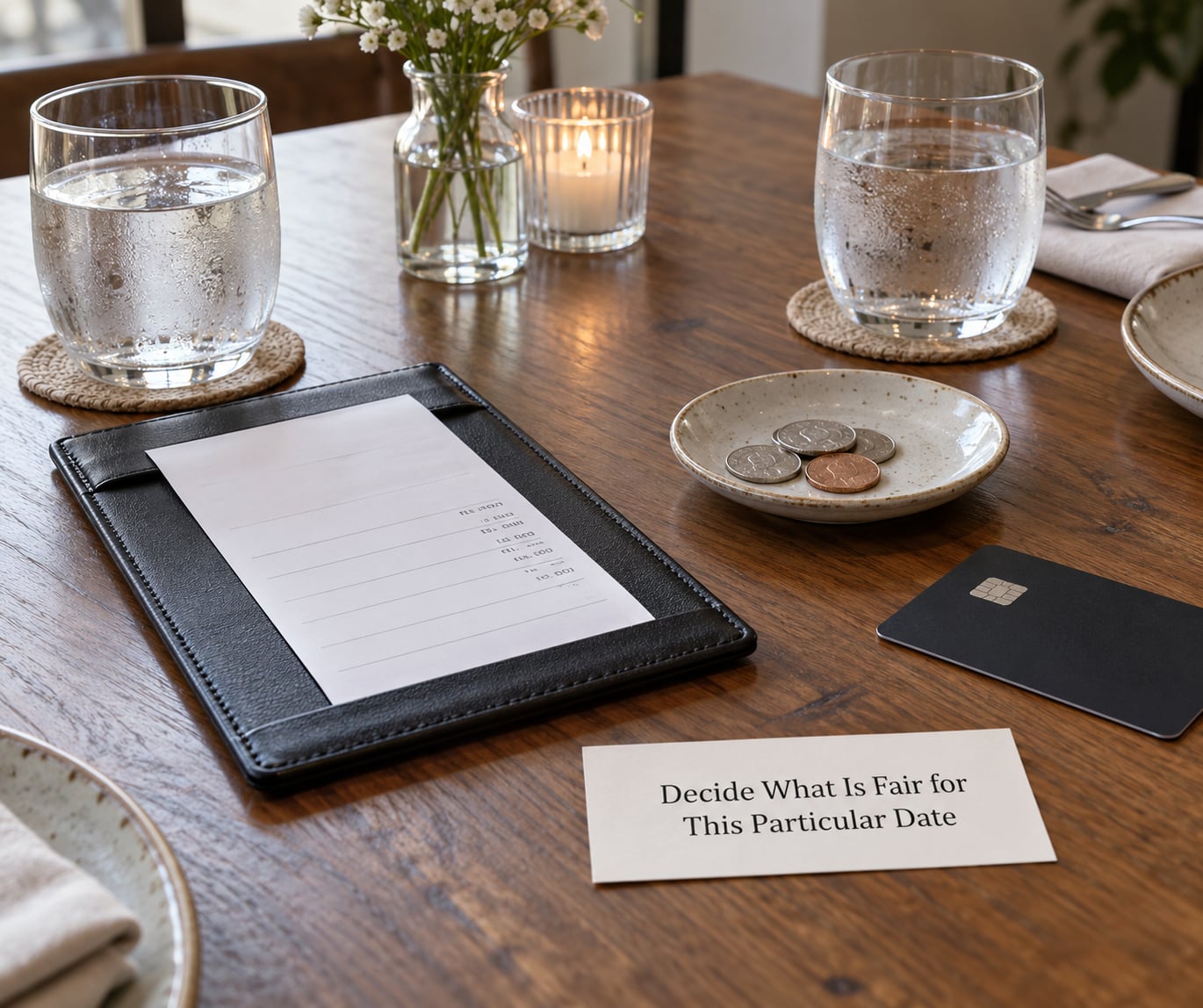
Fairness is not one thing, and the four workable arrangements are worth knowing cold before you need one.
- Split evenly. Each person covers half the bill, tax and tip included. Cleanest when you ordered roughly the same and neither of you has flagged income.
- Take turns. One date is yours, the next is theirs. This is the arrangement long-term couples converge on once the arithmetic every single time gets tiresome.
- You cover it. A genuine offer, made once, without an expectation attached. Fine when you chose the venue and can afford it.
- Something else entirely. They pick the coffee shop, you handle tickets for the show, one of you keeps a running tab that settles at the end of the month.
Which one applies depends on the date type, your budgets, and what came before. On a first date, an even split is the default because nobody knows anything yet. On date four, turns usually feel more relaxed than recalculating. If you invited someone to a place you know is expensive, taking it on yourself is a fair call even if you would rather not.
You will know it worked when you could state the arrangement in one sentence without wincing.
2. Make the Payment Plan Clear Before Ordering
Signalling early removes the entire problem. You do not need a speech, just one line delivered while you are still reading the menu, before either of you has committed to anything.
Try: Shall we go Dutch tonight? Or I would rather split this one, if that works for you. Or, if you are covering it and want that to be an offer rather than a claim: I would love to get this one, and I would totally understand if you would rather split it.
That last line is the one that does the most work. It gives the other person a clean way to say yes to splitting without disagreeing with you out loud, which is exactly the offer people are afraid to make and almost nobody rejects.
Venue choice does the same job silently. Suggesting the place with a modest menu is a clear signal that an even split suits you. Suggesting a tasting menu says you have already accounted for paying.
3. Check the Bill Without Making It a Test
When the check arrives, read it before you say anything. Look at the total, the tax, the tip, and whether anyone added an item you did not order. Two people looking at the same piece of paper for four seconds does more for fairness than any amount of guessing.
If something looks off, describe it rather than accuse. Did we get charged for the side dish twice? lands very differently from You added stuff without asking. The first is two people checking a bill. The second is a trial, and your date will feel like they are on one.
If your date orders noticeably more than you did, this is the moment to itemise. Ask the server to print the items with prices, then say plainly that you would like to pay for what you ordered plus a fair share of what is shared. Nobody reasonable will argue with a receipt and a number.
4. Say the Split Clearly: How to Ask Without Sounding Cheap
Clarity is what protects you here. Short sentences, no hedging, no apologising for asking.
Ask directly. Would you mind if we split this? It is a complete question and it deserves a complete answer.
Offer turns. I would rather split it this time and get the next one. This usually lands well because both people end up owing something, which is the least charged arrangement in dating.
Accept a treat gracefully. If someone insists on paying, ask once: Are you sure? We can split it. Then drop it. Repeating the offer three times makes your acceptance feel reluctant and makes them feel accused.
Decline gracefully. If they offer and you would rather split, say so warmly and once: Thank you, that is really kind, but I would feel better splitting it. Then actually split it.
Handle the unequal order. I got the smaller plate, so let me cover the difference. Or the itemised approach from the step above.
Settle it after the date. I put my card down, send me half and I will get it back to you tonight. Almost every payment app makes this a two-minute job, and it removes the negotiation from the table entirely.
Two moves to skip: the slow fake-out reach for your wallet, which reads as theatre, and the card-slap volley, where both people insist in turn until someone wins. People on the receiving end consistently describe both as childish, and neither one buys affection.
You will know it worked when the other person answers without a pause and the conversation moves straight back to the evening.
5. Handle Different Budgets Without Comparing Finances
Large income differences are the quietest source of resentment in dating, and they usually surface at the check. Nobody wants to be the person who cannot afford the venue, and nobody wants to be the person who keeps paying and slowly starts keeping score.
Three approaches work. Take turns, so the spending alternates without anyone keeping a ledger in their head. Suggest a venue that matches the smaller budget, which people consistently describe as one of the strongest signals of consideration available. Or split evenly and treat the difference as nobody’s business, because half of a modest bill is affordable to almost anyone.
What does not work is paying everything and calling it generosity while quietly resenting it, or paying everything to buy affection you cannot afford. Generosity is an offer. It stops being generosity the moment it becomes a transaction.
If you genuinely cannot afford the date, say so early and pick something else. Being broke is not a dating flaw, and pretending otherwise is how people end up quietly stressed for a week.
6. Avoid Turning the Bill Into a Test of Character
Be honest with yourself about which situation you are in, because the two need completely different responses.
A one-time mismatch is a communication gap. You assumed, they assumed differently, everyone was being reasonable. Fix it with a sentence and move on. I assumed we were splitting, but I would have been happy either way.
A pattern is something else entirely. If one person has paid every bill for months while never once asking how you would handle it, or if money is used to create an obligation, that is not a bill-splitting problem and no phrasing fixes it. That is a relationship conversation, and it deserves to happen away from a restaurant table.
Money is a genuinely useful compatibility signal, and pretending otherwise is its own kind of avoidance. People who can talk about paying early are usually the people who can talk about it later, when the stakes are much higher.
Five Ways to Handle the Bill, and When Each One Fits
- Split evenly. Fits first dates, similar budgets, and any date where both of you prefer it from the second one onward. Watch for tax and tip getting forgotten until after the card is already out.
- Take turns. Fits dating past the third or fourth date and long-term couples. Watch for one person quietly counting more carefully than the other.
- Itemise by dish. Fits very different orders, one expensive bottle, shared starters plus separate mains. Watch for it turning into public arithmetic if you do it in front of the server.
- One for one. Fits coffee, drinks, tickets, anything with a clean per-person price. Watch for awkwardness when one item costs noticeably more than the other.
- You cover it as an offer. Fits when you chose the venue, you can afford it, and you want to. Watch for expectations forming fast if it happens every single time.
Common Mistakes at the Check, and the Fix
Reaching for your wallet before anyone has decided. The fake-out makes both people guess, and it usually ends with the wrong person paying first. Fix: decide first, move second.
Asking in an apologetic tone. Sorry, but I kind of wondered if we could maybe split? turns a normal request into a small confession. Fix: drop the qualifiers and ask it straight.
Insisting after the other person has declined. One polite Are you sure? is courtesy. Three is an accusation. Fix: ask once, accept the answer, thank them.
Assuming income equals entitlement. Whatever you earn, the split you agreed to is the split you honour. Fix: decide the arrangement before you know what is on the bill.
Sitting in silence until the server hovers. Silence gets interpreted, and people read it in whichever direction their anxiety is already pointing. Fix: the second you decide, say it.
Letting one date’s ordering dictate the whole relationship. A single expensive bottle is a conversation, not a precedent. Fix: settle that bill, and choose the venue differently next time.
Treating the check as a scoreboard. The moment you are keeping track of who has spent more, the fun is over and you have started an accounting relationship. Fix: if the running total bothers you, switch to turns rather than tracking.
A few habits make the whole thing easier. Choose the venue when you can, and pick a place where the price is not the main event. Say the plan out loud before ordering rather than at the table. Keep cash or a card you are sure of, because a card that declines in front of your date is an awkwardness no script can cover.
Frequently Asked Questions
Should I offer to split the bill on a first date?
Yes, and offering is almost always better than staying silent about it. On a first date nobody knows the other person’s budget, so an even split is the fairest default and nobody has to be exposed by it. Saying it early, even something as casual as wanting to go Dutch tonight, removes the whole awkward guessing game.
How do I handle the bill if I ordered something more expensive?
Say it plainly when the check arrives and ask for the itemised version. Offer to cover what you ordered plus a fair share of anything you shared. A receipt and a specific number are hard to argue with, and they keep the conversation about the bill instead of about the person who ordered it.
What if my date expects me to pay every time?
You do not have to, and you also do not need to make it a confrontation. Pick a date, say you would like to cover this one, then on the next one say you would rather split or take the tab. Consistency over a few dates communicates more clearly than one long explanation would.
Is it okay to take turns paying for dates?
It is one of the most common arrangements in dating and most people find it the most comfortable one. Alternating means neither person keeps score, nobody is always the guest, and the decision stops needing to be made in public each time. Most couples land here naturally somewhere around the third or fourth date.
How do I discuss the bill without making the other person feel cheap?
Keep the words neutral and the timing early. Rather than raising the topic when the check lands, mention your preference while you are still looking at the menu. Splitting is a shared logistics decision, not a judgement about what the other person can afford or whether they are worth the money spent.
What should I do if my date says they will pay later but never does?
Send one friendly reminder once, a day or two later, with the amount. Most of the time it is simply forgotten rather than avoided. If a second reminder goes unanswered, that tells you something useful about reliability, and it is fair to stop expecting the balance without making it a confrontation.
Conclusion
Do one thing before your next date: decide the arrangement and say it out loud early. Name the split, the turns, or the treat, keep the sentence short and unapologetic, and let the evening stay about the evening.