
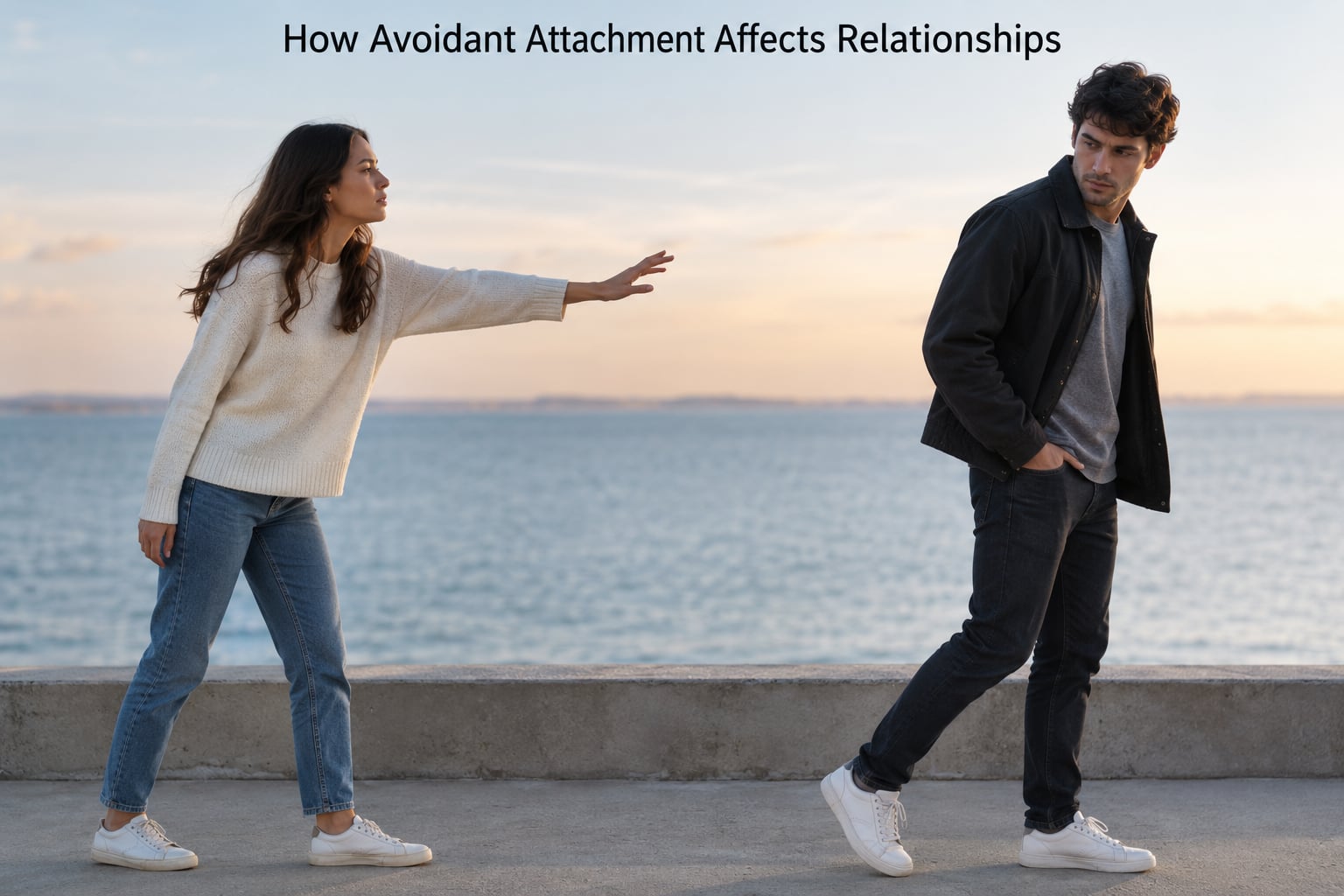
Avoidant attachment affects relationships by pulling closeness and emotional need out of reach. It shows up as hyper-independence, hot-and-cold attention, shutdown during conflict, and a push-pull cycle where one partner reaches and the other retreats. None of that is a verdict on anyone’s love, but the patterns are real, repetitive, and workable.
This guide is written for adults reading it at 11pm after another fight nobody finished, or after a week of texts going unanswered. You’ll find the everyday behaviors first, then the practical responses that help, then honest limits on what you can fix from the outside.
Table of Contents→
- How Avoidant Attachment Affects Relationships
- What Is Avoidant Attachment?
- Common Relationship Patterns
- Why Avoidant Attachment Can Look Confusing
- How Avoidant Attachment Affects Communication and Conflict
- How to Tell If Avoidant Attachment Is Affecting Your Relationship
- What Can Help When Someone Is Avoidant
- How to Respond Without Enabling Withdrawal
- Can Avoidant Attachment Change?
- Frequently Asked Questions
- Does avoidant attachment mean someone does not love you?
- How can I tell the difference between needing space and avoidant withdrawal?
- Is avoidant attachment the same as being a bad partner?
- What should I say to someone who keeps pulling away?
- Can someone with avoidant attachment learn to be more emotionally available?
- When is it time to stop trying to fix a partner’s attachment pattern?
- Where to Start
How Avoidant Attachment Affects Relationships
Attachment theory starts with John Bowlby’s idea that children seek proximity to a caregiver for safety, and Mary Ainsworth’s Strange Situation, which showed how reliably children use a caregiver as a secure base. What a child learns about whether the caregiver comes back shapes expectations about closeness for decades afterward.
Avoidant attachment is one insecure style. It forms when care was inconsistent, dismissive, or emotionally unavailable, so closeness came to feel risky rather than safe. In adult relationships that early learning turns into a set of habits: stay self-sufficient, ask for little, need no one, and leave before anyone can leave you.
The impact lands in five places most readers recognize:
- Fear of intimacy. Emotional closeness registers as danger, so depth gets treated as a risk to manage.
- Hyper-independence. Needing someone feels like weakness, and solitude gets dressed up as freedom.
- Hot-and-cold behavior. Strong attention early, followed by cooling as the relationship deepens.
- Conflict avoidance. Tension triggers shutdown, humor, or exit instead of repair.
- The push-pull cycle. Distance invites pursuit, pursuit invites more distance.
Here is what avoidant attachment looks like compared with the other styles:
| Style | Closeness | During conflict | Fears | Needs from a partner |
|---|---|---|---|---|
| Secure | Wants it, and can hold it | Stays and talks | Losing the relationship | Steady presence and honesty |
| Anxious | Craves it, worries about it | Pursues and escalates | Abandonment and being unworthy | Reassurance and responsiveness |
| Avoidant | Values it at a distance | Minimizes, deflects, or leaves | Being overwhelmed and controlled | Low-pressure requests and patience |
| Disorganized / fearful-avoidant | Wants closeness and fears it | Swings between clinging and vanishing | Abandonment and harm | Consistency without intensity |
What Is Avoidant Attachment?
Everyone needs personal space. Sometimes a hard week leaves someone quiet for two days, and nothing deeper is happening. That is ordinary life, not a pattern.
Persistent defensive behavior looks different: it recurs whenever the relationship deepens, it includes discomfort with dependence, vulnerability, or reassurance, and it shows up even when the person is the one who wants closeness most. Someone who can sit with an uncomfortable feeling and stay present is not avoidant, even if they’d rather go for a walk first.
Two subtypes are worth naming. Dismissive-avoidant people lean on self-reliance and often look confident from the outside, which is why friends and family struggle to believe anything is wrong. Fearful-avoidant people want closeness badly and still pull away, so they tend to appear anxious as often as distant.
Two caveats matter here. Attachment styles are a framework for describing patterns, not a diagnosis, and you cannot diagnose your partner from the outside. And avoidant traits overlap with PTSD, depression, autism, and grief, which are clinical matters and need a qualified professional rather than a relationship article.
Common Relationship Patterns
The pursue-withdraw cycle
One partner asks for reassurance, the other experiences it as pressure and pulls back, which increases the ask, which increases the retreat. Both people are behaving according to their own protective system, which is exactly why it feels so puzzling from inside.
Minimizing feelings
“You’re overreacting” and “it’s not a big deal” sound dismissive, but they often serve a real purpose: taking the emotional charge out of the room so the person can survive it. The problem is that the feeling does not disappear, it accumulates.
Delayed responses
Texts take hours, plans get confirmed late, and important answers arrive after the moment has passed. Often the reply is being composed carefully and then dropped, because composing feels like exposure.
Independence as protection
Saying “I don’t need anyone” is often the safest sentence available. Hyper-independence protects against disappointment, and it also makes being left feel less surprising.
Difficulty receiving support
Help with a move, a grief, or a bad month gets declined or deflected, sometimes with irritation. Accepting support requires letting someone see a struggling version of you, which is precisely what the defense is built to prevent.
Why Avoidant Attachment Can Look Confusing
Withdrawal rarely reads as withdrawal from the outside. It looks like busy, tired, uncommunicative, or simply not that interested, so partners end up explaining it away with reasons that are usually wrong.
Mixed messages make it worse. Someone can be affectionate on Sunday and unreachable by Tuesday, which sends the anxious partner searching for the version of the relationship that actually exists. On forums like r/AvoidantAttachment and r/HealMyAttachmentStyle, the recurring description is not indifference; it’s an automatic flight response the person describes as something they cannot stop, not a choice to hurt anyone.
Community discussion also makes clear how unreadable the silence is. On r/dating_advice and r/AvoidantBreakUps, people describe the same paralysis: is this partner taking space, or is this the beginning of the end? Almost nobody can tell from inside it, which is why distinguishing the two matters so much.
How the relationship often changes over time
| Stage | What it looks like | What is happening |
|---|---|---|
| Early dating | Strong attention, quick texting, easy availability | Intensity still feels safe at a manageable level |
| First few months | Replies slow, plans fragment, affection becomes inconsistent | Closeness starts to register as pressure |
| Committed stage | Distance rises after every rupture, hard conversations get avoided | Defense system is doing most of the driving |
| Long term | Two separate lives under one roof, or a slow fade-out | Unrepaired friction has built a wall |
How Avoidant Attachment Affects Communication and Conflict
The clearest effect is on repair. Couples recover from conflict through conversation, and conversation is exactly what shuts down when emotions climb. So a small disagreement gets stored instead of resolved, and the stored version grows quietly louder.
Common moves: stonewalling, sarcasm used as armor, changing the subject, intellectualizing feelings until the emotional content disappears, or physically leaving the room mid-sentence. In r/AskMenAdvice, partners describe avoidants ending relationships they actually wanted, simply because the felt intensity became unbearable.
Why a partner shuts down mid-conflict
Conflict raises emotional arousal, and for someone with avoidant attachment that arousal reads as a threat. Deactivation, the technical term for the response, kicks in: they disengage to self-soothe, and the shutdown looks like indifference from the outside. It usually isn’t indifference. It is a nervous system buying time.
Scripts that help and scripts that backfire
| Instead of | Try |
|---|---|
| “You never open up to me.” | “I miss the version of us that talks at night. Can we do that for ten minutes?” |
| “Why do you always shut me out?” | “Take what you need. Tell me when you’re back, and I’ll be here.” |
| “Are you even in this relationship?” | “I need to know where we stand this week.” |
| An ambush conversation at 11pm | A specific, low-stakes request during a calm hour |
How to Tell If Avoidant Attachment Is Affecting Your Relationship
Look for repetition, not single events. One argument, one quiet evening, one slow reply week is not a pattern. What matters is whether closeness reliably triggers distance, and whether that distance reliably refuses to come back.
Questions worth asking yourself over several months: does intensity reliably precede withdrawal? Do conversations about the relationship end the same way every time? Have you been left to guess where you stand? Do you plan your days around reading moods instead of making plans?
Attachment patterns also have several possible origins, including inconsistent caregiving, an abrupt loss, a controlling household, and grown children who became their own support too early. Two people can share a pattern and need entirely different help, which is why a licensed therapist’s assessment is worth more than a label you found online.
What Can Help When Someone Is Avoidant
People with avoidant attachment tend to respond better to invitations than to pressure. The request stays small, specific, and free of accusation.
- State one need at a time. Five asks sound like a verdict; one ask sounds like a door.
- Make it specific. “Let’s talk for fifteen minutes after dinner” beats “we need to talk.”
- Allow a time-out, with a return time. “I’ll see you Thursday at seven” turns withdrawal into a scheduled pause instead of an open-ended disappearance.
- Skip emotional ambushes. Big conversations delivered at the end of a long day almost always lose.
- Keep returning warmly. Consistency is the argument; repeated availability teaches more than any single conversation.
If the person is willing, individual therapy tends to do the heavy lifting here, particularly approaches built around recognizing the defense rather than arguing with it. Couples work helps when both partners are in the room.
How to Respond Without Enabling Withdrawal
Support is not surrender. The healthiest version of responding keeps you steady and observant rather than endlessly accommodating.
Set a boundary you can actually hold, and phrase it as an observation plus a request: “When conversations go quiet for a week, I can’t tell where we stand, and I need a check-in from you on Sunday.” Say it once, calmly, then stop negotiating the feeling of it.
Stop chasing. Repeated calling, extra messages, and long explanations raise the intensity that triggered the retreat in the first place. Availability is generous; pursuit is pressure.
Notice the accumulation. Unresolved conflict is the pattern most couples describe in r/LongDistance and r/adviceph threads, where silence becomes normal and nobody says the quiet out loud. If your relationship is mostly unrepaired friction with a confident exterior over the top, that is data.
Know your stopping point. Continued effort is worthwhile when there is honest engagement, some repair, and mutual effort. It is not worth it when the uncertainty is chronic, your needs keep being dismissed, or you are the only one tracking anything. Chronic uncertainty is itself a form of harm, and you are allowed to decide it has gone on long enough.
Can Avoidant Attachment Change?
Yes, with conditions. Attachment styles are patterns of expectation and defense, and patterns can shift when someone understands where they came from, has enough stability to tolerate discomfort, and gets consistent practice with vulnerability over time.
The timeline is slower than people hope. Several people on r/AvoidantBreakUps described gradual, non-linear progress with setbacks that felt like backsliding, and one partner reported their avoidant returning after a few months more open and more present than before. Change showed up in small behaviors, not in sudden personality shifts.
It also works best with both people involved. Anxious-avoidant pairings can absolutely succeed when both partners bring self-awareness and a willingness to grow. When only one does, the effort usually collapses into the same cycle.
Frequently Asked Questions
Does avoidant attachment mean someone does not love you?
Not necessarily. Many people with avoidant attachment love their partners deeply and express it through reliability, practical help, and showing up. What they struggle with is staying present in the emotional moments, where closeness registers as risky. Consistent withdrawal, repeated invalidation of your feelings, and refusal to repair are better evidence than distance alone.
How can I tell the difference between needing space and avoidant withdrawal?
Space with a return time is a request you can plan around: they name the reason, the length, and when you will reconnect. Withdrawal is open-ended, comes with no return point, and follows moments of closeness or conflict almost every time. If you have never once been told when they will be back, you are not dealing with a space request.
Is avoidant attachment the same as being a bad partner?
No. It is a protective pattern that interferes with intimacy, not a character judgement. Someone can be loyal, generous, and fair while still shutting down during hard conversations. The question worth asking is whether they recognise the pattern and will do anything about it. Willingness is what separates a difficult style from a relationship that quietly runs you down.
What should I say to someone who keeps pulling away?
Make one small, specific, low-pressure request and then give them room to answer it without a lecture. Something like: I miss talking with you, let’s do fifteen minutes after dinner on Tuesday, and I will start. Then actually pause. Repeated demands raise the emotional intensity that triggered the withdrawal, so short and clear beats long and urgent.
Can someone with avoidant attachment learn to be more emotionally available?
Yes, and many people do, though the change is gradual and not linear. Progress usually looks like returning to conversations after a time-out instead of disappearing for days, or asking for reassurance once without dismissing it. It tends to depend on insight, financial and emotional stability, and steady practice, often with support from a therapist who works with the defense rather than arguing against it.
When is it time to stop trying to fix a partner’s attachment pattern?
When effort has become one-sided for long enough that the cost outruns the hope. Warning signs include chronic uncertainty about where you stand, your needs being dismissed repeatedly, no repair after repeated breakups, and feeling more alone inside the relationship than outside it. Leaving is not failure. It is a boundary, and it can be the most secure choice available to you.
Where to Start
Pick one repeated cycle, not the whole relationship. Write down two lines: the observable behavior, and the response you need. “I go silent for three days after an argument. I need to know we’ll talk within a day of it.”
Then book a calm conversation for a neutral hour, make one specific request, and state one boundary you can hold. If nothing shifts after a few honest tries, that is information too, and you deserve support for working out what it means. A licensed therapist can help either way.