To date without losing your weekends, move the date out of the weekend and into a short weekday slot you book in advance. Pick one recurring anchor, like Thursday lunch or a Monday coffee after work, and treat it as fixed. Then protect one weekend day as your own, every week, without exception.
The reason weekends get eaten is arithmetic nobody calculates. A 30-minute coffee meet is roughly two hours out of your evening once travel, getting ready and the slow unwind afterward are counted. People in their fifties describe exactly that in dating forums, and the same thread has a clear preference: skip the date rather than do a bad one.
So the goal isn’t fewer dates. It’s shorter ones, placed on the days where the cost is low, with a recovery window left over.
Table of Contents→
- What You Need
- How to Date Without Losing Your Weekends: Step-by-Step
- Common Mistakes
- Frequently Asked Questions
- How often should I date if I want to keep my weekends free?
- Should I agree to a date that is not planned in advance?
- What time is best for a first date without taking over my weekend?
- Is it okay to cancel a date because I need more rest?
- How can I ask for a date to end at a specific time?
- How do I know if I am spending too much time dating?
- Conclusion
What You Need
You need five things before you change anything, and none of them cost money.
A realistic minimum of free time. Look at the last two full weeks and count the hours that were genuinely yours, not errands, not family obligations. Most people find between three and five a week. That number, not your ideal, is what your date has to fit inside.
A preferred date length. Pick one number and stop negotiating with yourself. Sixty minutes is the most sustainable choice for a busy week. Thirty works for first meets and midweek catch-ups. Anything past two hours stops being a weekday date and starts eating the evening.
Clear no-go windows. Name the blocks you refuse to give up, out loud, before you ever propose anything. Sunday morning for church or sport, Saturday afternoon for family, the first hour after a night shift. A boundary you haven’t said out loud isn’t one.
An honest read on your energy. Some evenings you have the capacity for a long conversation. Some you have about forty minutes of it. Knowing which is which before you send an invite saves you from agreeing to something you’ll resent.
One simple tool for scheduling and cancelling. A shared calendar, a notes list, whatever you’ll actually look at. The point is that both of you can see when you’re free and can flag a cancellation without it turning into a conversation.
How to Date Without Losing Your Weekends: Step-by-Step
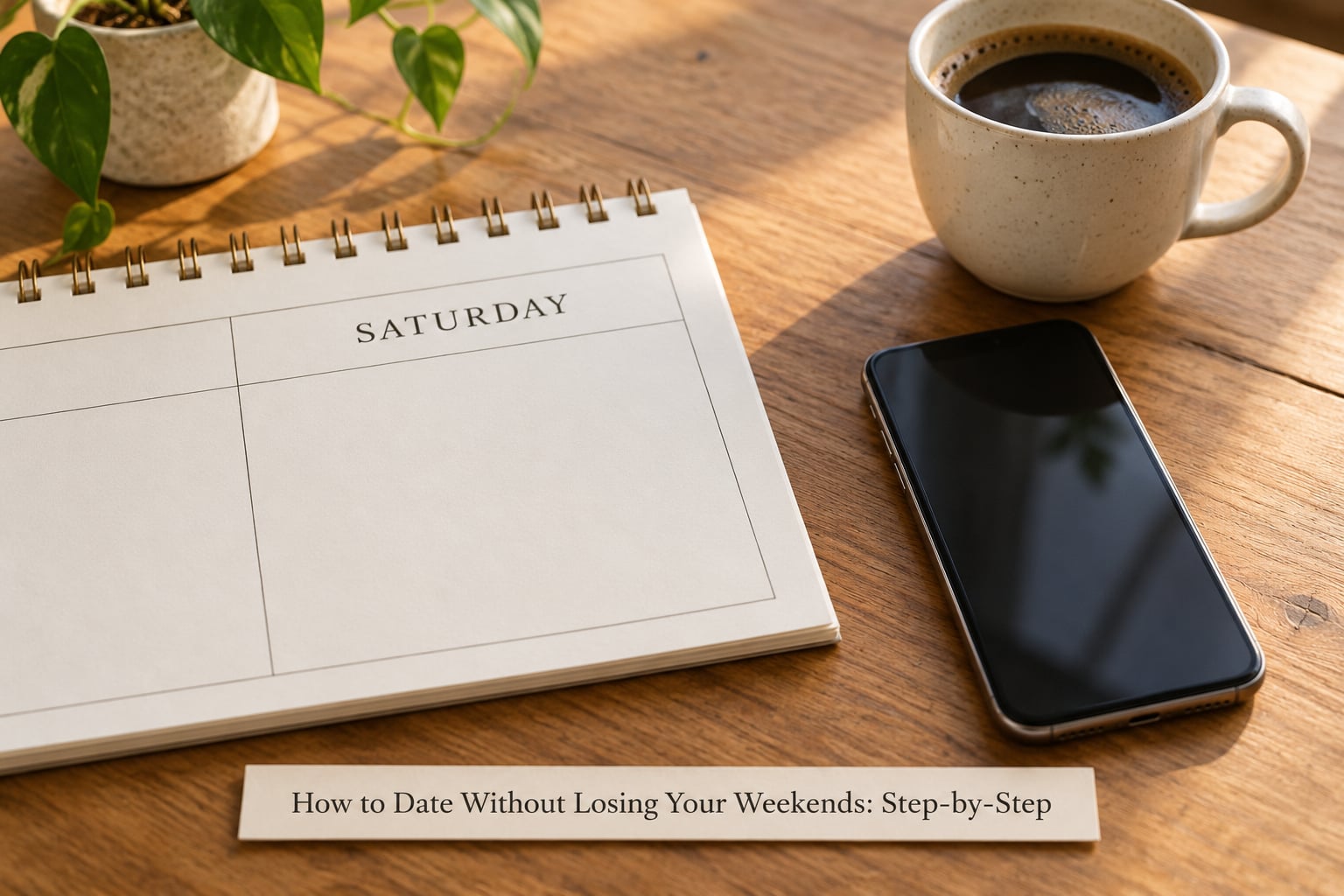
The system below takes about ten minutes to set up and about two minutes a week to maintain.
1. Set a Minimum Amount of Free Time
Decide how much unscheduled time you want to protect, then write it as a number. Two hours a week, three evenings, one whole Saturday afternoon. A number you can check, not a feeling.
Next, separate genuinely free time from obligation time. Waking up at six with a fixed eight-to-five isn’t free time, even if nobody else claims those hours. Free time is what has no consequence if you don’t use it.
Now match a date length to that number. If you protect two hours, your dates need to average well under that, because you also have to get there, get back and recover. Sixty-minute dates leave room. Three-hour dates don’t.
2. Choose Dates That Fit Your Energy
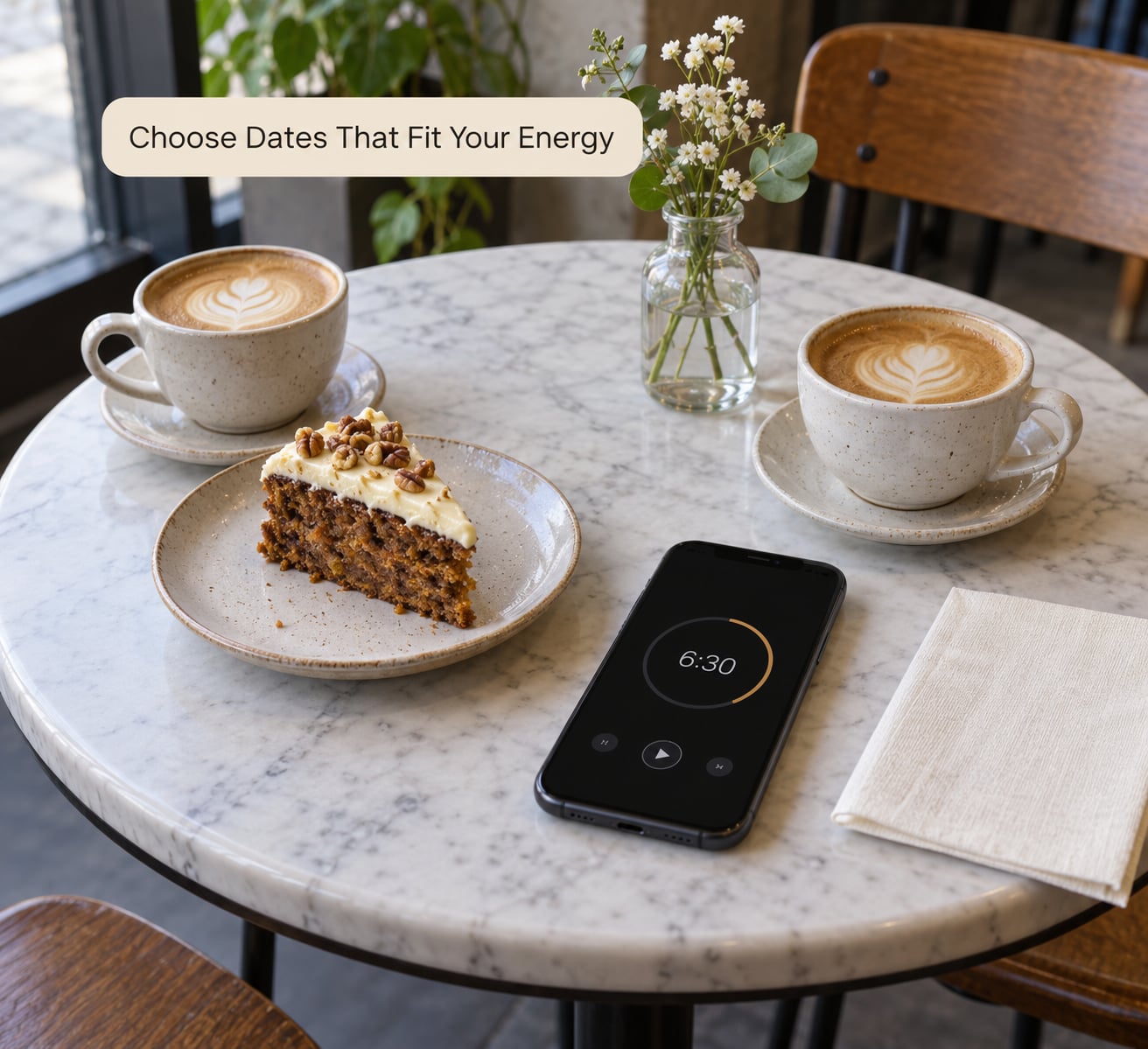
Stop treating every date as an evening event. Pick the format that matches how much you actually have left today, not how much you wish you had.
| Format | Planned time | Real cost with travel | Best when |
|---|---|---|---|
| Coffee and a walk | 45 minutes | About 1.5 hours | You’re tired but want to see them |
| Weekday lunch | 60 to 75 minutes | About 2 hours | You both do better in daylight |
| Shared meal with friends | 90 minutes | About 3 hours | You want lower-key time together |
| Cook one thing together | 2 hours | 2 hours plus leftovers | You want depth, not an outing |
Short formats only feel rushed when they’re unstructured. Give a 45-minute date three parts: a drink, a walk or a sit somewhere different, and one question you’ve been meaning to ask. That structure removes the dead air that makes people call a short date boring.
The “day date” label is worth borrowing. A long Sunday lunch or a Saturday morning coffee is a date, and treating it as one stops friends and family from assuming your Saturday belongs to them.
3. Propose a Specific Time Instead of a Vague Weekend
“This weekend some time?” is the sentence that costs you Saturdays. It has no end, no start and no location, so the only person who can shape it is the person who replies fastest.
Replace it with five details: the day, the start time, the duration, the neighbourhood, and the plan. Thursday, 6:30, about an hour, the coffee place two blocks from my office, walk if the weather holds.
Give a fallback in the same message, not as a rescue. If Thursday doesn’t work, here’s Saturday at 10am instead. Two named options removes most of the back-and-forth that turns a week of planning into two.
Say the end time out loud before the day happens, not during it. “I’ll need to head off around eight” is much easier to say on Wednesday than at eight o’clock on Friday with your coat already on.
4. Use a Weekend Budget to Practice How to Date Without Losing Your Weekends
Set a weekly cap, and pick one of two versions. Either one planned date a week, or a fixed number of time blocks that dates may occupy. Blocks work better for people who rotate shifts, because they follow your capacity instead of forcing it into a pattern.
Write the cap where you will see it. Sunday night, take two minutes and check the coming week against it. If you’re over, move the least important thing before you get tired and start negotiating with yourself.
Build the budget around the people and obligations that are already non-negotiable. Family, training, the friend who needs a lift on Saturdays. The cap protects those too, and it stops dating from becoming the most flexible thing in your week, which is how it quietly becomes the least protected.
Alternate who fills it. If you always send the invite, you always carry the planning, and resentment starts well before anyone says a word about it. Assign the next invitation at the end of each date and the load stays even.
5. Keep the Rest of Your Weekend Off the Calendar
This is the part most advice skips. A date that ends at nine on Saturday still leaves you a whole Saturday night to recover, and that recovery time is what lets you be present rather than running on fumes.
Three rules make it work. Keep the date local, so getting home takes under thirty minutes. Don’t book a second event afterwards. And don’t treat the following morning as a bonus hour, because you still have to function.
One weekend block each week is genuinely non-negotiable. Not this weekend, not next weekend, the following one. Friends will adjust; family mostly does too, once they have a pattern rather than an excuse.
6. Change the Plan When It Stops Working
Review the arrangement after a real week, not an imagined one. Three questions do the work: did I have energy for the date, did I get the rest time I needed afterward, and was the planning shared or was it all me again?
If the answer is no, no and yes, the plan needs to shrink before it breaks. Move from two-hour dates to sixty minutes. Drop to fortnightly. Replace the outing with the Sunday-morning walk that costs nothing and takes an hour.
There’s one honest limit here. If you genuinely have no overlap, no scheduling system will create one, and that is a workload and rostering problem rather than a love problem. Say that plainly to yourself before you spend another month trying harder on a calendar that has no room. Changing a shift, shortening a commute or arranging care support are bigger levers than any date format.
Taking a break from the apps for a month is a legitimate move too. It costs you nothing and it makes the next choice clearer.
Common Mistakes
Treating every weekend as available. It’s the default for a reason, which is that both people are usually free. The correction is boring and effective: give the weekend a job before anyone else can claim it, and schedule dates against the leftovers.
Accepting vague invitations. “Sometime this weekend?” gives you no way to plan around it. Reply with two specific windows and let them pick one. The invitations that can’t be answered with a time usually weren’t about the weekend at all.
Letting dates run past their end time. Every overrun is borrowed from tomorrow. Announce your end time when you make the plan and check in once during the evening so nobody is surprised at the door.
Saying yes on a tired day. A tired yes is not agreement, it’s avoidance, and it turns into resentment later. Decline it instead, with a reason attached so it isn’t read as rejection.
Making every decline feel like a verdict. Some people turn one cancelled plan into a story about being unimportant. Set that aside early, because the argument takes far more energy than the date you were protecting.
A few lines worth having ready:
- “Thursday works better than Saturday for me. I’m keeping Sunday morning off.”
- “Let’s do 6:30 to about 8, so I can still get going after.”
- “I don’t have the energy for that tonight. Can we do Wednesday instead?”
- “You take the next one.”
Frequently Asked Questions
How often should I date if I want to keep my weekends free?
Once a week is comfortable for many busy people, and once a fortnight is genuinely fine too. What matters is that the time is protected, undistracted and consistent rather than the raw count. Keep one recurring weekday slot and treat a missed week as an exception rather than the start of a decline. Consistency reads as intent in a way that frequency alone does not.
Should I agree to a date that is not planned in advance?
Sometimes, but not on a weekend you were counting on. If someone suggests a spontaneous plan and you have a rest block protected, say yes and enjoy it. If it lands on the one free day you have left, offer an alternative day instead. Saying yes out of guilt costs you the rest you were trying to protect, and the plan stays the same size.
What time is best for a first date without taking over my weekend?
Weekday daytime works best for a first date. A coffee at 4:30 on a Wednesday or a lunch on Thursday costs around two hours including travel and leaves the evening and the weekend intact. Evening dates on a Friday are the usual default, but they leave you tired and short on sleep before the weekend begins. Keep the first one short and specific.
Is it okay to cancel a date because I need more rest?
Yes, as long as you say why in a sentence and offer another time in the same message. Cancelling on Thursday for a Saturday plan is normal scheduling, not rejection. What damages things is a silent no-show or a vague you-are-busy. People take rest reasons well when they are stated plainly and paired with a date you are happy to keep.
How can I ask for a date to end at a specific time?
Name the time when you propose the plan rather than during it. A simple line, like let’s make it 6:30 to about 8, removes all ambiguity and sounds organised rather than impatient. Most people find this easier than being asked to leave on the night. If the end time is repeatedly ignored, say once, calmly, that you need to head off at eight, and mean it.
How do I know if I am spending too much time dating?
Three signals usually show up first. You start dreading invites you used to look forward to, your weekends are gone by Friday evening, or you are the one planning and cancelling every time. That combination is dating fatigue, and it usually shows up before burnout does. The fix is a shorter date, a longer gap between them, or a break from the apps for a month.
Conclusion
Weekends disappear because dates are assumed to be Saturday night events, not because you don’t care about your own time. Move one date to a fixed weekday slot, keep it to about an hour, protect one weekend block as non-negotiable, and alternate who plans the next one.
That’s the whole system. Start tonight: choose your date length, pick your anchor day, and send one specific invitation with two options.