
Balancing dating and parenting works when you treat it as a scheduling and communication problem rather than a personality test: know your real weekly time, lock in childcare and co-parenting coverage, set boundaries you can hold for months, tell your children age-appropriate truth, and move at a pace your family can absorb. It is not fast work, and it usually takes a season of small, boring decisions before it stops feeling like juggling.
Most of the parents who have written about this online say the hard part was never finding a date. It was keeping the rest of life standing still while something new was happening in it.
This guide covers the six steps that make it work, what to fix when it wobbles, and the questions parents search for most. Whether you are divorced, widowed, or never married, the mechanics are the same: your children need predictable safety, and you need a life that is not entirely made of logistics.
Table of Contents→
- What You Need to Balance Dating and Parenting
- Step-by-Step
- Frequently Asked Questions
- How long should I wait after a divorce before I start dating again?
- When should I introduce my kids to a new partner?
- How do I tell my kids that I am dating someone?
- What if my child does not like my new partner?
- How do I keep co-parenting civil while I start dating?
- What are the red flags when dating as a single parent?
What You Need to Balance Dating and Parenting
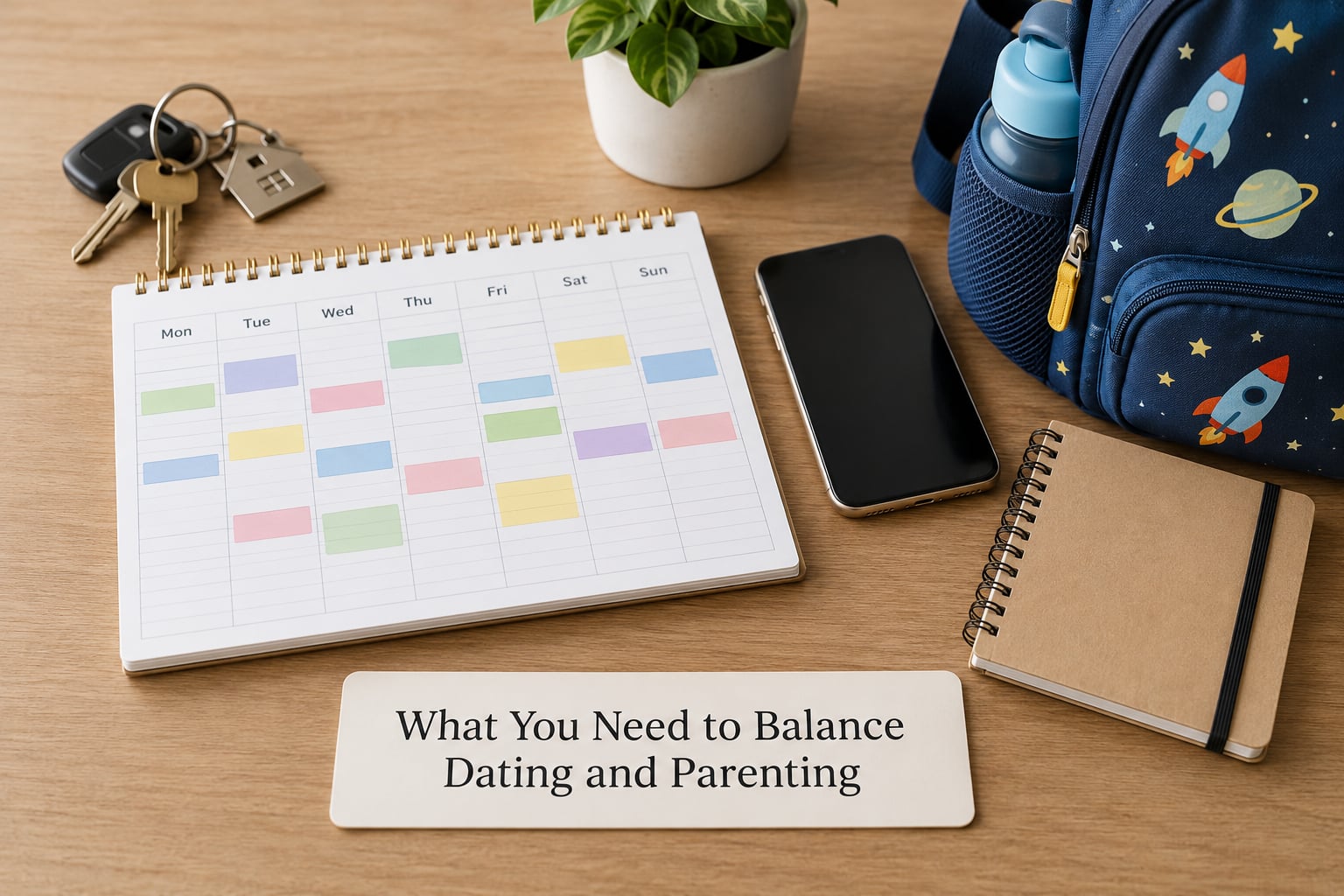
You need four things in place before you meet anyone, and three of them are logistical.
The first is an honest picture of your time. Not the version where nothing goes wrong, the version where soccer practice gets cancelled and a fever hits at 5:40pm. Look at a real week, including yours. If you cannot name a person who covers Tuesday pickup when you are not there, dating will not start, it will start and then collapse in week two.
The second is a childcare plan that survives a bad week. That might be a sibling, a neighbor with a standing deal, a sitter you have already used, or a co-parent with an agreement in writing.
The third is boundaries you can keep when you are tired and disappointed. A boundary you drop once teaches everyone that it was never real.
The fourth is realistic expectations. Parents on forums like r/SingleParents and r/singlemoms repeatedly describe the same two mistakes: starting too soon after a breakup, and expecting a new relationship to feel easy when it is still competing with bedtime.
Step-by-Step
Six steps, in the order that tends to hold up best. Skip ahead and the later ones get harder to fix.
How to Balance Dating and Parenting by Starting Honestly
Start by auditing one ordinary week and writing down where your hours actually go. Include work, school runs, practice, the admin you forget counts, and the time your children need you when they do not need anything at all.
Then check three less visible things. How much energy do you have at 8pm, honestly? What can you spend on dates, including childcare and getting a sitter, without the month going sideways? And how settled is your children’s world, from school to team to who watches them in August?
Say the hard part out loud, which is that you may be ready while they are not, or the reverse. Either version is workable. Ambiguity is what makes it hard.
A sign of progress: you can answer who covers Tuesday pickup at 9pm without hesitating, and you know which two hours in the week are genuinely yours.
Set a Realistic Dating Schedule
Most single parent dating advice that actually survives contact with a real calendar comes back to two or three protected windows a week. Not a nightly open schedule. Windows.
Build them around what is already fixed. School nights, practices, music lessons, and the co-parent handoff are immovable furniture. What is flexible is Saturday morning, a Sunday afternoon, or the one evening a week a trusted adult can cover from pickup to bedtime.
Schedule your dates in blocks rather than single events. Two dates in a row without a kid-free recovery night is how you end up snapping at your seven-year-old over toast.
Coordinating with a co-parent is the part everyone underestimates. Put the shared calendar somewhere both of you can see, agree on how notice for a changed plan works, and decide in advance what happens when a child is sick on the night you were supposed to meet someone.
A simple version looks like this:
- Weeknight window: one evening, usually the sitter’s night, ending before the kids’ bedtime buffer.
- Weekend window: a half-day on one day, leaving the other half completely unscheduled.
- Recovery: at least one kid-free evening after any date, protected from being given away.
- Flex reserve: one open block for the week anything goes wrong, which it will.
A sign of progress: your children stop registering when you go out. They stop asking who is watching, stop negotiating bedtime on the way home, stop asking you to stay home instead.
Build Boundaries You Can Keep
Boundaries are not about being cold. They are about making the rules visible so nobody has to guess, including you on a tired Thursday.
Time boundaries are the first one. Say out loud which parts of the week belong to your kids and are not up for negotiation. Then say what happens when plans change: a text, a short delay, no explanation required in the moment. People who plan to date a parent need to know that a sick kid outranks a reservation, and how you handle it is the first real test.
Child privacy is the second. Your children are not a selling point and not a test audience. Do not show photos before your kids are ready, do not let them field questions, and do not make them the reason you say yes or no to a date.
Sleepovers and overnight guests deserve an explicit line. Decide your rule now, before you meet the person who makes you want to renegotiate. “Not while the kids are this young,” “no sleepovers until we are serious, and we will discuss it,” and “yes, with notice and a morning plan” are all workable. Ambiguity is what causes arguments.
The last boundary is yours alone. One adult evening a week with friends, a class, a walk, or nothing at all. You cannot be the sole source of stability for three humans without somewhere to put your own weight down.
A sign of progress: you can decline a date in two sentences and not feel the need to write a justification.
Tell Your Children at the Right Time
Tell them when dating actually starts, not when it turns into something official. Children pick up on the change well before you announce it, and the gap between noticing and being told is where most of the hurt lives.
The words change by age, and being vague with a teenager is worse than being blunt with a toddler.
For toddlers and preschoolers (roughly 2 to 5): keep it small and concrete. “Mommy is going to dinner with a friend.” They cannot hold a concept like “a relationship,” but they absolutely can read your mood the next morning. Say that bedtime is still bedtime and you are still there.
For school-age kids (roughly 6 to 11): answer the question they are really asking, which is whether you will still be here. “I am meeting someone. You guys are not changing anything. Bedtime, school, and Saturday are the same.” Expect questions about whether the person is nice and whether the person likes soccer. Answer plainly.
For teenagers: give more than you would have in the past. Teens are pattern detectors and they will read your phone face-up on the couch. Tell them you are dating, answer honestly how serious it is, and be clear about one thing: the kids do not need to be polite, welcoming, or invested for the relationship to continue. A teen who says “I don’t like them” is allowed to keep saying it, and your job is to keep the routine steady anyway.
Label their fears when you see them, because naming beats arguing. “You are worried I will pay less attention to you. That is not what is happening. I still do your bedtime every single night.” You do not need to defend against every possibility. You need to repeat the true one.
A sign of progress: a child can ask you a question about it without panic in their voice.
Communicate Before Dating
Before the second date, say the parenting part out loud. Not the version where they nod along, the actual schedule and the actual priority.
Say it plainly: “I have two kids, they come first, and my Friday evenings are not usually available.” Anyone who hears that and responds with resentment has just told you something useful for free. On the r/dating_advice side of the internet, the most repeated piece of advice to other single parents is the same one, that a partner who respects the schedule without complaint is the single strongest green flag.
Then get specific about the mechanics that cause conflict later. What happens when a child is ill on a date night. Whether they can meet your children, and when. What they can and cannot do with your time. How you handle a disagreement between you two while the kids are watching.
Have the harder conversations early too. How serious are you both looking. What the other parent is like, and how much detail you want to share. Money habits, debt, whether you keep accounts separate. A person who is honest about their own situation has usually thought about yours.
A sign of progress: they stay calm and helpful when a child is sick and the date does not happen.
Protect Your Family and Your Well-Being
A relationship that makes you a worse parent is not a win, no matter how good it feels on a Tuesday. Judge it by what it does to the household rather than by how it makes you feel when the kids are asleep.
Watch for red flags that matter more when children are in the picture. Someone who resents or jokes about your kids. Someone who pushes to meet them in week two, or who treats the introduction as a test they have to pass. Someone who gets angry about your ex in a way that spills toward you. Someone who wants access to your home, your money, or your routine before the relationship has any shape. Someone who cannot tolerate plans changing.
People who date single parents and show up consistently for years are not rare. People who rush the timeline and want credit for it are the ones who cost you time.
Protect the boring parts of your life. Sleep, since an overtired parent is short-tempered by default. Money, since dating plus a sitter adds a real monthly line and it should not quietly become a reason you feel guilty about saying no. And your support network, which may be your sibling, your closest friend, a group chat, a support group, or a therapist. Single parents who use a professional support source describe it as the thing that made the transition survivable rather than isolating.
You will date better after a bad week of parenting, not worse, once the systems exist.
A sign of progress: your own mood is steadier across a normal month, and you are still showing up for your kids when a date fizzles.
Common Mistakes
Overexplaining dating to your children. A five-year-old does not need the emotional context of your loneliness. Short, calm, and repeatable beats thorough. Fix: one sentence about what is happening, one sentence about what stays the same.
Treating excitement as a plan. New relationships generate their own momentum, and that momentum is the most dangerous thing in a house with small children. Fix: hold the pace you decided on before the feeling showed up.
Not coordinating with your co-parent. Two households running on different calendars will schedule over each other every time, and your kids will feel the tug. Fix: one shared calendar, one agreed notice period, and a written answer for the sick-kid night.
Accepting boundaries that keep moving. You set a rule, it bends once, then it bends every time. Fix: state the rule, restate it when it is tested, and do not renegotiate under pressure in the moment.
Letting your kids carry messages. Children reporting on the relationship, asking whether the new person likes them, or inviting themselves into plans eventually becomes a loyalty conflict you did not choose. Fix: all logistics run through you.
Dating through the hardest stretch of your family’s year. A move, a new school, a grief anniversary, a diagnosis, a custody change. Fix: date lightly, keep the windows open, but do not build a relationship on top of a transition that is still moving.
Most parents who regret the pace did not regret the person. They regret the timing, which is something you can actually control.
Frequently Asked Questions
How long should I wait after a divorce before I start dating again?
There is no rule that fits everyone, and the number you find online is not evidence. The common practical threshold described by single parents is six to twelve months, mostly because that is roughly how long it takes a child to settle into a new routine. Judge readiness by three things instead: the household is stable, you can name a childcare backup, and you are not dating to escape how you feel. If all three are true, the calendar can tell you more than the calendar anniversary.
When should I introduce my kids to a new partner?
Introductions usually happen between six and twelve months into a relationship for many single parents, and earlier if the relationship is very casual. Four tests before you do it: you have seen the person handle ordinary disappointment, they can sit through a normal evening with your kids without performing, your children have had weeks of a settled routine, and your co-parent is not going to be blindsided. Start low-stakes, like a short daytime outing or a meal, and let the relationship grow separately from the introduction.
How do I tell my kids that I am dating someone?
Tell them when dating actually starts rather than when it becomes official, because children notice the change well before you announce it. Keep the words age-appropriate: a simple daily-life line for toddlers, a reassurance about routines for school-age kids, and honest detail for teenagers. Repeat the true thing, which is that bedtime, school, and who does what stays the same. Do not make your children polite to anyone.
What if my child does not like my new partner?
Expect resistance, especially from teens, and do not treat it as a verdict on your judgment. Say out loud that you are allowed to like people and that they are allowed not to like this one, and that neither opinion has to change the other. Watch their behavior over months rather than weeks. Children often warm up after a slow start, and a relationship that survives that is usually sturdier. Persistent contempt aimed at you or at your parenting is worth a conversation with a pediatrician or family therapist.
How do I keep co-parenting civil while I start dating?
Keep the relationship and the co-parenting separate as far as you can, because children read tension instantly. Share the shared calendar, agree on notice for changes, and answer the sick-kid question before you need it. Tell the other parent about a new relationship when it is relevant to the schedule, not as news. If your ex reacts with insults or attempts to block your time, keep communication short, factual, and written. Cooperative parenting resources and a family therapist can help when the channel keeps jamming.
What are the red flags when dating as a single parent?
The ones that matter most involve your children or your money. Warning signs include resenting or mocking your kids, rushing to meet them, treating the introduction as a performance they must win, asking for access to your home or finances early, reacting badly to changed plans, and getting you into conflict with your ex. Another quiet red flag is your own decline, when you start skipping your children’s routines to protect a new relationship. Trust the discomfort, slow the pace, and talk to someone outside the situation.
Whatever stage your family is in going into 2026, the first move is small. Open your calendar this week, write down the two or three hours that are genuinely free, and confirm one backup adult by name. Everything else in how to balance dating and parenting builds on that page.